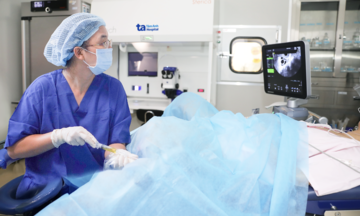
"Robotic surgery is not a luxury; it optimizes treatment outcomes and eliminates potential human errors. We hope health insurance (BHYT) will soon cover a portion of the cost so patients can benefit," said Associate Professor, Doctor Vu Le Chuyen, Director of the Urology, Andrology, and Nephrology Center at Tam Anh General Hospital TP HCM, during the ceremony for receiving the Certificate of Excellence in new-generation Da Vinci Xi robotic surgery, marking a record 200 operations within 7 months, on 4/12.
According to Chuyen, many hospital directors are petitioning insurance agencies to consider covering robotic surgery at a rate equivalent to conventional laparoscopic surgery. Patients would then pay the remaining difference.
"Robotic surgery helps eliminate human errors. We hope BHYT will provide support soon so this technique does not become a privilege for the wealthy," he stated.
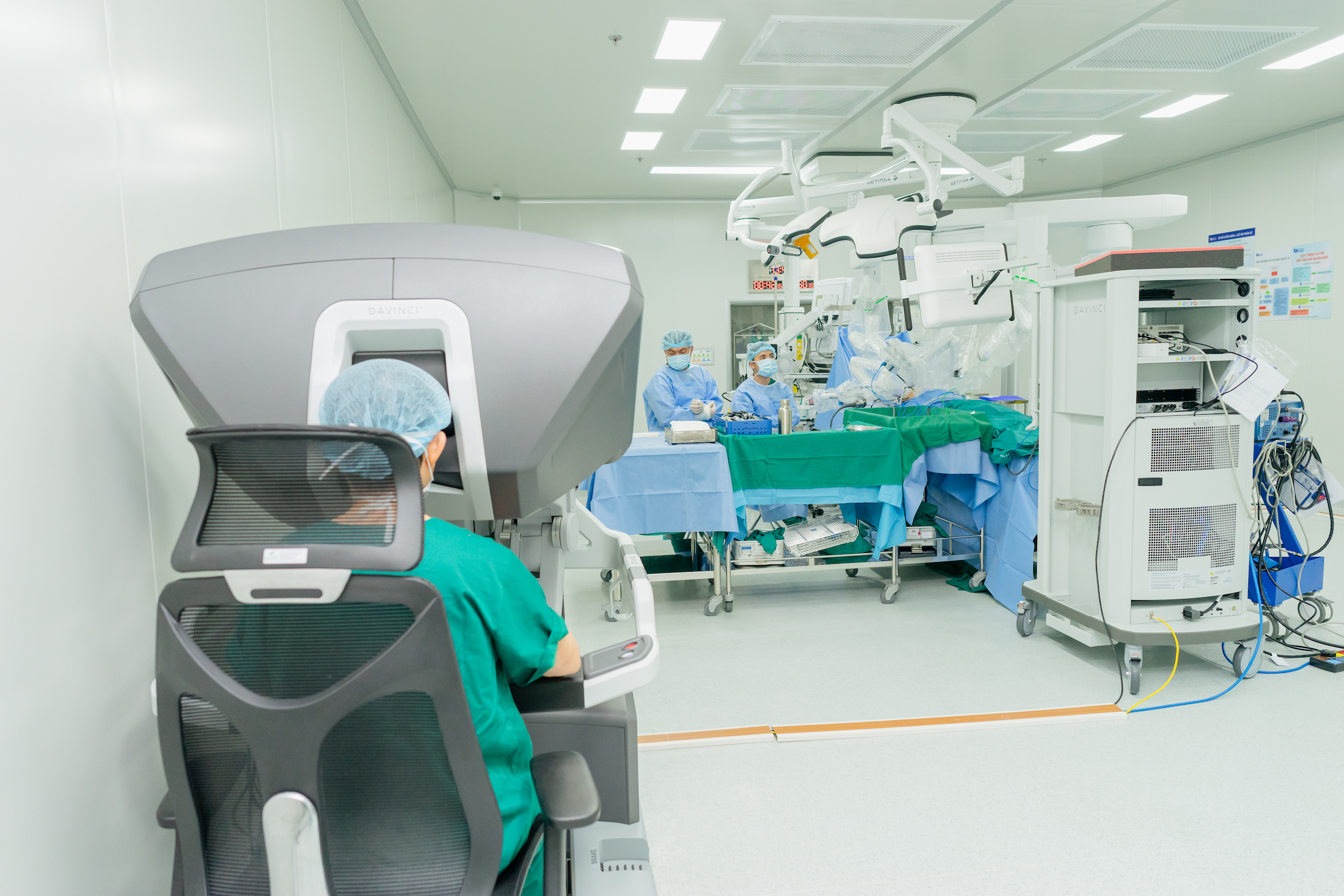 |
A doctor controls a surgical robot for a patient. Photo: Hospital provided |
Currently, the cost of a robotic surgery in Vietnam ranges from 120-180 million VND, which patients must cover entirely. While this price is much lower than in Singapore (USD 20,000-50,000) or South Korea (USD 15,000), it remains a significant barrier for most people. In contrast, health insurance in many countries already covers this advanced procedure.
The director of the Urology, Andrology, and Nephrology Center calculated that if Vietnam operated about 20 robotic systems, performing around 10,000 cases annually (including 5,000 cancer cases), the BHYT fund's expenditure would not be substantial compared to current total spending, yet the community benefits would be high.
There is a high demand for high-tech surgery domestically, but the capacity to meet it is limited. Vietnam currently has only 4 facilities deploying Da Vinci robots: Binh Dan Hospital, Cho Ray Hospital, K Tan Trieu Hospital, and Tam Anh General Hospital TP HCM. This number is modest compared to 58 systems in Southeast Asia and over 8,000 machines globally. Existing hospitals operate at maximum capacity, averaging three cases daily, but overload persists, leading to long patient wait times.
The primary advantage of surgical robots is their high precision, ability to preserve organs, and improve post-operative quality of life. For prostate cancer, for example, robotic arms help preserve neurovascular bundles, reducing the risk of urinary incontinence. For small kidney tumors, surgeons can precisely dissect the tumor while preserving the kidney, helping patients avoid lifelong dialysis.
This technique also demonstrates clear effectiveness in specialties such as head and neck, cardiovascular-thoracic, gastrointestinal surgery, and obstetrics and gynecology. Doctor Nguyen Ba My Nhi, Director of the Obstetrics and Gynecology Center at Tam Anh Hospital, noted that robotic surgery is a global trend. At major international medical conferences, 60-70% of demonstrated surgeries utilize robots. This technology excels in complex cases like deep endometriosis or lesions in hard-to-reach anatomical areas, which traditional laparoscopy struggles with.
The new-generation Da Vinci Xi system features compact 6 cm arms that rotate 540 degrees, making it suitable for the average Vietnamese physique. The equipment integrates a 3D camera with 15x magnification, fluorescence imaging technology, and an anti-shake filter, supporting surgeons in precise manipulations in deep, narrow areas. Additionally, a smart surgical knife with integrated sealing and hemostasis mechanisms helps create tight sutures, minimizing bleeding and complications.
"The world regularly operates nearly 8,000 robots; if Vietnam stands still, its healthcare will fall behind. The biggest barriers remain the cost and people's income," Doctor My Nhi remarked.
Le Phuong