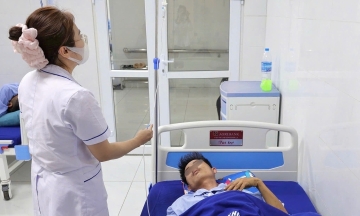
On 14/3, a representative from Hau Loc General Hospital announced that the patient's health had recovered, allowing him to walk again after intensive electrolyte replacement therapy. His family had previously rushed him to the emergency room when his legs progressively weakened, muscles ached, and he became completely unable to stand.
 |
The patient receiving treatment at Hau Loc General Hospital. Photo: Hospital provided |
Doctors, upon reviewing his medical history, noted that the evening before his hospital admission, the man had consumed alcohol with friends. Feeling thirsty, he then drank two cans of energy drink. He also revealed a two-month habit of drinking one to two cans of these beverages daily to stay alert for work. The following morning, he awoke in a panic, discovering both his legs were paralyzed. Clinical tests led the medical team to diagnose him with periodic paralysis syndrome caused by hypokalemia.
Doctor Nguyen Van Nghiem, Head of the Emergency, Intensive Care, and Anti-Poisoning Department, explained that prolonged energy drink abuse disrupts metabolism and electrolyte balance. Each can of these drinks contains about 39 grams of sugar, significantly exceeding the recommended daily limit of 25 grams for adults. This excessive sugar intake causes blood sugar to spike, leading to osmotic diuresis. Consequently, the kidneys increase sugar excretion through urine, which also expels large amounts of water and essential minerals, especially potassium.
Potassium is crucial for maintaining muscle and nervous system function. A deficiency can lead to fatigue, muscle weakness, temporary limb paralysis, and even life-threatening heart rhythm disturbances.
Doctor Nghiem emphasized that hypokalemic muscle paralysis can recover rapidly with early medical intervention. However, symptoms will recur if patients continue unhealthy dietary habits. Health experts advise the public to prioritize plain water for hydration, consume a nutritious diet, never substitute energy drinks for water, and seek medical attention immediately if signs of muscle weakness or paralysis appear.
Le Hoang