


A CT scan at Tam Anh General Hospital in Ho Chi Minh City revealed a tumor measuring 10.5x10x8.5 cm located directly behind Mr. Quang's sternum. The mass had invaded upwards, attaching to the chest wall, superior vena cava, and other critical blood vessels.
Following a consultation, Associate Professor Doctor Vu Huu Vinh, Director of the Thoracic and Vascular Surgery Center, and his team decided to perform open surgery via a sternotomy. The goal was to remove the tumor from the chest and prevent it from growing and compressing vital organs such as the heart, lungs, and major blood vessels.
After splitting the sternum, the team carefully dissected the tumor from the pleura and freed it from critical anatomical structures, taking care to avoid damaging nearby blood vessels or nerves. Subsequently, the surgeons meticulously controlled all bleeding points and cleaned the chest cavity, ensuring the complete removal of the entire tumor.
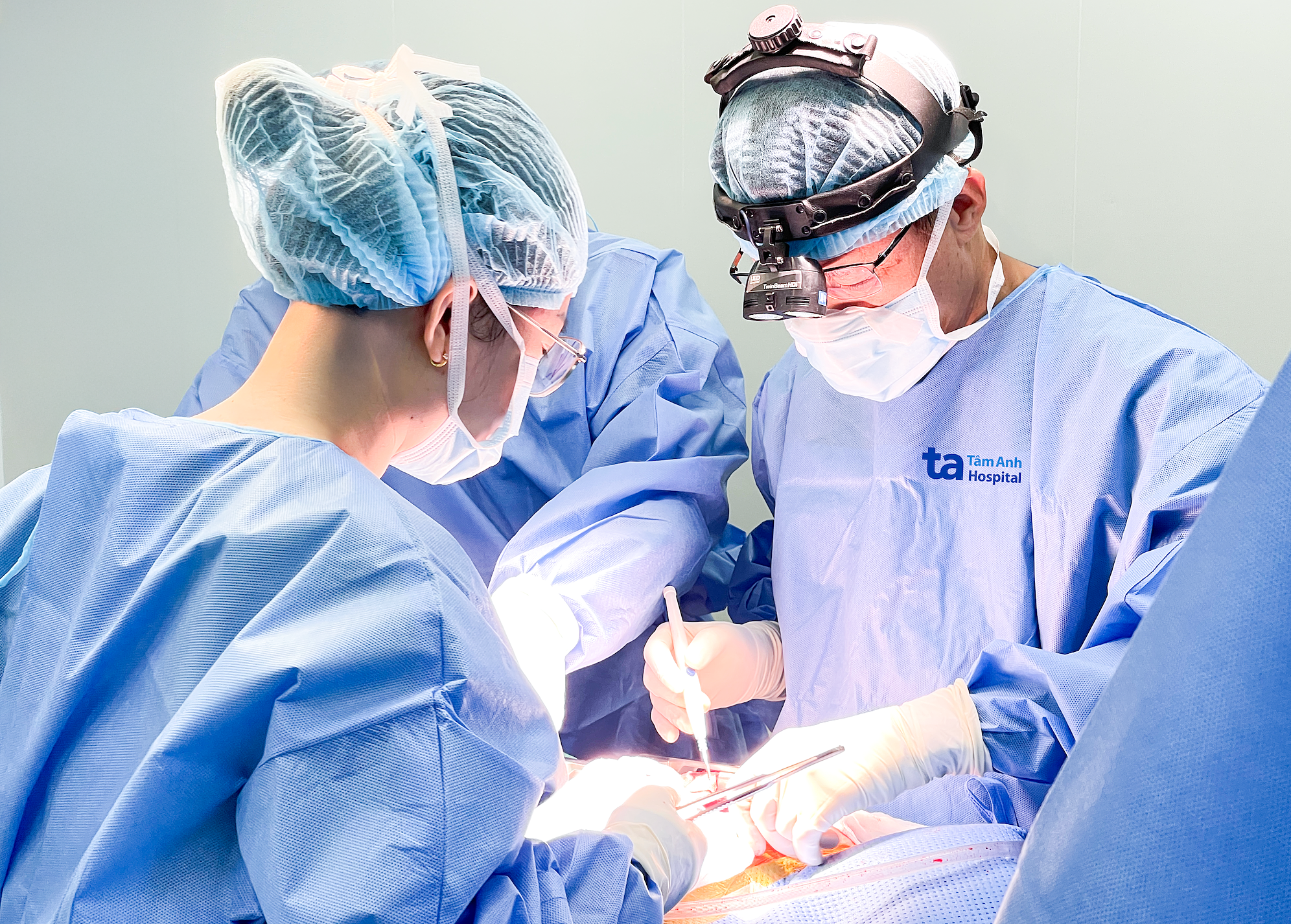 |
Associate Professor Vinh (right) and his team perform surgery to remove a chest tumor from a patient. *Photo: Tam Anh General Hospital* |
Post-surgery, Mr. Quang's chest pain resolved, and he experienced no complications. His incision was dry after one week, and he was discharged from the hospital.
Pathology results confirmed the tumor to be benign thyroid tissue located in an unusual position (the anterior mediastinum).
Associate Professor Vinh explained that thyroid tissue forms when thyroid follicles enlarge. This condition commonly manifests as a substernal goiter, where the thyroid gland from the neck grows downwards into the chest, or as ectopic thyroid tissue, which forms directly in the mediastinum during the fetal period. Depending on anatomical characteristics, the tumor can exist independently within the chest cavity or have a stalk directly connected to a thyroid lobe in the neck.
Most mediastinal tumors develop silently within the chest, making them easy to overlook in their early stages. When a tumor grows large, it begins to compress and invade surrounding organs, leading to symptoms like chest pain and shortness of breath, at which point treatment becomes more complex.
Associate Professor Vinh advises everyone to maintain a habit of regular health check-ups to detect any abnormalities early, as timely treatment significantly improves outcomes.
By Bao Anh
*Patient's name has been changed
| Readers can submit questions about cancer here for doctors to answer. |


