The government has issued Decree 76, amending and supplementing Decree 125, which addresses administrative penalties in the field of gender equality. This new decree doubles previous fines to deter impositions stemming from gender bias. The updated document also stipulates that management agencies will fine 5-10 million dong for individuals who hinder relatives from earning income or discriminate among family members based on gender.
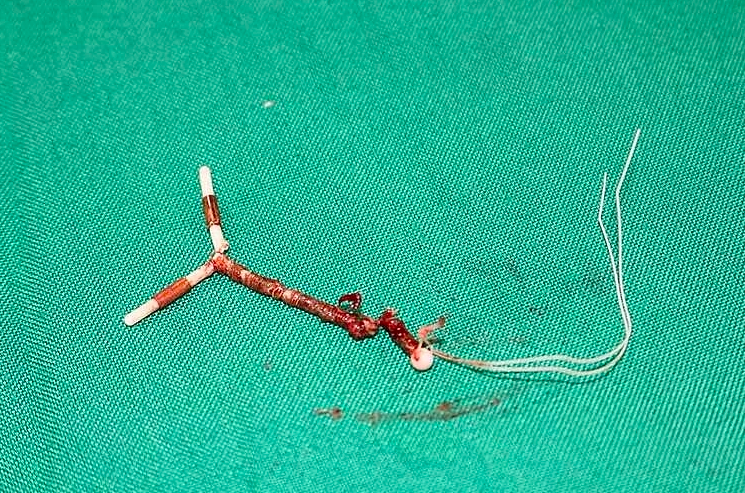 |
An intrauterine device misplaced in the abdomen of a patient in Thai Nguyen. Photo: Hospital provided. |
The government's move to increase penalties aims to address the imbalance in family planning responsibilities in Vietnam. According to the 2020 Population Change Survey, the healthcare system recorded over 120,000 female sterilizations but only about 10,000 men underwent this procedure. A study published in the Vietnam Medical Journal indicated that women bear almost the entire burden and consequences of contraception, while men often avoid it.
Specifically, many Vietnamese men refuse family planning procedures due to gender bias. Instead of undergoing a vasectomy, a safe, quick, and physiologically unaffected minor surgery, husbands pressure their wives to take emergency contraception repeatedly or use implants or IUDs, even if their bodies are incompatible. When temporary methods fail, leading to unintended pregnancies, wives endure the physical and mental pain of abortion. Many women admit they undergo surgery simply to appease their partners, protect their happiness, and prevent their husbands from having affairs.
Medical professionals consider female sterilization an endoscopic intervention equivalent to major surgery, requiring significant recovery time and directly affecting health. Doctors often advise combining tubal ligation with a C-section to minimize risks. In contrast, male sterilization is a simple, minimally invasive procedure with quick recovery, completely unaffected by hormones or physiological capability.
The trend of Vietnamese men sharing family planning responsibility currently contrasts with global practices. For instance, in the US, about 500,000 men undergo vasectomies each year. Health experts and sociologists suggest that the healthcare sector and social organizations need to enhance communication efforts, encouraging men to share responsibility with their partners to improve women's health and build a foundation for equal marriages.
Le Nga