The scientific journal Emerging Infectious Diseases (EID), published by the US Centers for Disease Control and Prevention (CDC), detailed this rare medical case in its march issue.
On 15/10/2025, after a forceful sneeze, the patient noticed worm-like organisms expelled from her nose and sought immediate medical attention. An otolaryngologist subsequently removed a total of 10 larvae at various developmental stages and one wriggling pupa from her nasal cavity.
DNA test results confirmed these organisms were larvae of the sheep bot fly (*Oestrus ovis*), a common parasite in arid, warm regions bordering the Mediterranean Sea. This species typically inhabits the sinuses of sheep and goats.
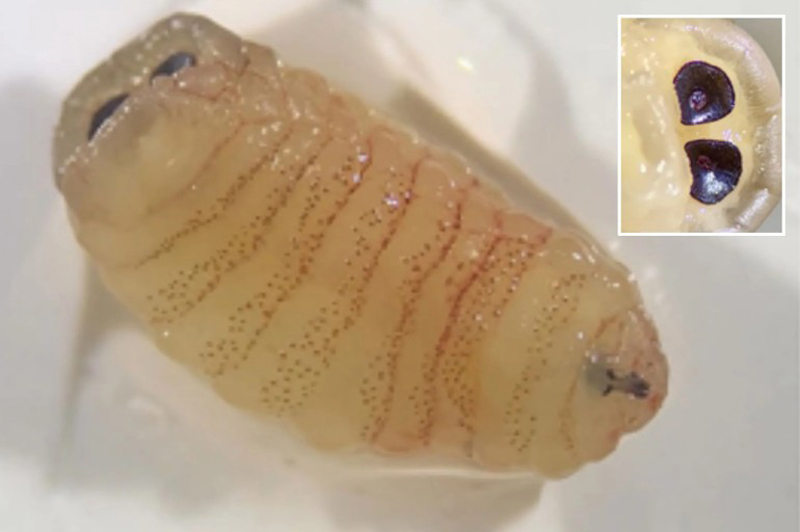 |
The 'strange creatures' expelled from the Greek woman's nose were identified as larvae of the sheep bot fly (*Oestrus ovis*). *Photo: Ilias P. Kioulos, Emmanouil Kokkas, and Evangelia-Theophano Piperak*.
The incident began in 9/2025, when a swarm of flies surrounded the woman's face as she worked in a field near a sheep pasture on a Greek island. A week later, she experienced pain in her upper jaw and suffered persistent coughing for the next two to three weeks. Doctors diagnosed the patient with nasal myiasis caused by *O. ovis*, accompanied by pupation. She was prescribed a decongestant nasal spray for treatment and has since fully recovered.
Theoretically, mammals or humans cannot sustain the complete development of *O. ovis* larvae. The human nasal cavity lacks sufficient temperature and humidity, and secretions along with immune responses create a harsh environment that kills parasites. Typically, larvae entering the sinuses would dry out, liquefy, or calcify, unable to progress to the pupal stage.
The research team explained that the patient's severely deviated nasal septum created conditions for pupation to occur within her body. This structural defect allowed her nasal cavity to become a safe haven for a large number of parasites, a condition not experienced by her colleagues working in the same environment. Scientists also hypothesize that this case represents an early sign of evolutionary adaptation, enabling *O. ovis* to complete its life cycle in humans rather than solely relying on livestock.
By Binh Minh (Source: CDC, Livescience, People)