Dr. Nguyen Hoang Thi, from the Spine Surgery Department at Tam Anh General Hospital Ho Chi Minh City, states that back pain is a common reason why patients struggle with movement, miss work, and experience a decline in quality of life. However, not all instances of back pain are serious.
Muscle strain back pain is a common injury in the lumbar region. It typically results from heavy lifting, carrying loads, incorrect twisting movements, prolonged sitting, or overexertion. These actions can overstretch muscle fibers and ligaments, causing micro-tears that lead to muscle spasms and pain.
Muscle strain back pain often manifests suddenly after strenuous activity or incorrect movements. The pain is localized to the lower back, intensifying with bending or extending, and upon palpation of the affected area. It is frequently accompanied by muscle stiffness and restricted movement. This type of pain does not radiate to the legs, nor does it involve numbness or weakness. It can significantly improve within a few days to a week with proper rest and treatment.
 |
Dr. Thi examines and assesses a patient's back health. *Illustration: Tam Anh General Hospital* |
However, back pain can also indicate underlying spinal conditions such as spinal degeneration, spinal spurs, disc herniation, spinal stenosis, or scoliosis. According to Dr. Thi, these are serious conditions that require timely examination and treatment to prevent complications that could severely impact a patient's daily life. Common symptoms include:
Spinal degeneration and spinal spurs cause prolonged lower back pain, accompanied by joint stiffness, with pain increasing when bending, twisting, or carrying loads.
Disc herniation leads to a dull ache in the lower back that radiates to the buttocks, thighs, and calves, often with numbness and leg weakness.
Spinal stenosis and spondylolisthesis are characterized by electric shock-like, burning pain. The pain worsens with movement and lessens when slightly bending forward or resting.
Scoliosis typically causes chronic back pain, which may be accompanied by leg numbness.
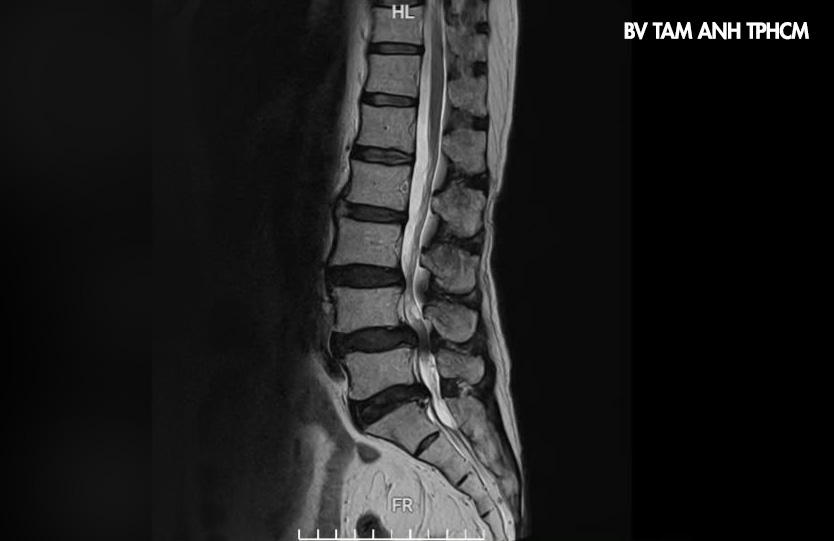 |
MRI scan of a patient with back pain due to disc herniation compressing the spinal canal and nerves. *Photo: Tam Anh General Hospital* |
Back pain that occurs at night can disrupt sleep, potentially leading to long-term issues like poor concentration, memory loss, and declining mental health. For pain resulting from a spinal condition, delayed treatment risks severe complications such as weakness or paralysis of lower limb muscles, numbness or loss of sensation in both legs, and loss of mobility. More severe cases can cause nerve compression and bowel or bladder dysfunction.
Doctors advise patients to seek medical attention promptly if they experience any unusual pain signals, such as back pain following a significant injury, pain lasting over two weeks without improvement despite rest, or pain accompanied by fever and chills. Other warning signs include pain that intensifies at night, radiates to the lower abdomen or legs, or is accompanied by numbness, leg weakness or paralysis, urinary retention, or incontinence. If necessary, doctors may order diagnostic tests to ensure an accurate diagnosis and appropriate treatment.
Phi Hong