Dr. Nguyen Anh Dung, Head of the Thoracic and Vascular Surgery Department at Tam Anh General Hospital in Ho Chi Minh City, explains that both traditional laparoscopic surgery and robot-assisted surgery prioritize safety and minimal invasiveness. However, for lung tumors with complex structures or challenging locations, dissection can be difficult, risking incomplete removal or damage to surrounding tissues. In these scenarios, doctors consider employing robotic assistance. Key differences between the two methods include:
Flexibility and precision: During traditional laparoscopic surgery, doctors use straight instruments controlled directly by hand, offering limited flexibility. With robot-assisted surgery, the surgeon operates from a control console located within the operating room or even remotely. Four robotic arms, mimicking human wrists, can rotate 540 degrees, enabling surgeons to easily maneuver in deep, narrow, and hard-to-reach surgical areas.
When dissecting large lung tumors or those adhered to surrounding tissues, the robotic system features vibration filtering and motion control. This eliminates natural hand tremors from the surgeon, preventing bleeding and damage to healthy lung tissue.
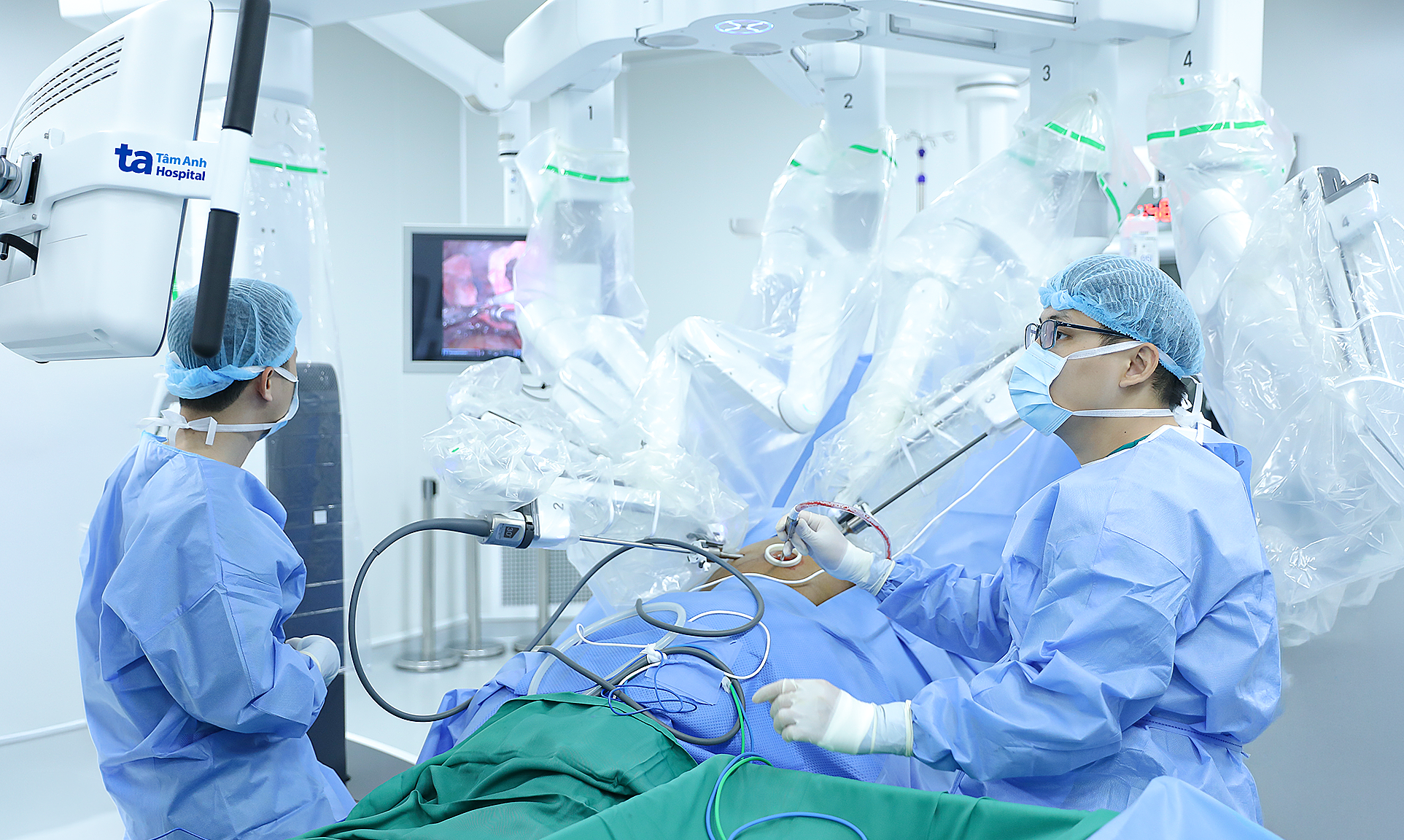 |
A lung tumor resection surgery assisted by the Da Vinci Xi robot. Photo: Tam Anh General Hospital |
Surgical field visualization: Traditional laparoscopic camera monitors provide 2D or limited-depth 3D images. In contrast, the robot's 3D camera can magnify images up to 15 times, with auto-focus and adjustable lighting. This allows surgeons to clearly observe and differentiate critical blood vessels, tissues, and nerves that are difficult to discern with the naked eye.
Reduced risks and complications: Traditional laparoscopic surgery uses straight instruments, making it difficult to access deep or critical tumors due to the risk of damaging blood vessels or the lung hilum; it is less suitable for highly complex cases. The robotic arm control system can rotate 360 degrees, allowing access to various surgical areas without moving the entire system, thereby minimizing risks during surgery. This is a significant advantage for complex or lengthy procedures, especially in elderly patients or those with underlying conditions.
Incision size: Compared to the 1-1.5 cm incision of traditional laparoscopic surgery, robot-assisted surgery uses an 8 mm incision, resulting in a more aesthetic outcome.
Pain and bleeding: Patients undergoing traditional laparoscopic lung tumor surgery may experience mild pain, requiring pain medication for a few days. In contrast, robots integrate smart surgical tools, such as a 7 mm vessel sealing and cutting device, which simultaneously cuts tissue and controls bleeding, reducing blood loss. Patients may require no pain medication or only low doses.
Recovery speed: Patients undergoing robot-assisted lung tumor surgery can resume normal activities after one day and are discharged after 1-3 days. This significantly shortens the recovery period compared to 3-5 days for traditional laparoscopic surgery.
Dr. Dung notes that robot-assisted surgery is suitable for elderly patients with multiple underlying conditions, poor health, or those undergoing treatment for chronic diseases such as liver failure, kidney failure, or cancer. While highly effective, this method is less common than traditional laparoscopic surgery due to its higher cost and the need for specialized surgeon training. Doctors will advise on the most appropriate and effective treatment method based on the patient's health status and the severity of their condition.