Associate Professor Nguyen Duy Thinh, a former official at the Institute of Biotechnology and Food Technology, Hanoi University of Science and Technology, stated that accurate identification of food treated with chemicals or formalin requires specialized testing. "It is difficult to identify by sight," he said, following an incident on 23/12 when authorities in Thanh Hoa province intercepted an oto carrying 10 tons of Chinese ribbonfish preserved with formalin. The National Institute for Food Safety and Hygiene (Ministry of Health) confirmed through testing that the entire batch of fish contained formalin at concentrations ranging from 90 to 105 mg/kg.
Associate Professor Dr. Tran Hong Con, a former lecturer at the Faculty of Chemistry, University of Natural Sciences, Vietnam National University, Hanoi, explained that formalin is known as a preservative in laboratories but is absolutely prohibited for use in food. However, in practice, some individuals still use formalin to preserve food, posing serious dangers to human health.
Formalin can enter the body through the digestive and respiratory systems, causing acute and chronic harm. Upon inhalation, users may experience rhinitis, bronchitis, and pulmonary edema. Upon ingestion, users risk acute gastritis, enteritis, abdominal pain, nausea, damage to the excretory system, and dangerous complications such as laryngeal edema and coma. Mild formalin poisoning manifests as headache and fatigue; moderate poisoning causes hoarseness, chest pain, and persistent cough; severe poisoning can lead to irreversible damage and be life-threatening.
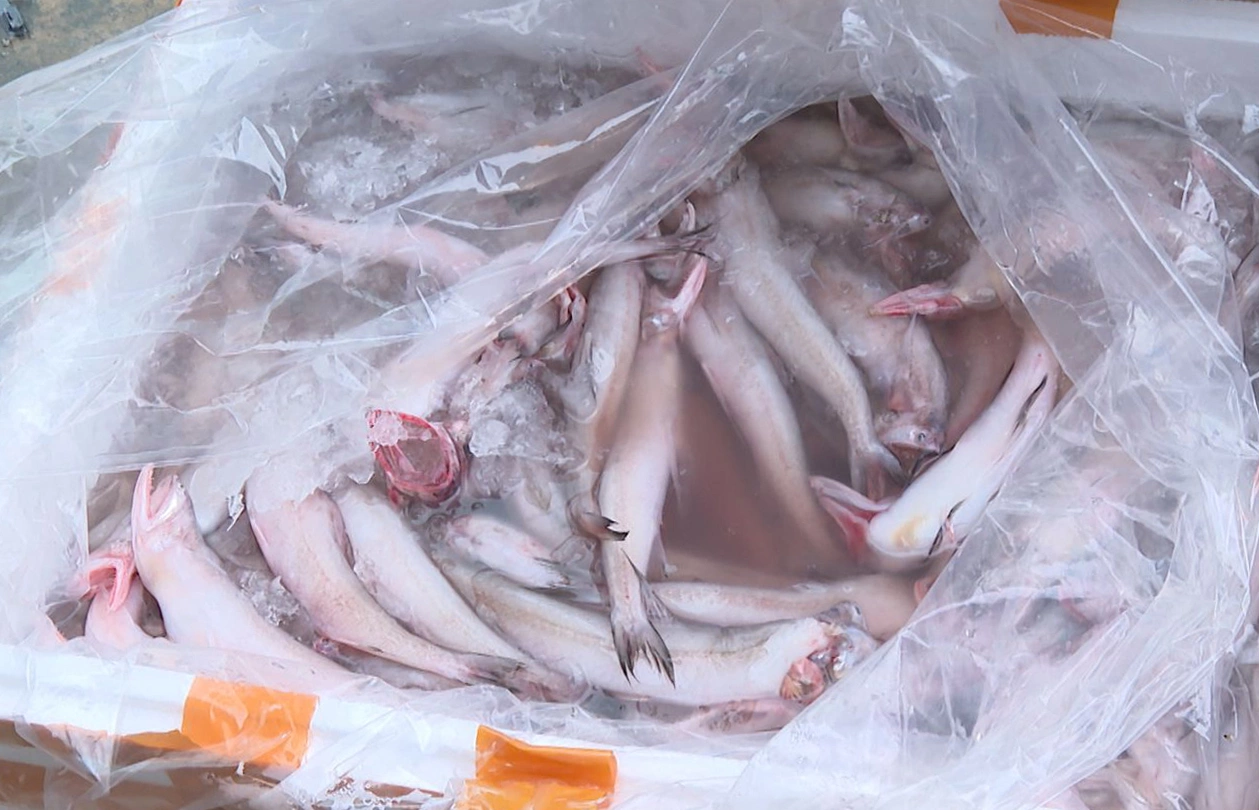 |
More than 10 tons of ribbonfish contained very high levels of formalin. Photo: Lam Son
How to identify food and seafood treated with chemicals
Associate Professor Thinh suggested some "relative" identification methods through sensory perception of color, smell, and food elasticity.
Chemically treated seafood often displays an unusually bright color, less slime on its surface, and an overly attractive appearance. For example, oysters soaked in chemicals will have reduced natural slime, clearly visible folds, and clear, non-cloudy soaking water. Squid, after treatment, often appears unusually white and bright, with a drier, less slimy surface.
Seafood treated with chemicals or formalin is typically rigid and lacks elasticity. Squid and oysters become slippery but not sticky, while shrimp are unusually hard and brittle, breaking easily. Naturally fresh seafood always has a mild, characteristic fishy smell. "If you detect a smell similar to hospital disinfectant, it is very likely the product has been chemically treated," warned Associate Professor Thinh.
For fish, fresh specimens typically exhibit elasticity, tightly arranged and shiny scales that do not peel off. Chemically preserved fish may appear fresh, but its body lacks high elasticity; when pressed, it feels soft and dents, and it does not have the characteristic fishy smell upon close inspection.
Shrimp injected with impurities often have a swollen head, possibly protruding significantly from the body, bulging, waterlogged gill covers, and splayed tail spikes and fins. Additionally, seafood priced unusually low compared to the average market rate often poses risks.
Experts advise consumers to purchase food from reputable sources with clear origins and to limit the use of products with unknown provenance. To protect public health, authorities must increase inspections, trace food origins, and severely punish those who use toxic preservative chemicals. Preventing formalin-treated food from circulating in the market is an urgent measure to ensure consumer safety.
Thuy Quynh