Eng English
China 中国人

Eng English
China 中国人
  • News
  • World
  • Business
  • Entertainment
  • Sports
  • Law
  • Education
  • Health
  • Lifestyle
  • Travel
  • Science
  • Digital
  • Automobiles
  • Trở lại Thể thao
  • Health
Thursday, 17/9/2026 | 15:17 GMT+7

Infant in critical condition, airway perforated after family mistakenly administers acid

Mistaking an 80% trichloroacetic acid bottle for a vitamin dropper, family members administered five drops into the mouth of a one-month-old infant, causing severe airway burns and requiring emergency mechanical ventilation.

A representative from Ninh Binh Obstetrics and Pediatrics Hospital reported this incident on 17/9. The infant patient was admitted with frothing at the mouth, fussiness, and no vomiting. Clinical examination revealed the chemical had corroded the entire oral cavity and left cheek, with significant mucus accumulation. Minutes later, the child became agitated, lips turned cyanotic, blood oxygen levels plummeted, and a harsh, creaking sound emanated from the larynx due to edema obstructing the airway, leading to a significant decrease in ventilation of both lungs.

Recognizing the life-threatening chemical burn, the on-duty team immediately performed orotracheal intubation to open the airway and urgently transferred the patient to the Intensive Care and Anti-poisoning Department.
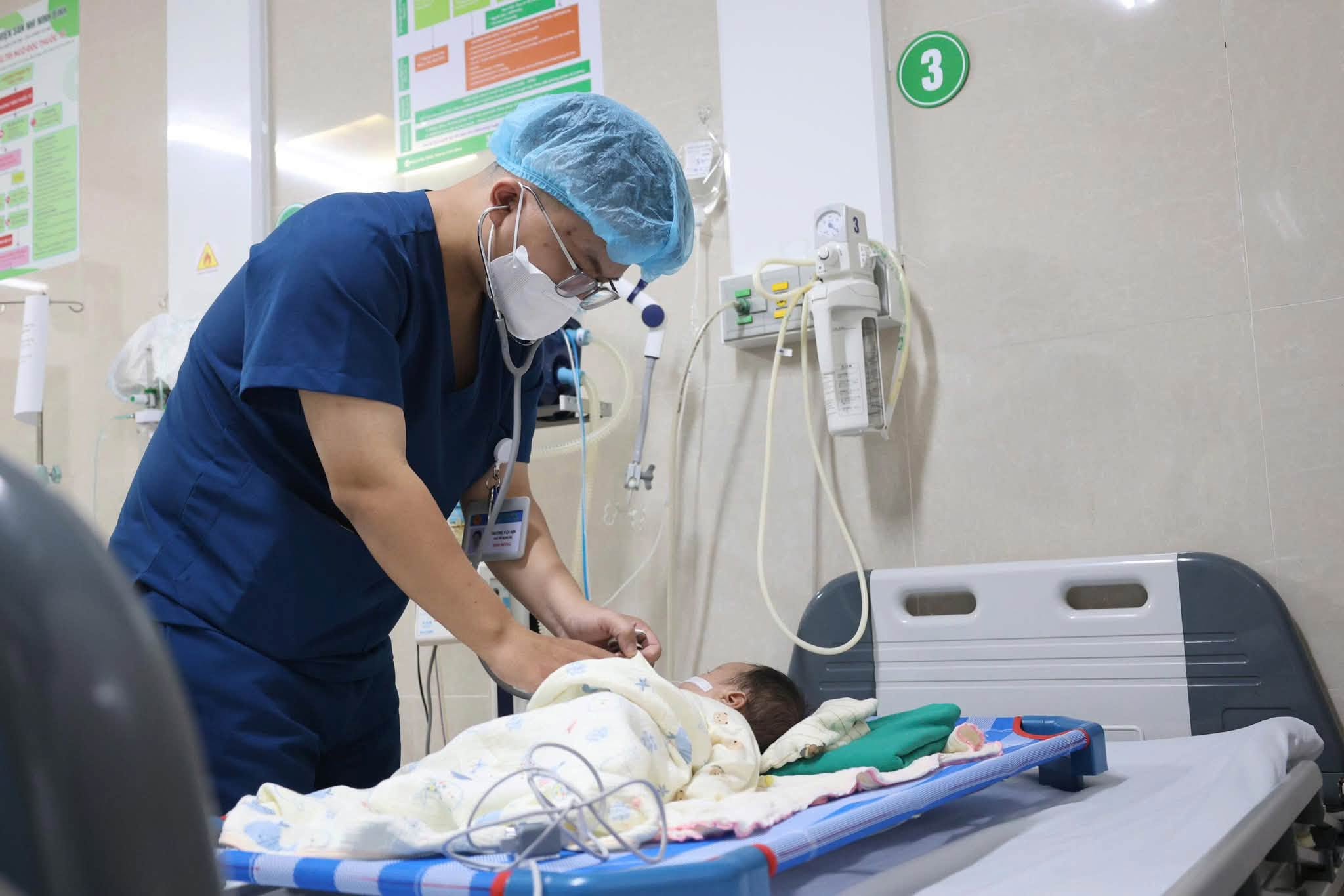
The patient receiving emergency treatment at the hospital. Photo: Hospital provided

Doctors prescribed sedation, mechanical ventilation, antibiotics, and high-dose anti-inflammatory drugs. After six days of intensive treatment, the baby's health improved significantly, successfully weaning off the ventilator. The damaged cheek skin began to heal, pseudomembranes in the mouth shed well, and the baby resumed breastfeeding.

Although no immediate complications were noted, the hospital will continue to closely monitor the child for the next one to two weeks to manage risks of fibrotic scarring leading to airway narrowing or gastrointestinal stricture.

According to treating doctors, the mucous membranes of an infant's mouth, throat, and airways are much more delicate than those of adults. Even a small amount of chemical can destroy local tissue, causing laryngeal edema that obstructs airflow and eroding the lining of the esophagus and stomach.

Doctors advise parents never to store acids, alkalis, or cleaning solutions in bottles that previously contained drinks, food, or old medicine. All hazardous chemicals must be kept in their original manufacturer's packaging, clearly labeled with warnings, tightly capped, and locked away out of reach of small children.

If a child is found to have swallowed acid, adults should calmly follow these steps: have the victim rinse their mouth with clean water, and swallow small sips of water to dilute the toxic substance (unless organ perforation is suspected or the child is vomiting blood). Continue to keep the victim in a sitting or upright position to limit reflux; never lay them on their back. Finally, family members must urgently take the victim to the nearest medical facility, bringing the exact chemical bottle so doctors can identify the toxic substance and choose an appropriate treatment protocol.

Crucially, first responders must strictly adhere to the "three no's" principle: do not induce vomiting by irritating the throat, as refluxed acid will burn the esophagus a second time; do not apply ice, toothpaste, snake oil, or folk remedies like plant leaves to the wound; and do not use strong alkaline solutions like limewater to neutralize, as the heat-generating chemical reaction inside the body will deepen the burn.

Thuy Quynh

By VnExpress: https://vnexpress.net/be-so-sinh-mon-me-thung-duong-tho-vi-nguoi-nha-nho-nham-axit-vao-mieng-5121404.html
Tags: accidental acid administration infant chemical burn airway perforation

News in the same category

Four snacks to help curb hunger

Four snacks to help curb hunger

Boiled soybeans, yogurt with berries combine protein, fiber, and healthy fats, promoting lasting fullness between meals and limiting blood sugar fluctuations.

Hoang Mai medical center evacuates patients, maintains normal operations during floods

Hoang Mai medical center evacuates patients, maintains normal operations during floods

Hoang Mai Medical Center has been deeply flooded for two days, requiring patients, belongings, and equipment to be evacuated to the second floor, even as about 50 emergency patients were admitted.

5 people suffer respiratory burns after 4-story house fire in TP HCM

5 people suffer respiratory burns after 4-story house fire in TP HCM

Five individuals were hospitalized after escaping a four-story house fire in Cho Lon ward, all suffering from skin and respiratory burns.

5 ways to increase beneficial bacteria for a healthy gut

5 ways to increase beneficial bacteria for a healthy gut

Eating diverse fruits and vegetables, yogurt, limiting ultra-processed foods, and getting enough sleep can maintain gut microbiota diversity.

Mole removal leaves pitted scars on facial skin

Mole removal leaves pitted scars on facial skin

Mai, 30, used an unverified "remedy" on three moles on her face and forehead, resulting in ulcers, pitted scars, and hyperpigmentation.

Tho Sinh Duong participates in international traditional medicine workshop

Tho Sinh Duong participates in international traditional medicine workshop

A Vietnamese enterprise and Asian experts discuss traceability, technology, and cooperation for traditional medicine development in Seoul.

What happens to your eyes when you eat sweet potatoes?

What happens to your eyes when you eat sweet potatoes?

Yellow or orange sweet potatoes are rich in beta-carotene and antioxidant compounds, providing essential nutrients for eye health.

Why thin people still have excess visceral fat?

Why thin people still have excess visceral fat?

I am 1.5 m tall and weigh 43 kg. Although I am thin, an ultrasound revealed a significant amount of visceral fat. Why do thin people experience this condition? (Hong Anh, 28 years old)

Can a CT scan detect early stroke risk?

Can a CT scan detect early stroke risk?

I am 52 years old, have high blood pressure, and recently experience frequent headaches and transient dizziness. Can a brain CT scan detect early stroke risk? (Mong Hung, Tay Ninh)

waiting for food to cool before refrigerating: a habit inviting pathogens

waiting for food to cool before refrigerating: a habit inviting pathogens

leaving food at room temperature until completely cold before refrigerating inadvertently turns family meals into a breeding ground for bacteria, according to warnings from US food safety experts.

Eng English
China 中国人
  • News
  • World
  • Business
  • Entertainment
  • Sports
  • Law
  • Education
  • Health
  • Lifestyle
  • Travel
  • Science
  • Digital
  • Automobiles
FPT Tower, 10 Pham Van Bach Street, Dich Vong Ward,
Cau Giay District, Hanoi, Vietnam
Email: contacts@vnportal.net
Tel: 028 7300 9999 - Ext 8556
Advertise with us: 090 293 9644
Register
© Copyright 2026 vnnow.net. All rights reserved.
Terms of use Privacy policy Cookies