Many people, after cooking a large pot of soup or stew, or having leftover hot food, habitually leave it at room temperature until it cools down, or even becomes completely cold, before putting it in the refrigerator. They believe that hot food should not be placed directly into a cold appliance.
However, this common practice is harmful, as affirmed by doctor Vanessa Coffman, program director at Stop Foodborne Illness in the US. Bacteria multiply rapidly, doubling their numbers every 20 minutes, when food remains in the "danger zone" of 4 to 60 degrees C.
The US Department of Agriculture (USDA) advises that cooked food should only be left at room temperature for a maximum of two hours. This timeframe is reduced to one hour if the ambient temperature exceeds 32 degrees C. Rather than passively waiting for food to cool, home cooks should actively implement methods to lower its temperature quickly and move it into a cool environment as soon as possible.
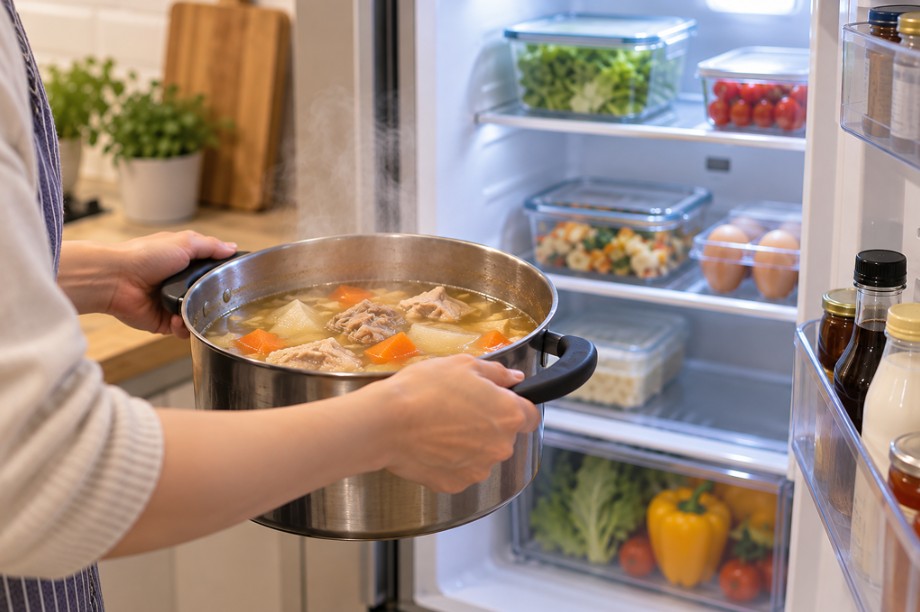 |
Experts recommend dividing hot food into multiple containers instead of putting an entire hot pot into the refrigerator. AI-generated image |
To effectively prevent the growth of pathogens, cooks need to reduce the food's temperature to 21 degrees C within two hours. Following this, the temperature should be further lowered to 5 degrees C or below within the next 4 hours. Doctor Coffman highlights that normal room temperature cannot bring food down to the safe threshold of 5 degrees C, making the waiting period a significant risk to digestive health.
Conversely, placing an entire steaming hot pot directly into the refrigerator's cold compartment also presents similar risks. Deep pots retain heat for an extended period, particularly in their core, which creates an environment conducive to microbial proliferation. This substantial heat mass also warms the refrigerator compartment, potentially compromising the safety of other stored ingredients.
To address the challenge of rapid cooling, doctor Bryan Quoc Le, a food consultant in the US, recommends dividing food portions into shallow containers. This technique increases the surface area exposed to air, facilitating immediate heat release and ensuring that the food's core cools evenly.
The choice of container material also influences cooling efficiency. Metal containers conduct heat quickly, allowing food to cool rapidly. Glass dishes, known for their heat resistance, eliminate the risk of microplastic exposure, a concern with common plastic containers.
For large stews or pots of soup, an ice bath is a highly effective cooling method. Home cooks can prepare a basin or sink with ice water, then place the food container into the basin, ensuring that water does not spill over the rim, and stir the food continuously.
Once a food thermometer indicates the temperature has reached 21 degrees C, the food should be immediately transferred to the refrigerator to complete the cooling process to below 4 degrees C. Doctor Bryan Quoc Le notes that this method is particularly effective for liquid dishes such as soups and sauces, as their consistency allows for superior heat transfer through the container walls compared to solid meat blocks.
Binh Minh (According to Martha Stewart)