The Wenzhou Medical University First Affiliated Hospital, Longgang Campus, Zhejiang Province, recently performed a successful endoscopic procedure to remove a mercury thermometer that had been "sleeping" in patient Wang’s abdomen for two decades, as reported by Wenzhou Metropolitan Daily on 8/4.
Chinese media reported that Wang, 32, sought medical attention due to persistent bloating and indigestion. A computed tomography (CT) scan of his abdomen revealed a foreign object in his duodenum, identified as a mercury thermometer. The sharp tip of the thermometer was pressing against the intestinal wall, threatening to cause perforation or severe bleeding at any moment.
Wang recounted swallowing the thermometer when he was 12 years old. Fearing his parents’ scolding and experiencing no unusual symptoms at the time, he kept it a secret and gradually forgot about it. Throughout the past two decades, he had never undergone a routine health check-up.
The medical team at the hospital’s Endoscopy Center immediately prepared for the removal procedure. Given that the thermometer had been in his body for such a long time, its deep location, and its proximity to sensitive organs like the bile duct and pancreatic duct, the operational space was restricted. Even a minor oversight could have damaged the intestinal wall or shattered the thermometer, leading to mercury poisoning.
With the aid of specialized equipment, doctors precisely located the foreign object. They used a medical snare to loop one end of the thermometer and gently pulled it out. After 20 minutes, the thermometer was successfully removed intact, though the graduation marks on its glass body had been worn away by digestive fluids.
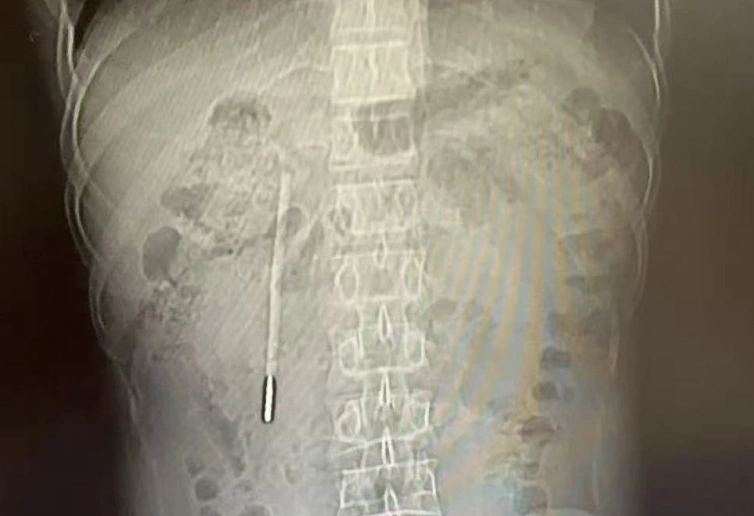 |
An X-ray showing a mercury thermometer inside the patient's abdomen. Photo: Wenzhou Metropolitan Daily |
An X-ray showing a mercury thermometer inside the patient's abdomen. Photo: Wenzhou Metropolitan Daily
According to statistics, over one million patients are hospitalized each year in China due to swallowing foreign objects, with children accounting for over 60% and the elderly around 25%. Common foreign objects include: fish bones, chicken bones, button batteries, magnets, and dentures. If not promptly addressed, these can lead to serious complications such as: digestive tract abrasions, intestinal perforation, or intestinal obstruction.
Medical experts emphasize that proper first aid is crucial if a foreign object is accidentally swallowed. The Endoscopy Center at Wenzhou Medical University First Affiliated Hospital advises that individuals should immediately stop eating and drinking, and minimize swallowing or talking to prevent the object from moving deeper. Following this, they should quickly go to the Ear, Nose, and Throat (ENT), Gastroenterology, or Emergency Department and provide accurate information about the foreign object to the doctor. Currently, endoscopy remains the most effective clinical method for foreign body removal. In cases where the object is deeply lodged or has caused complications, surgical intervention will be indicated.
Furthermore, people should abandon incorrect habits when dealing with foreign objects. Doctors caution against attempting to swallow large pieces of rice or dumplings in hopes of "pushing" the object down. They also advise against drinking vinegar to soften the object or self-inducing vomiting by poking the throat. These methods are not only ineffective but can also cause more severe damage to the mucous membranes, potentially leading to dangerous complications such as: esophageal perforation or choking.
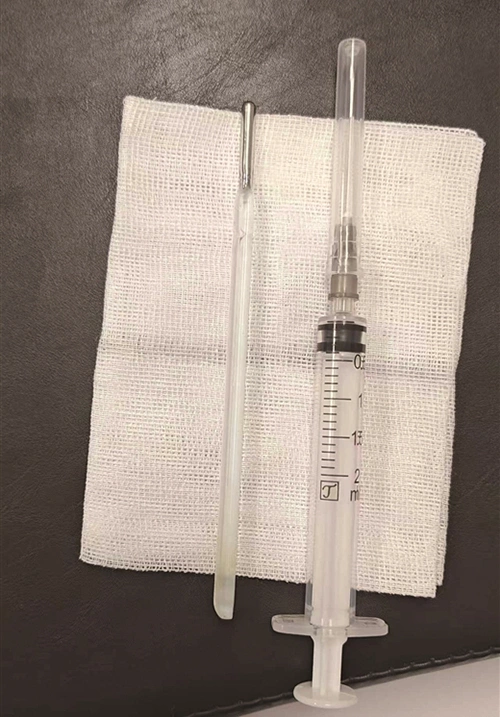 |
The thermometer after its removal. Photo: Wenzhou Metropolitan Daily |
The thermometer after its removal. Photo: Wenzhou Metropolitan Daily
By Binh Minh (Source: Wenzhou Metropolitan Daily, Sina)