On 30/12, Master of Science, Doctor Nguyen Van Hai, head of the Department of Cardiology and Interventional Cardiology at Hong Ngoc - Phuc Truong Minh General Hospital, shared details about a patient who came for an examination after experiencing prolonged abdominal cramps. The patient also had underlying conditions of high cholesterol and diabetes.
Previously, Mr. Son had been diagnosed with an abdominal aortic aneurysm at a local hospital. However, due to the complexity of his condition and the challenges of treatment, he was advised to undergo medical management and home monitoring. He sought further care at Hong Ngoc General Hospital when his pain intensified and began to affect his daily life.
Examinations at the hospital revealed that Mr. Son had an abdominal aortic aneurysm located just below the kidney. The aneurysm measured 57 mm in diameter, which is nearly three times the normal range of 16-20 mm.
"An aorta exceeding 30 mm is already considered an aneurysm, so this case carried a very high risk of rupture," Doctor Hai explained.
 |
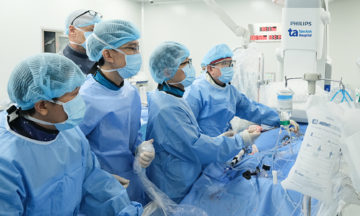
The team placing an abdominal aortic stent graft for Mr. Son. Photo: Hong Ngoc General Hospital |
Given the critical situation, the medical team at Hong Ngoc General Hospital held an urgent consultation and decided on an abdominal aortic stent graft procedure. This minimally invasive solution uses a specialized stent with a membrane, offering a safe option for elderly patients with multiple underlying conditions. The procedure helps shorten recovery time and reduces the risk of complications.
The intervention presented challenges because the aneurysm was large and positioned close to the renal artery, increasing the risk of kidney failure if there was any misalignment. Utilizing a modern digital subtraction angiography (DSA) system, the team accurately identified the exact location. They successfully placed the stent, covering the entire aneurysm, restoring normal blood flow, and mitigating the risk of rupture.
Two hours after the procedure, Mr. Son was awake and free of abdominal pain. He was able to eat and engage in light movement.
 |
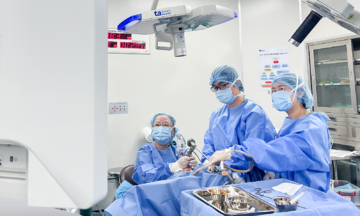
A doctor examining Mr. Son after the intervention. Photo: Hong Ngoc General Hospital |
Based on this case, Doctor Hai advises that abdominal aortic aneurysms often progress silently with few symptoms. When signs such as severe abdominal pain, persistent back pain, or a feeling of fullness around the navel accompanied by a noticeable pulse appear, patients should seek immediate hospitalization for timely treatment.
Van Ha
Hong Ngoc General Hospital is proficient in modern interventional methods, including: coronary stent placement, aortic and peripheral artery stenting, drug-coated balloon angioplasty, and pacemaker implantation. The hospital is equipped with advanced machinery for precise screening, accurate diagnosis, and timely, effective intervention for complex cardiovascular and vascular diseases.
Department of Cardiology - Interventional Cardiology, Hong Ngoc - Phuc Truong Minh General Hospital
Address: 8 Chau Van Liem, Tu Liem Ward, Hanoi
Hotline: 0911 858 626