Under the 2010 Food Safety Law, three ministries—Health, Industry and Trade, and Agriculture (now the Ministry of Agriculture and Environment)—along with People's Committees at all levels, jointly manage food safety. Speaking at a workshop contributing to the draft revised Food Safety Law on july 31, Doctor Chu Quoc Thinh, Director of the Food Safety Department, stated that this model has been likened to a "three-ministry oversight" system. This model has revealed many shortcomings as supply chains grow more complex, with numerous products falling into overlapping regulatory areas.
The Politburo has assigned the Ministry of Health to develop a project for a unified state management focal point for food safety. Following this direction, the draft law outlines a general principle: the Ministry of Health will serve as the lead agency for state management of food safety, with other ministries, sectors, and local authorities coordinating implementation. Once the project is approved, the specific functions and duties of each agency will be detailed in guiding decrees.
"The goal is to build a unified management system from central to local levels. Ministries will maintain responsibility within their specialized fields, while local authorities, especially at provincial and communal levels, will play a direct role in market management," Thinh said.
Pham Khanh Phong Lan, Director of the Ho Chi Minh City Food Safety Department, noted that "unifying the focal point is a prerequisite for transitioning from incident-based handling to risk-based and supply chain management." According to her, if responsibilities must be re-determined among multiple agencies every time an incident occurs, effective supply chain control will be difficult to achieve.
At the conference, Deputy Minister of Health Do Xuan Tuyen announced that the draft law is being finalized for submission to the National Assembly at its october 2026 session. The draft focuses on four main policy groups: food safety management across the entire supply chain; reforming management and inspection methods; digitalization and building a food safety database; and enhancing the effectiveness of managing street food and prepared meal services.
Among these, managing food safety across the entire supply chain represents a fundamental change in the draft law. Instead of controlling each stage individually, the draft proposes continuous management from initial production, harvesting, slaughtering, processing, transportation, and distribution until products reach consumers.
At the production stage, many types of facilities must apply advanced food safety management systems such as HACCP, ISO 22000, FSSC 22000, or equivalent standards. Facilities producing health protection foods will continue to be required to meet GMP standards. During distribution, regulatory agencies will increase proactive sampling for testing, risk analysis, and traceability, rather than primarily responding after violations occur.
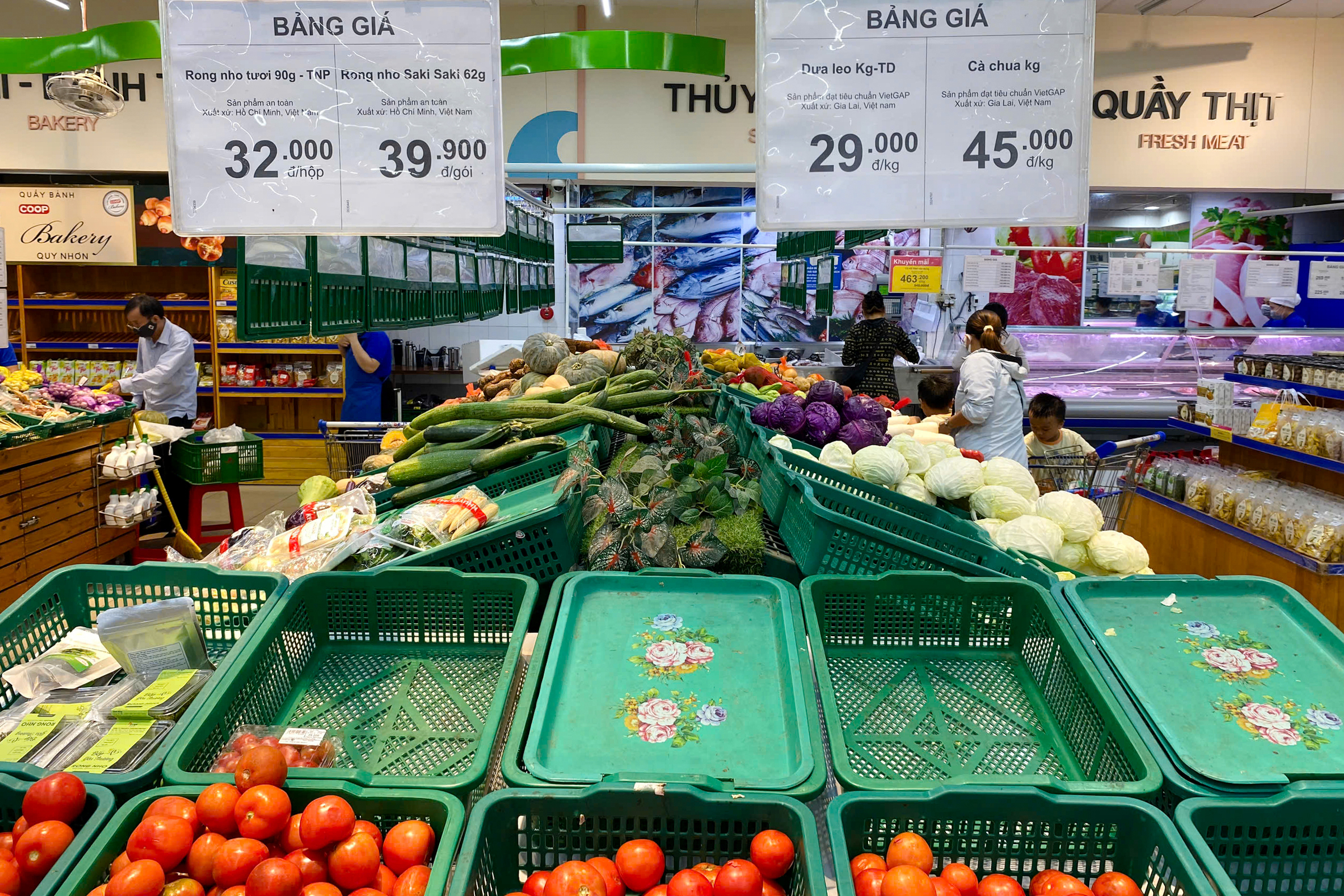 |
People shop at a supermarket in Quy Nhon. Photo: Thanh Tung |
The draft reforms post-inspection methods towards data-driven and risk-analysis-based management. Instead of traditional inspections, regulatory agencies will implement "smart" post-inspection mechanisms, using digital data to identify risks early, proactively prevent violations, and food safety incidents. The draft clearly defines post-inspection forms, including planned and dot xuat (unscheduled) post-inspections, along with their content and implementation methods.
The Ministry of Health proposes a significant increase in penalties for food safety violations. The maximum fine will be raised to one billion dong for individuals and two billion dong for organizations, a 10-fold increase from current regulations.
In addition to administrative penalties, violating organizations and individuals may face criminal prosecution, compensation for damages, and remediation of consequences in accordance with the law. Individuals who abuse their positions or authority to violate food safety regulations will also face disciplinary action or criminal prosecution, depending on the severity.
Le Nga