Professor Doctor Tran Phan Chung Thuy, Director of the Ear, Nose, and Throat Center at Tam Anh General Hospital, TP HCM, performed an ear, nose, and throat endoscopy on Ba Xinh, revealing large nasal and nasopharyngeal tumors, approximately 4 cm in size. A computed tomography scan confirmed a space-occupying lesion in the bilateral nasopharyngeal region, obstruction of the sinus ostiomeatal complex, and pneumatization of the left middle turbinate (an anatomical structural abnormality inside the nasal cavity).
The tumor in the nasopharynx blocked the posterior choana, hindering airflow and leading to nasal congestion and difficulty breathing. The tumor also invaded the torus tubarius, the area near the opening of the eustachian tube—a small tube connecting the middle ear to the nasopharynx. This compression caused fluid retention, resulting in ringing in the ears.
Professor Chung Thuy diagnosed Ba Xinh with nasopharyngeal and nasal cavity tumors, along with mucopurulent pansinusitis, and ordered a tissue biopsy. The results indicated chronic ulcerative inflammation with widespread purulent necrosis, raising suspicion of a malignant lesion.
The patient was scheduled for surgical removal of the entire nasopharyngeal and nasal cavity tumors, with samples sent for histopathology. According to Professor Chung Thuy, a large tumor completely filling both nasal cavities requires surgical removal followed by radiation therapy. For smaller nasopharyngeal tumors that only protrude slightly, patients typically only need radiation therapy and no surgery.
 |
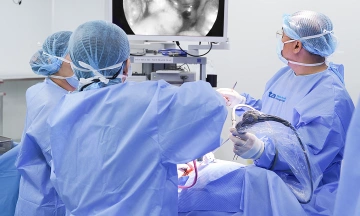
Professor Chung Thuy observing through the IGS navigation screen and performing endoscopic surgery to remove Ba Xinh's tumor. Photo: Tam Anh General Hospital
During the surgery, doctors noted that the nasopharyngeal tumor was deeply located, in a narrow space, and close to many important blood vessels and nerves. The tumor was highly vascularized, increasing the risk of intraoperative bleeding. The surgical team cauterized the left sphenopalatine artery, the main artery supplying blood to the nasal and nasopharyngeal regions, to minimize bleeding. Subsequently, a coblator surgical system was used to simultaneously resect and aspirate the tumor while controlling bleeding for the patient.
Histopathology and immunohistochemistry staining of the tumor confirmed undifferentiated non-keratinizing squamous cell carcinoma, stage T2N0. The tumor had spread significantly beyond the nasopharynx but had not yet metastasized to the cervical lymph nodes, indicating a good prognosis.
Following surgery, Ba Xinh recovered well and was healthy enough to undergo radiation therapy. To date, after over three months of adhering to a personalized radiation therapy regimen, she has responded well to treatment, gained weight, improved her eating habits, has normal bowel and bladder function, and her health remains stable.
Nasopharyngeal cancer is a malignant disease originating from the epithelial cells in the nasopharynx, the uppermost part of the throat located behind the nose. Risk factors for nasopharyngeal cancer include Epstein-Barr virus (EBV) infection, genetic predisposition, family history, a diet high in salt, smoking, alcohol consumption, and occupational exposure to chemicals and dust.
According to Professor Chung Thuy, nasopharyngeal cancer is a type of cancer sensitive to radiation therapy; cancer cells are easily destroyed by radiation, and tumors often shrink significantly after treatment. If detected early, the prognosis is very good, with a five-year survival rate in early stages potentially exceeding 80-90%. However, in its initial stages, symptoms like nasal congestion and ringing in the ears are often subtle and easily mistaken for rhinosinusitis, as was the case with Ba Xinh.
Individuals experiencing prolonged unilateral nasal congestion or ringing in the ears, especially if sinusitis treatment is ineffective, should seek an early ear, nose, and throat examination and nasopharyngeal endoscopy to detect the disease and receive timely treatment.
Uyen Trinh
*Patient's name has been changed
| Readers can submit questions about ear, nose, and throat conditions here for doctors to answer. |