Upon arriving at Tam Anh General Hospital, Ho Chi Minh City, for treatment, she had several co-morbidities including hypertension, dyslipidemia, and was taking anticoagulant medication. Following a consultation, doctors from the Breast, Head and Neck Surgery department decided to perform wide excision of the skin cancer lesion on the right side of her nose and reconstruct it using a local skin flap rotation with Mohs micrographic surgery via frozen section. Before surgery, Ba Sang needed to temporarily stop her anticoagulant medication to ensure safety.
Mohs micrographic surgery allows doctors to precisely control the margins during the operation, avoiding removal of healthy tissue while ensuring all cancer cells are eliminated. Mohs micrographic surgery via frozen section offers the advantage of enabling surgeons to quickly examine the margins during surgery to determine if any cancer cells remain. If the result is positive, the surgeon will extend the excision at that exact location; if negative, healthy skin is preserved, leading to a smaller, more aesthetic incision and reduced scarring.
Examination results confirmed that all cancer cells had been completely removed. Doctors performed a local skin flap rotation to cover the defect, helping the patient maintain the natural contours of their face. Post-surgery, Ba Sang was alert, had no swelling, recovered quickly, and was discharged the next day.
 |
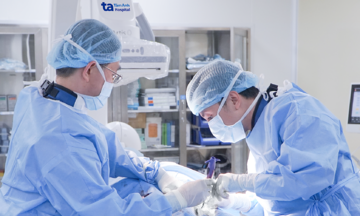
Doctor Huan and his team operating on patient Sang. Illustration: Tam Anh General Hospital |
Doctor Huan and his team operating on patient Sang. Illustration: Tam Anh General Hospital
Doctor Do Tuong Huan, a specialist in Breast, Head and Neck Surgery at Tam Anh General Hospital, Ho Chi Minh City, stated that removing facial skin cancer is more challenging than in other areas because surgeons must completely excise the tumor while preserving the natural shape of the face. Mohs micrographic surgery can assess up to 99% of the excision margins, whereas conventional frozen section methods only check less than 10%. This allows doctors to completely remove cancer cells while preserving natural structures like the nose, lips, and eyelids.
Skin cancer is common among older adults, and many discover it late, mistaking it for a mole or a small dark spot. Doctors recommend paying attention to: persistent nodules, slow-healing sores, discolored skin areas, or prolonged oozing, especially in sun-exposed areas like the nose, forehead, and ears. Thorough protection, using sunscreen, and regular skin examinations are the most effective ways to prevent the disease.
Minh Tam
*Patient's name has been changed