When the episodes of numbness and weakness became more frequent, accompanied by forgetfulness, difficulty understanding speech, and less fluent expression, Mr. Hung sought examination at Tam Anh General Hospital. An MRI 3 Tesla scan revealed a cavernous malformation (cavernoma) located deep within his left temporal lobe, an area involved in language processing, memory formation, and emotion regulation.
Dr. Chu Tan Si, Head of Neurosurgery - Spine Department, Neuroscience Center, Tam Anh General Hospital Ho Chi Minh City, explained that the tumor had silently bled for an extended period. This caused multiple mild hemorrhagic strokes, creating both old and new blood clots around the lesion. These recurrent hemorrhages affected functional brain regions responsible for motor skills, language, and memory, leading to the patient's frequent limb numbness, weakness, and speech difficulties.
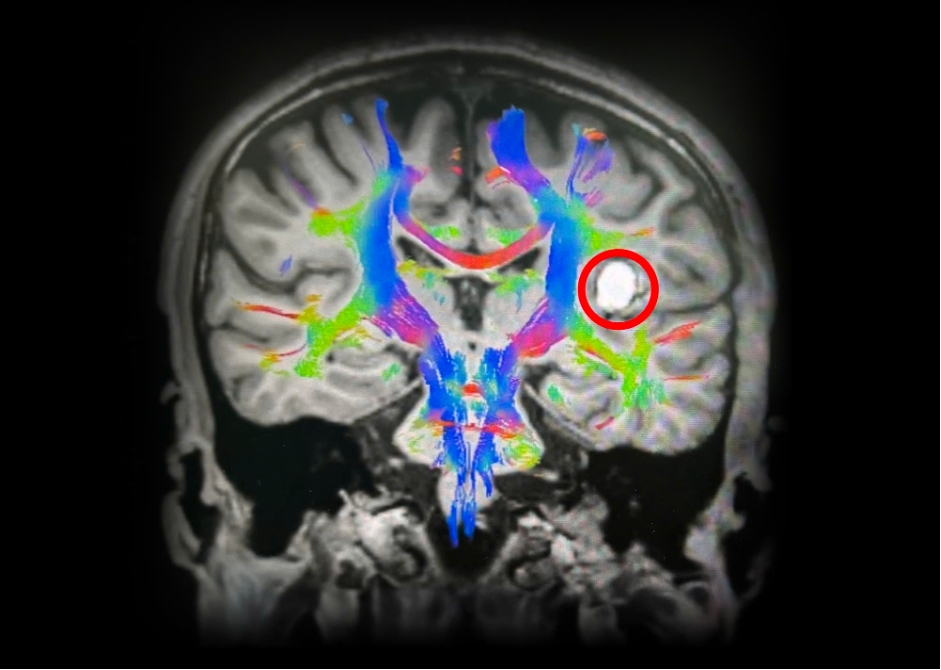 |
An MRI 3 Tesla image shows Mr. Hung's vascular malformation (red box) located deep and close to nerve fiber tracts, a crucial functional brain region. *Photo: Tam Anh General Hospital* |
According to Dr. Tan Si, high-flow vascular malformations often cause massive hemorrhages, whereas cavernous malformations silently bleed small amounts repeatedly over a long duration. This prolonged bleeding causes blood to degenerate and deposit in the surrounding brain tissue, abnormally stimulating nerves and gradually damaging adjacent nerve cells.
A cavernous malformation is a type of brain vascular malformation formed by the abnormal development of capillaries. The condition can be congenital or related to gene mutations.
Initially, patients often show no distinct symptoms or only experience headaches, dizziness, and reduced concentration. When the lesion silently bleeds or hemorrhages repeatedly, patients may experience numbness and weakness in limbs, speech difficulties, seizures, or transient ischemic attacks. Most cases exist for many years without detection. Over time, the brain region around the lesion continues to be damaged, leading to epilepsy, paralysis, or permanent neurological deficits.
Dr. Tan Si noted that the tumor was located deep in the left temporal lobe, close to nerve fiber tracts and critical functional brain areas, making intervention difficult. Traditional surgical methods would require opening a wider surgical field and traversing more healthy brain tissue to access the lesion, increasing the risk of post-operative weakness, paralysis, or speech disorders.
To ensure safety, doctors performed microsurgery to completely remove Mr. Hung's cavernous malformation using a Modus V Synaptive robot, integrated with artificial intelligence (AI) and a real-time neuronavigation system.
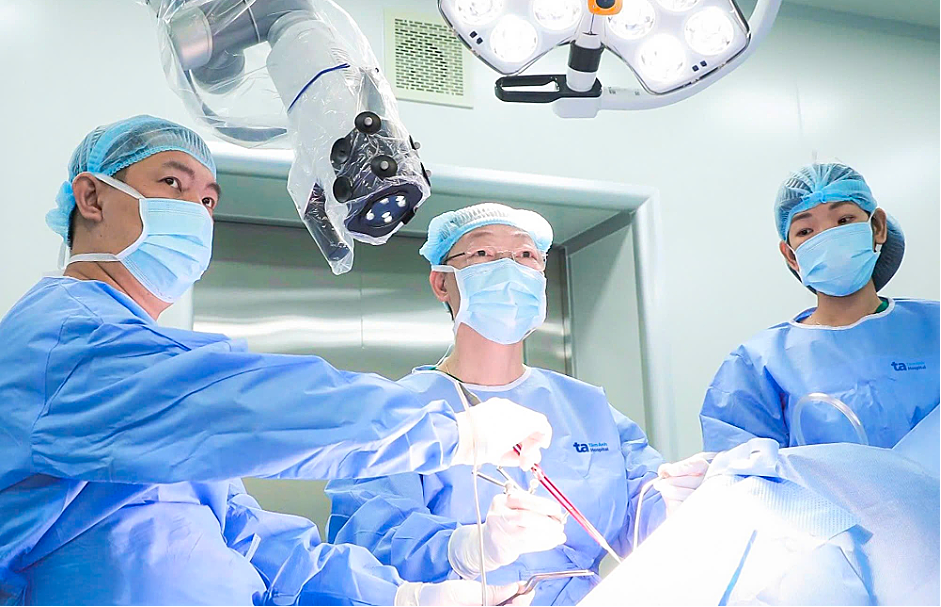 |
Doctors performing brain tumor removal surgery on Mr. Hung using the Modus V Synaptive AI robot. *Photo: Tam Anh General Hospital* |
This system displays comprehensive brain imaging data, including the tumor's location, old hemorrhage sites, and nerve fiber tract systems. This allowed the surgical team to plan a simulated procedure in advance, selecting the shortest and safest craniotomy site and surgical path, thereby minimizing healthy brain tissue traversal.
The AI robot provided precise, millimeter-by-millimeter dissection control while maximally preserving surrounding healthy neural structures. After two hours, the cavernous malformation and old hemorrhage sites were completely removed, preventing future silent bleeding and brain hemorrhage.
Following surgery, Mr. Hung was alert, had good mobility, with no recorded weakness, paralysis, or speech disorders. Post-operative examination confirmed the complete removal of the lesion, including the tumor capsule, limiting the risk of recurrence.
According to Dr. Tan Si, cavernous malformation is a benign condition that can lead to serious consequences if bleeding recurs. Patients should not be complacent when experiencing recurrent neurological symptoms such as persistent headaches, numbness and weakness in limbs, speech difficulties, seizures, blurred vision, or transient loss of consciousness. Early examination with MRI can help detect potential brain vascular malformations, enabling timely treatment and limiting the risk of severe deficits.
Trong Nghia
*Patient's name has been changed
| The Tam Anh General Hospital System is organizing a consultation program titled "Next-Generation 'Super Machines' and Surgical Robots Support Safe, Accurate Diagnosis and Treatment, and Rapid Recovery," featuring an experienced team of doctors. Readers can submit questions here for answers. |