During a seminar titled "Proactively preventing HPV, contributing to family health protection," organized by VnExpress in collaboration with MSD Viet Nam on 29/6, artist Oc Thanh Van shared insights as a mother of three children aged 11, 13, and 15. Her two eldest children are currently navigating puberty, a period marked by rapid physical and emotional changes, alongside evolving needs for privacy.
She described how her eldest son seemed to grow "in one night," with clothes quickly becoming too small and his physique nearing adulthood. Her 13-year-old daughter experienced her first menstrual cycle and has since become more reserved, private, and less inclined to share everything with her mother. Children at this age begin to develop their own worlds, spending more time with friends, forming special bonds, and becoming protective of their personal image. They also desire to be consulted before parents post photos or share stories about them. Even within the family, their habits change, from how they dress to how they maintain privacy, no longer as carefree as they were in childhood.
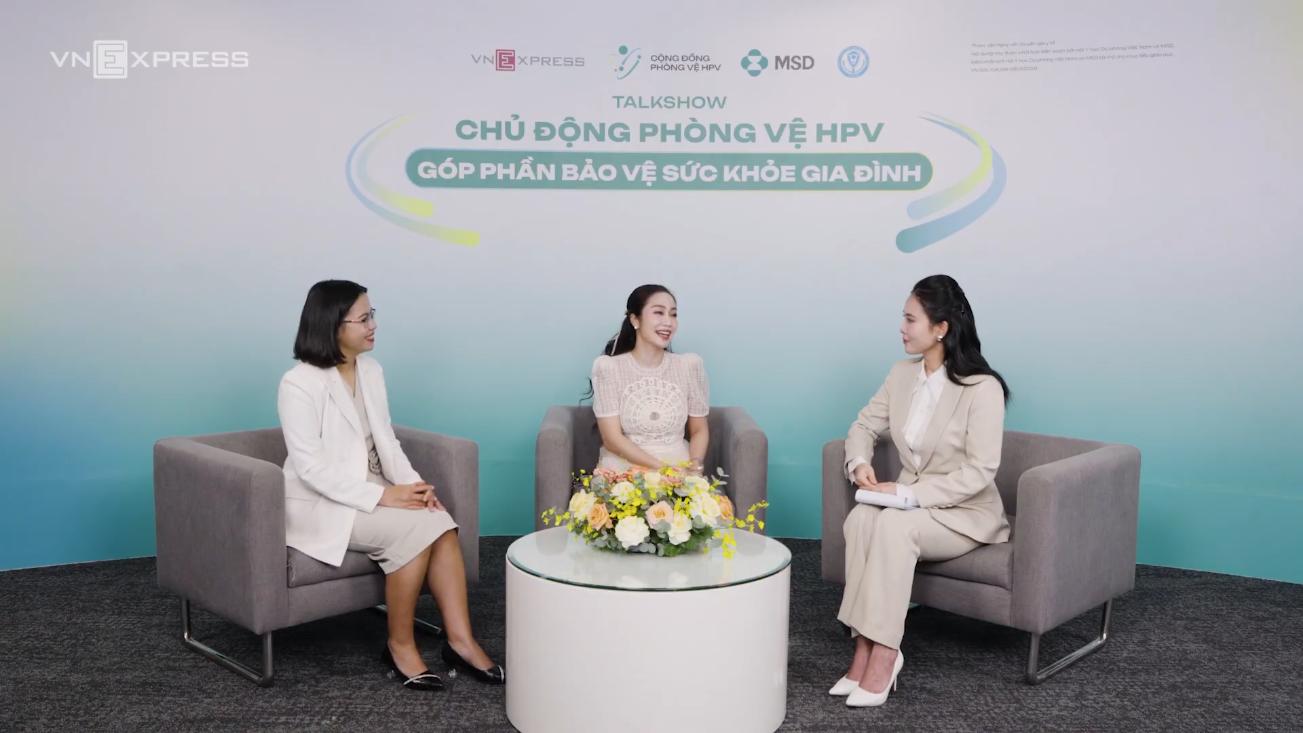 |
Guests share their thoughts at the seminar. Photo: Van Ha |
Oc Thanh Van noted that the biggest adjustment for her was realizing that each child responds differently. Her eldest son enjoys conversation and can confide for hours when ready. Her second daughter is private, often falling silent when sad and crying into her pillow without speaking. Her youngest, however, needs to debate until a conclusion is reached to feel at ease. This led her to believe that parents cannot apply one general formula to every child, even within the same family.
Dr. Nguyen Le Quyen, a specialist in Obstetrics and Gynecology at Tu Du Hospital and National Ambassador for HPV in Vietnam, explained that puberty is a period of significant life changes. During this stage, a girl gradually becomes a young woman, and a boy undergoes distinct physical and psychological transformations. This is also when children become more sensitive to how parents ask questions, react, or intervene in their private lives.
Many Vietnamese parents often postpone conversations about sexuality due to shyness, uncertainty about how to begin, or fear of "leading the deer astray" (introducing ideas too early). However, children today access the internet and various information sources at a young age. If parents do not provide accurate knowledge, children may seek information independently, but might not always find appropriate sources.
"The correct view today is not to avoid, but to guide the deer on the right path," Dr. Quyen stated.
She emphasized that sex education should not be seen as a dry lesson only for older children. Instead, it is an ongoing process of sharing age-appropriate information, from preschool through elementary and high school. The first important aspect is helping children understand and respect their bodies. When children comprehend how their bodies are changing and what their personal boundaries are, they establish a foundation for self-protection.
The second pillar is developing sharing skills. Parents need to create an environment where children can openly discuss changes, concerns, or difficult situations without fear of judgment. For reserved children, this requires even more patience. The third pillar involves refusal and help-seeking skills. Children must learn to say "no" to inappropriate situations and know whom to approach when facing difficulties.
From a mother's perspective, Oc Thanh Van clarified that being friends with children does not equate to being lenient or lax. Her family maintains clear boundaries regarding where children can go, time limits, and safety measures. However, the communication approach needs to adapt. Not every conversation requires a "family meeting." Sometimes, a text, a phone call, or a special one-on-one outing between a mother and a child can be enough to open a dialogue.
"I believe that as children change, we parents must also adapt. If parents constantly demand obedience, children will be even less inclined to share," she noted.
One common information gap during puberty concerns sexual health, including human papillomavirus (HPV). According to Dr. Quyen, many people still believe HPV is only relevant to women or only needs to be discussed in adulthood. In reality, HPV can affect the health of both men and women. According to the U.S. Centers for Disease Control and Prevention (CDC My) in 2024, almost everyone will be infected with HPV at some point in their lives. Over 42 million Americans are currently infected with disease-causing HPV types, and approximately 13 million Americans, including adolescents, acquire new HPV infections each year.
The doctor also stressed that an HPV infection does not automatically mean developing cancer. According to the CDC My, about 9 out of 10 HPV infections can clear naturally without causing health issues. However, while most HPV infections are asymptomatic and self-clearing, persistent infection can lead to genital warts, precancerous lesions, and related cancers.
 |
Dr. Quyen shares medical information on adolescent healthcare. Photo: Van Ha |
Dr. Quyen explained that HPV is primarily transmitted through vaginal, anal, or oral sexual contact. Additionally, HPV can spread between body areas in the same person, such as from genitals to mouth or anus, through skin-to-mucosa contact. Mother-to-child transmission during childbirth is documented but rare. Therefore, parents should not wait until their children are adults to initiate discussions on this topic. These conversations should be normalized as a routine part of healthcare, similar to discussions about nutrition, exercise, personal hygiene, or disease screening.
When discussing HPV prevention with children, experts advise parents against simply issuing commands. Adolescents need explanations: why their bodies require protection, what HPV is, the significance of preventive measures, and how these decisions directly relate to their own health. If parents find it difficult to start these conversations, they can seek advice from gynecologists, preventive medicine doctors, or other healthcare professionals.
 |
Artist Oc Thanh Van shares her experiences raising children during puberty. Photo: Van Ha |
Oc Thanh Van believes this information needs broader dissemination, reaching not only parents of daughters but also families with sons. She argues that parental proactivity lies not in tighter control over children, but in understanding their growth, respecting their changes, and seizing every opportunity for meaningful conversation.
Concluding the seminar, Dr. Le Quyen emphasized that "proactivity" is the critical keyword: proactively seeking accurate knowledge, proactively accompanying children, and proactively implementing appropriate healthcare measures. Puberty is not just a time for children to change; it is also a time for parents to learn to communicate with less imposition and more listening, equipped with sufficient knowledge so their children do not have to navigate difficult questions alone.
Van Ha