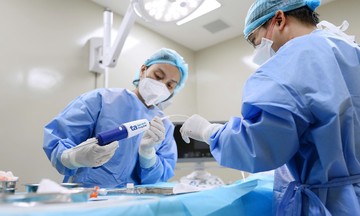
Ms. My occasionally experienced mild headaches. An MRI 3 Tesla scan of her brain and cerebral blood vessels at Tam Anh General Hospital in Ho Chi Minh City revealed severe narrowing of the distal left internal carotid artery, along with abnormalities in the collateral vascular system. This system consists of small blood vessels already present in the body, which help maintain blood flow to tissues and organs when main blood vessels are narrowed or blocked.
Master of Science, Doctor, Second Degree Specialist Mai Hoang Vu, from the Department of Neurosurgery - Spine at the Neuroscience Center, diagnosed Ms. My with Moyamoya disease, a cerebral vascular condition. It is characterized by abnormal thickening of the vessel walls at the distal internal carotid artery, where it branches into the anterior and middle cerebral arteries.
The thickening of the vessel walls progresses silently, gradually narrowing the lumen over time and reducing blood supply to the brain. Consequently, the brain is forced to form collateral circulation. On angiograms, this vascular system creates a faint, "smoky" image, which is the origin of the name Moyamoya in Japanese.
Moyamoya is classified into 6 stages according to the Suzuki grading system. In early stages, surgical intervention may not be necessary. However, when the disease progresses to stage 3-4, the vessel lumen is significantly narrowed, and collateral circulation becomes prominent, leading to a high risk of cerebral ischemia and stroke. At this point, surgery is required.
Ms. My's condition was classified as Suzuki stage 3. Brain perfusion MRI results showed a clear reduction in blood flow to the affected cerebral hemisphere compared to the opposite side, indicating a potential risk of stroke, despite her never having experienced weakness, paralysis, or a cerebrovascular accident.
Doctors held a consultation and decided to perform cerebral artery bypass surgery on Ms. My, utilizing an AI-integrated surgical microscope. The operation employed a low-flow bypass method, connecting the superficial temporal artery, part of the external carotid artery system, directly to the narrowed middle cerebral artery, part of the internal carotid artery system. This bypass creates an additional "supplementary blood pathway", allowing the brain to self-regulate blood flow according to metabolic demands, compensating for the deficient perfusion area.
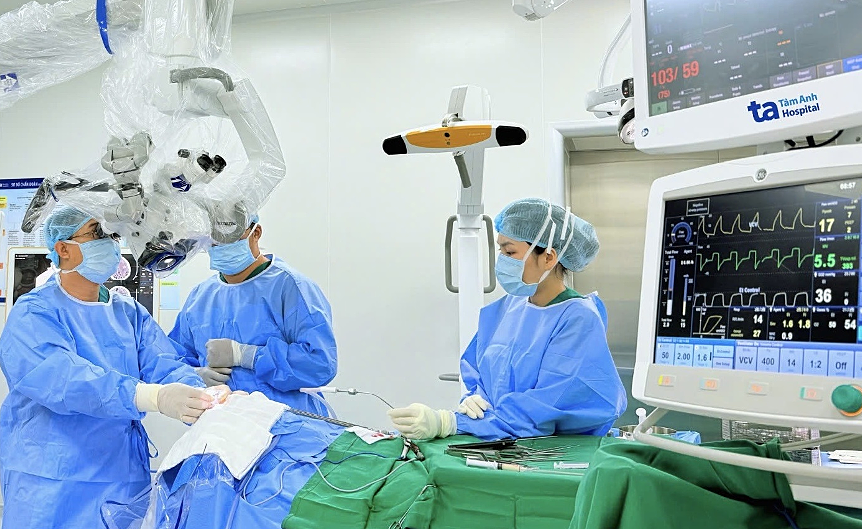 |
The surgical team operates on Ms. My using the AI Zeiss Kinevo 900 surgical microscope. Photo: Tam Anh General Hospital |
According to Dr. Vu, the goal of the surgery is not to widen the already narrowed blood vessels but to create a new, long-term blood supply for the brain. This helps the brain adapt to the disease's progression and reduces the risk of future strokes.
Post-surgery, Ms. My recovered well with no neurological complications. She will need follow-up appointments and an MRI to assess perfusion after 3-6 months.
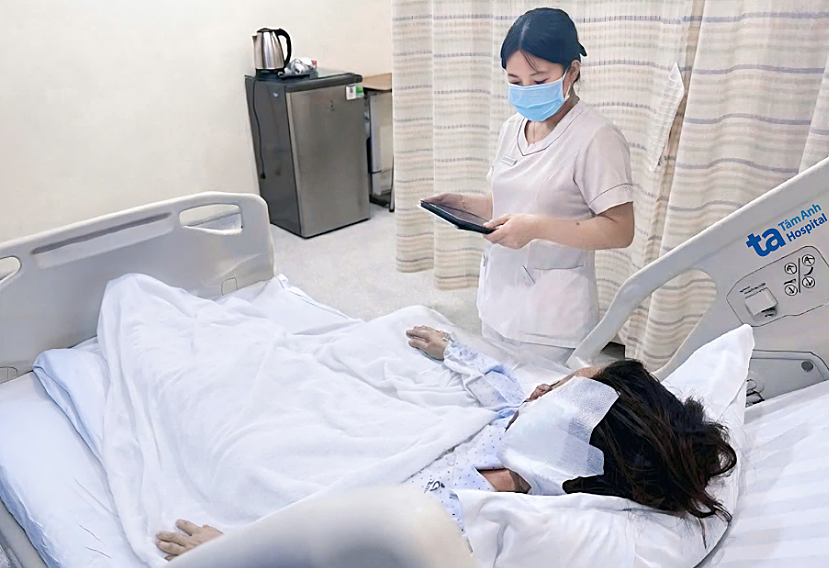 |
Ms. My receives post-surgical care instructions from a nurse before discharge. Photo: Tam Anh General Hospital |
Doctors state that if Moyamoya disease is not detected and treated early, it will progress to Suzuki stage 5-6. At these stages, the internal carotid artery system is almost completely occluded, and collateral circulation is exhausted. At this point, bypass surgery is largely ineffective, and monitoring and controlling the risk of stroke become challenging.
Moyamoya commonly affects children and young adults, but middle-aged individuals can also develop the disease, often with few symptoms and silent progression. If persistent headaches of unknown cause, recurrent dizziness, or transient weakness occur, patients should seek medical examination for diagnosis and timely intervention.
Trong Nghia
*Patient's name has been changed
| Readers can ask questions about neurological diseases here for doctors to answer |