On 14/7, Doctor Tran Ngoc Tuan, Specialist Level 2, of Nguyen Trai Hospital, stated that the patient's left leg was swollen from thigh to foot, red, and painful, making walking difficult. About one week prior, she felt her leg was heavy but dismissed it as a common symptom, not seeking medical attention.
Ultrasound and angiography revealed the patient had extensive deep vein thrombosis (dvt) affecting the entire venous system of her left leg, extending to the femoral and iliac veins. This is a dangerous condition as a blood clot can detach, travel to the lungs, causing pulmonary embolism, which is life-threatening. It can also cause limb necrosis due to insufficient blood supply, potentially leading to disability.
During the evaluation of the thrombosis's cause, doctors discovered the patient had a large right ovarian tumor. Although the tumor was not directly compressing the leg's venous system, doctors suspected it was a factor increasing blood coagulation, leading to blood clot formation.
 |
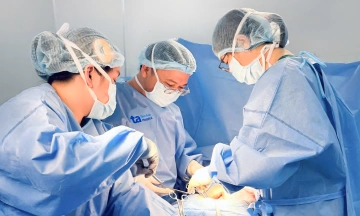
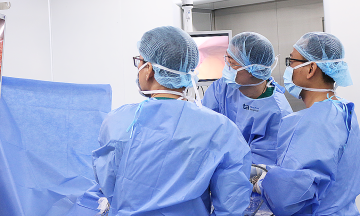
Doctors performing intervention for the patient. *Hospital provided*.
The patient underwent an interdisciplinary consultation, prioritizing thrombosis treatment to reduce the risk of pulmonary embolism and ensure safety for the subsequent tumor removal surgery. The team decided to apply catheter-directed thrombolysis. A catheter was inserted directly into the thrombus in the iliac vein to deliver thrombolytic drugs, helping to dissolve the blood clot on site.
After two days of treatment, the thrombus significantly dissolved, and the left leg's swelling rapidly decreased, with pain subsiding. The patient then underwent laparoscopic surgery to remove the ovarian tumor. Pathological results confirmed it was ovarian clear cell carcinoma. The patient recovered after 21 days of treatment, her left leg almost returned to normal, and she was discharged, continuing follow-up with cardiology and oncology specialists.
According to Doctor Tuan, this case demonstrates that deep vein thrombosis can sometimes be the first manifestation of underlying diseases, especially cancer. Many types of cancer can increase the body's coagulation state, making patients prone to forming blood clots even without injury or prolonged immobility.
Doctors advise people not to be complacent when one leg suddenly swells, experiences calf or thigh pain, or a gradually increasing feeling of tightness, especially when symptoms appear only on one side. This could be a sign of deep vein thrombosis, a condition that risks causing pulmonary embolism and death if not treated promptly.
When venous thrombosis is detected, in addition to treating the blood clot, patients need a comprehensive evaluation to find the cause, including malignancies, coagulation disorders, or vascular system abnormalities.
Le Phuong