Thuong, 72, experienced frequent, painful urination and traces of blood in his urine, prompting him to seek medical attention. Doctors suspected prostate cancer. He visited Tam Anh General Hospital TP HCM for a specialized examination, where his prostate-specific antigen (PSA) levels were found to be 33 ng/ml, eight times higher than normal. Magnetic resonance imaging (MRI) revealed a localized lesion in the left lobe, classified as PIRADS 4, indicating suspected malignancy, with no evidence of lymph node involvement or bone metastasis.
Master, Doctor Nguyen Tan Cuong, Deputy Head of the Urology Department at the Urology - Nephrology - Andrology Center, took 12 prostate tissue samples for testing. Pathology results confirmed cancer in the left lobe, still localized within the prostate gland. Despite having underlying conditions of hypertension and diabetes, Thuong was in good physical condition, making him a candidate for robot-assisted surgery using the Da Vinci Xi system. According to Doctor Cuong, the tumor in the prostate's left lobe had invaded the capsule and left seminal vesicle, making dissection challenging. The Da Vinci Xi robot, with its high-resolution 3D camera, allowed doctors to clearly visualize anatomical structures.
The surgeon operated the robot to remove the entire prostate gland and both seminal vesicles, while maximally preserving neurovascular bundles. This approach reduced the risk of complications and maintained better urinary and sexual function compared to open or traditional laparoscopic surgery. Two days after surgery, Thuong recovered well, was able to walk around easily, and was discharged.
Patients need to attend follow-up appointments as scheduled to assess recovery and monitor for recurrence risk. PSA levels will be checked to detect any residual cancer cells early; if found, patients will receive hormone therapy combined with adjuvant radiation therapy.
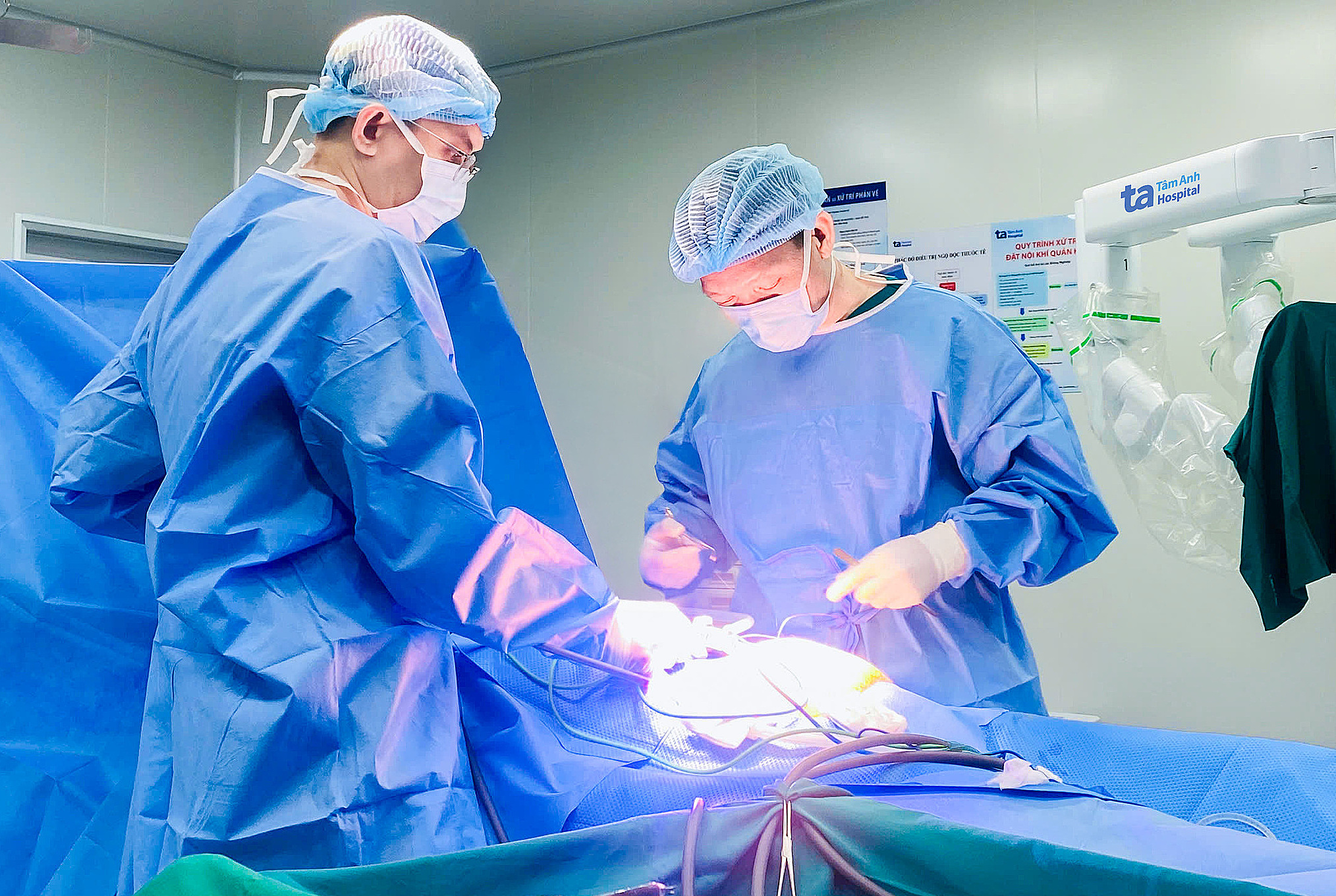 |
Doctor Cuong (right) performs a radical prostatectomy for Thuong with the assistance of the Da Vinci Xi robot. Photo: Tam Anh General Hospital |
In Vietnam, prostate cancer ranks 7th in new cases and 9th in cancer mortality rates, according to Globocan 2022 data. The disease often progresses slowly with few symptoms in its early stages. In advanced stages, patients typically experience urinary dysfunction, hematuria, bone pain, leg swelling, and kidney failure.
Doctor Cuong stated that radical prostatectomy or radiation therapy can cure early-stage prostate cancer. For cases that have progressed or metastasized, treatment aims to slow tumor growth, extend life expectancy, and improve quality of life. Key treatment methods include hormone therapy using testosterone-suppressing drugs, chemotherapy, immunotherapy, radiation therapy, and palliative care.
Doctors recommend that men, especially those over 50 or in high-risk groups, undergo regular prostate cancer screening. To prevent the disease, it is advisable to maintain a healthy lifestyle, exercise regularly, and follow a balanced diet. This includes limiting red meat and saturated fats, increasing green vegetables, reducing alcohol consumption, and not smoking.
Ha Thanh
*Patient's name has been changed