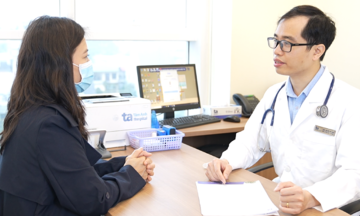
Mrs. Hoa sought medical attention after sustaining a chest injury. Doctor Nguyen Anh Dung, Head of Thoracic and Vascular Surgery at Tam Anh General Hospital, TP HCM, reported that she had soft tissue injuries but no fractures. Imaging scans revealed a 3,5 cm thymic tumor located directly in front of her heart, aorta, and pulmonary artery.
The patient exhibited no symptoms despite the tumor's moderate size. The thymus gland is situated in the chest, behind the sternum, and superior to the heart and major blood vessels like the aorta and pulmonary artery. As part of the lymphatic system, it produces lymphocytes, which are white blood cells that help the body fight infections. Thymic tumors originate from epithelial cells on the outer surface of the thymus and can be either benign or malignant.
Mrs. Hoa's tumor presented a mixed structure, comprising both cystic and solid components, and had not spread to the lymph nodes. Its location made it challenging to access, even with open or traditional thoracoscopic surgery, posing a high risk of damage to the heart and vascular system. Consequently, doctors decided to perform the surgery using the Da Vinci Xi robot.
 |
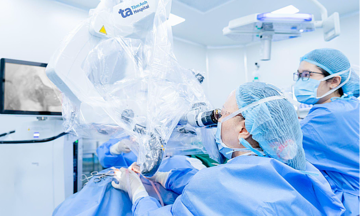
Doctors control robot arms to remove a thymic tumor. Photo: Minh Huyen |
The surgical team made four small incisions (1-1,5 cm) in the chest and abdomen to insert the robot arms. The intuitive navigation system and touchscreen allowed surgeons to operate easily in the hard-to-reach area without affecting healthy tissue. A tremor filtration and motion control system eliminated natural hand tremors of the surgeon. The doctors completely removed the tumor in one hour. The patient experienced less pain, reduced blood loss, and was discharged after three days.
For larger thymic tumors (over 5 cm) located near major blood vessels, doctors typically opt for open surgery to ensure complete removal without affecting surrounding structures. Open surgery involves a 10-15 cm incision through the sternum, increasing risks of infection and blood loss.
Currently, doctors prioritize minimally invasive approaches for patients, utilizing endoscopic surgery and robot assistance. Robot-assisted surgery overcomes limitations of traditional endoscopy by reducing the risk of damage to adjacent organs, facilitating operations in deep and narrow areas, and shortening hospital stays by 20-30% compared to traditional endoscopy (2-3 days versus 3-5 days), according to Dr. Dung.
Most patients with thymic tumors show no symptoms in the early stages. Symptoms only appear when the tumor affects organs within the chest. For example, the tumor can displace the trachea, causing shortness of breath; shift the esophagus, leading to difficulty swallowing; damage the recurrent laryngeal nerve, resulting in hoarseness; or compress the superior vena cava, causing superior vena cava syndrome. If pathology results indicate a malignant tumor, patients undergo chemotherapy, radiation therapy, immunotherapy, or targeted therapy to destroy cancer cells. For benign tumors, no further treatment is required, but regular follow-up appointments are necessary.
Thu Ha
* Patient's name has been changed
| Readers can submit questions about cardiovascular diseases here for doctors to answer. |