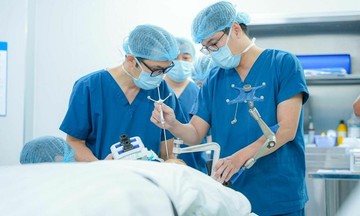
Early in 2025, Nguyen Van Minh, a normally active and healthy 7-year-old from Thai Nguyen, began experiencing unusual leg pain. Initially, his family dismissed it as a result of excessive activity or calcium deficiency. However, by the 30/4 holiday, Minh's thigh had swollen abnormally. Examinations confirmed he had stage IIB bone cancer, with the tumor extensively spread throughout his femur. Most hospitals recommended amputation to save his life. Minh's mother, Hien, refused this option and sought other possibilities. In her desperation, she learned about limb preservation cases for bone cancer patients using individualized 3D printing technology at Vinmec and immediately brought her son to Vinmec Times City International Hospital.
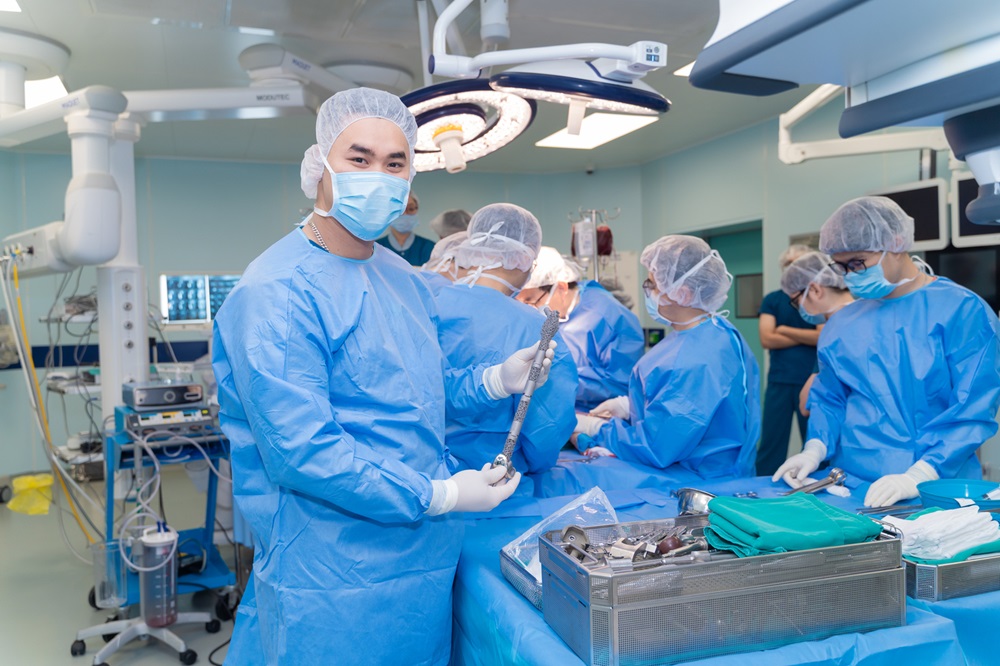 |
The operating room and the artificial bone replaced in the boy's leg. Photo: Vinmec |
After a consultation by the multidisciplinary bone tumor council (MTB Sarcoma), chaired by Professor Doctor Tran Trung Dung, doctors determined Minh still had a chance to keep his leg. The plan involved replacing his entire femur with a personalized 3D-printed implant, a technique Vinmec has mastered. This procedure would allow Minh to eradicate the tumor while preserving his leg's motor function. On 15/10, at 9h, Minh entered the operating room at Vinmec. The complex surgery lasted four hours. Doctors meticulously removed the invasive tumor, preserved healthy surrounding tissue, and precisely reconstructed the femur's structure to ensure Minh could walk normally in the future. The surgery concluded successfully.
“When the doctor said, 'we saved your son’s leg,' I burst into tears. For the first time in months, I cried from relief, as hope had become a reality,” Hien shared. However, the surgery marked only half the journey. Minh still required intensive rehabilitation, pain management, and movement adjustment.
 |
Minh and his mother five days after surgery. Photo: Vinmec |
Doctor Nguyen Tran Quang Sang, head of the Department of Bone and Soft Tissue Tumor Surgery at Vinmec Times City International Hospital, stated that the biggest challenge for Minh was not the technology, which Vinmec had mastered, but the patient's cooperative recovery process. “Young children often fear pain and find it difficult to cooperate, yet rehabilitation must begin one or two days after surgery,” the doctor explained. At Vinmec, physical therapists worked with Minh daily. His first steps were difficult, but effective pain control and the medical team’s encouragement led to good progress after five days. Doctor Nguyen Van Vi, head of the hospital’s Department of Rehabilitation and Sports Medicine, added, “Rehabilitation is challenging for adults; for a 7-year-old after major surgery, it is even harder. But thanks to good pain management and constant encouragement from the medical team and his parents, Minh recovered very well after five days.” Minh’s progress, from needing to be carried and supported to standing and taking small steps on his own, surprised the entire medical team.
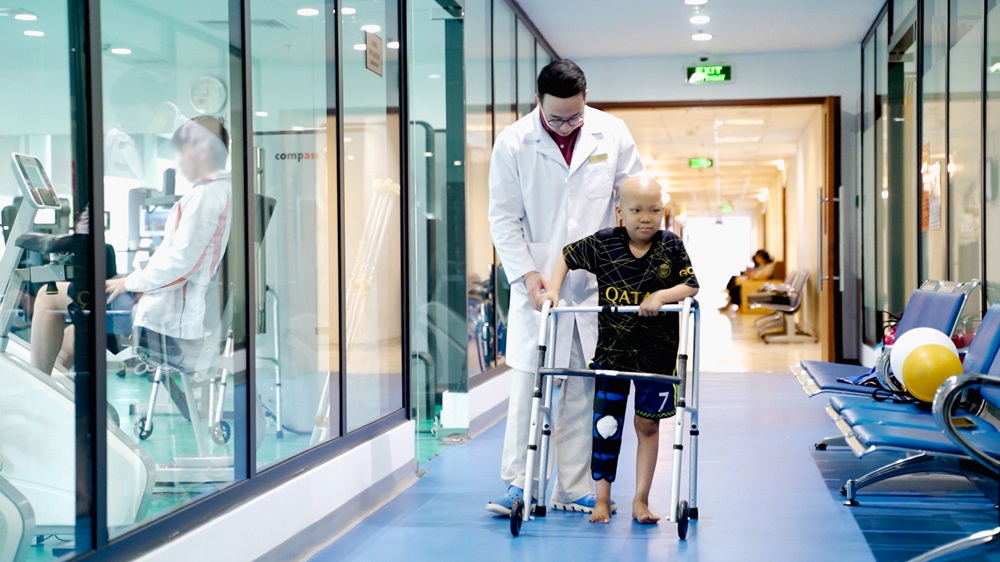 |
Minh practicing walking with an aid after surgery. Photo: Vinmec |
Minh is currently the youngest pediatric patient in Vietnam to undergo total femur replacement using individualized 3D printing technology. This achievement follows a similar success at Vinmec in May with 8-year-old Minh Duc. “Vinmec’s complete mastery of bone replacement techniques using personalized 3D printing technology offers renewed hope for many bone cancer patients on their journey against this disease,” a system representative stated.
The Dan