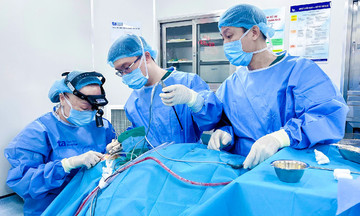
From behind the wheel of his BMW, Doctor Yates observed the tangible rewards of years of rigorous training, The Economist reported on 14/12. Yet, beneath this veneer of prosperity lies a somber atmosphere. His colleagues are unhappy. They entered medicine with the Hippocratic Oath to save lives, but daily work often forces them into roles as high-level data entry clerks, constantly battling insurance companies and administrative bureaucracy. This is the root of a paradox in US healthcare: doctors earn some of the highest incomes globally, yet face burnout and professional dissatisfaction more severely than in any other developed nation.
 |
Illustration: PharmD Live |
According to Medscape's 2023 physician compensation report, the average income for doctors in the US reached 352,000 USD per year. This aspirational figure is significantly higher than the average in countries belonging to the Organization for Economic Co-operation and Development (OECD). Even at the primary care level, the average income of approximately 242,000 USD for US doctors far surpasses their counterparts in the United Kingdom or Germany.
Despite high earnings, a large-scale survey by The Commonwealth Fund involving 11,000 doctors across 10 developed countries revealed that 43% of US doctors admit to experiencing burnout. This rate significantly exceeds all other surveyed nations. In contrast, in the United Kingdom, where the National Health Service (NHS) faces substantial budget pressure, only about one-third of general practitioners reported physical or mental exhaustion.
Burnout has evolved from a personal issue into a systemic characteristic of the US medical field. Doctor Revathi Ravi, an internal medicine and pediatrics specialist in Boston, described this situation as an "open secret" within the industry, where a confluence of toxic factors once led her to consider leaving the profession. Celli Horstman, co-author of The Commonwealth Fund report, indicated that the core cause is not medical expertise but the administrative workload. US doctors are burdened with excessive tasks, ranging from complex patient charting and managing overflowing email inboxes to constant disputes with insurance companies over payment claims. The time dedicated to these bureaucratic procedures severely encroaches on the time that should be spent with patients.
The proliferation of electronic health records (EHRs), initially expected to modernize healthcare processes, has inadvertently become a major burden. Studies show that the average family doctor spends nearly one hour daily solely responding to patient messages. Doctor Tait Shanafelt, a burnout research expert at Stanford University, noted that the Covid-19 pandemic accelerated the use of telemedicine applications, resulting in a "tsunami of messages" overwhelming doctors. While this technology supports better treatment, it simultaneously blurs work boundaries and increases invisible pressure on medical staff.
The consequences of this situation directly impact patient safety and the economy. Medical data indicates that burnt-out doctors are twice as likely to make professional errors compared to those not experiencing burnout, and their turnover rate is also significantly higher. A 2019 economic analysis estimated that costs associated with staff turnover and reduced working hours due to burnout cost the US healthcare system approximately 4,6 billion USD annually, equivalent to a loss of 7,600 USD per practicing physician.
In response to this reality, professionals are seeking structural solutions rather than relying solely on individual efforts. Researchers are examining Australia's model, where a centralized administrative platform has significantly reduced redundant paperwork. Additionally, Jen Brull, President of the American Academy of Family Physicians, places hope in artificial intelligence to automate repetitive tasks such as charting and data coding.
The approach to addressing the problem is also fundamentally changing. Doctor Ravi in Boston shared that a decade ago, solutions often involved advising medical staff to "practice mindfulness" to self-manage stress. Now, the medical community has a clearer understanding of the urgent need for systemic reform to alleviate the workload. While awaiting these macro-level changes, doctors like Ravi continue to strive to help themselves and their colleagues through training in coping skills for pressure, though they recognize these are only temporary fixes for a pervasive issue.
Binh Minh (According to The Economist, CNN)