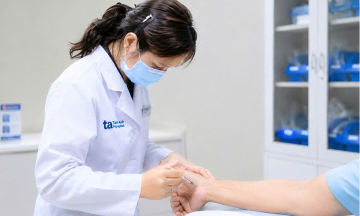
Upon his family's move to Vietnam, Liam's knee pain worsened, and abnormal lumps became palpable around his right knee. Following X-rays and examinations at Tam Anh General Hospital Hanoi, Dr. Tran Tuan Anh, a specialist from the Department of Orthopedics, diagnosed Liam with three osteochondromas, each 2 cm, located on the right distal femur and proximal tibia.
Osteochondromas are benign tumors originating from the bone surface, near the growth plate—a cartilaginous tissue zone at bone ends that facilitates bone formation and lengthening. These tumors typically emerge during adolescence and cease growing after puberty. An anomaly in this developmental process can cause a small portion of the growth plate to herniate or displace, resulting in abnormal bone outgrowth and tumor formation.
Dr. Tuan Anh noted that this benign tumor type affects about 0.4% of the population, primarily as solitary, asymptomatic growths. However, approximately 0.002% (1/50,000) of individuals develop multiple osteochondromas, where numerous tumors around joints cause pain from compressing or rubbing against tendons, muscles, and ligaments.
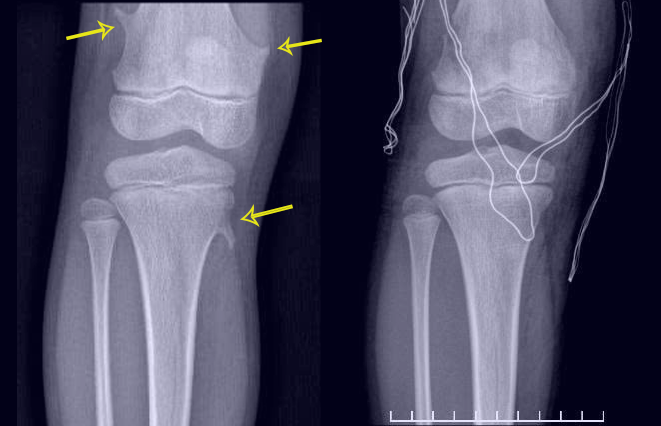 |
Liam's three osteochondromas (left) after surgical removal (right). *Photo: Tam Anh General Hospital* |
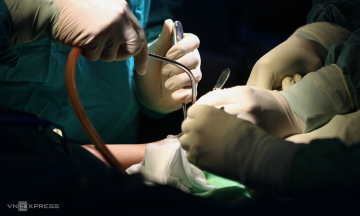
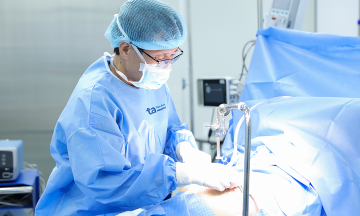
Liam underwent surgery for tumor removal and pathological examination. About 60 minutes after the procedure, he recovered well, experienced minimal pain, and began light physical therapy in bed. By the second postoperative day, he could walk with assistance, and he was discharged on day 4.
Doctors projected Liam would resume normal activities within 4 weeks and return to strenuous exercise or sports after 3 months. Pathological results confirmed all three of Liam's tumors were benign osteochondromas, requiring regular follow-up for monitoring.
 |
Liam being monitored during inpatient care on the third postoperative day. *Photo: Tam Anh General Hospital* |
Dr. Tuan Anh clarified that benign osteochondromas do not require intervention unless they cause symptoms. Multiple osteochondromas are often more genetically linked than solitary cases and carry a higher risk of malignant transformation. Surgical removal is necessary when these growths restrict movement or pose a risk of bone axis deviation during development.
Parents of growing children should observe for unusual symptoms, including limping, inward or outward foot rotation during walking, uneven sitting, leg extension, or pain during running, jumping, or sports that subsides with rest. Early consultation with a specialist at a hospital for examination and treatment is advised.
Thanh Long