The findings of this study were published in the New England Journal of Medicine (NEJM) on 9/9, as reported by People. A research team at Texas Children's Hospital, in collaboration with Baylor College of Medicine in the US, utilized an improved CAR-T immune cell therapy for the patient.
The child was admitted with rapidly relapsing hepatoblastoma that had metastasized to the lungs. Previously, the patient had undergone three chemotherapy regimens and major surgeries to remove liver tumors and damaged lung tissue. However, the cancer cells continued to resist conventional chemotherapy. As a last resort, doctors decided to enroll the child in the CARE clinical trial.
Specialists extracted the patient's own T-cells, which are infection-fighting white blood cells, and genetically modified them in the laboratory. This modification involved attaching a specific glypican-3 antigen-recognizing receptor to the surface of the hepatoblastoma cells. Additionally, it activated two immune-regulating molecules, interleukin-15 and interleukin-21, designed to enhance the longevity of these modified cells.
The patient received two outpatient immune cell infusions. Following the first dose, the tumor partially shrank. After the second dose, CT scans revealed the complete disappearance of metastatic lesions, with only a thin fibrous scar remaining where the tumor once was. Dr. David Steffin, a lead researcher, highlighted that the patient maintained a sustained treatment response for one year, with no dangerous systemic toxicity observed.
This initial success in a single case offers promising prospects for applying cell therapy to pediatric solid tumors. Historically, solid tumors have presented a significant challenge for decades, primarily because they often create a highly immunosuppressive microenvironment.
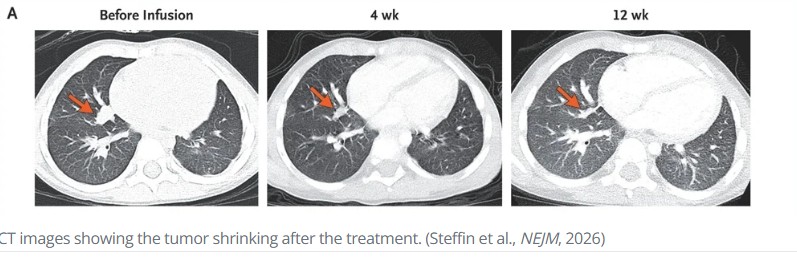 |
CT images show the tumor significantly reduced after treatment. *NEJM*
By Binh Minh (via People)