Initially, the surgical incision healed well, but after one year, it began to redden, itch, thicken, and expand. Despite Thy’s efforts with dietary restrictions and various scar-fading products, her condition did not improve. The scar became particularly itchy in hot weather or when clothes rubbed against it.
Dr. Nguyen Ngoc Tran, a Specialist Doctor I in Dermatology and Aesthetic Dermatology at Tam Anh General Hospital, Ho Chi Minh City, explained that postpartum keloid scars form due to excessive fibrous tissue proliferation that extends beyond the original wound boundaries. Unlike typical scars that tend to stabilize or fade over time, keloids can continue to spread and increase in size if left untreated.
Beyond cosmetic concerns, keloid scars can cause itching, tightness, or mild pain. In some cases, persistent itching occurs due to chronic inflammation and fibrous tissue overgrowth in the affected area.
 |
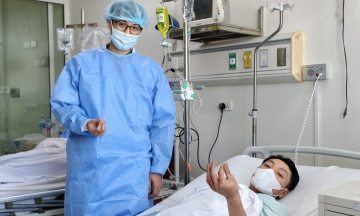
Dr. Tran advises Thy on treatment methods. Photo: Tam Anh General Hospital
The doctor prescribed a course of triamcinolone injections for Thy, administered 6 to 8 times, with one month between each session. This method is commonly used to treat keloid scars, aiming to reduce inflammatory reactions, inhibit excessive collagen proliferation, and soften the scar tissue.
Thy received direct injections into the scar area in stages. After each injection, the itching gradually subsided, the scar area softened, and its elevation decreased. Following approximately four treatments, the keloid scar significantly flattened, the skin surface became smoother, and the discomfort disappeared.
After the injections, Thy was advised to avoid rubbing or applying strong pressure to the scar area to prevent stimulating further scar tissue growth. She was instructed to keep the treated skin clean and not apply additional medications or scar-treating products without medical guidance. Patients should attend follow-up appointments as scheduled to allow doctors to assess treatment response and adjust the regimen, thereby minimizing the risk of scar recurrence or side effects such as skin atrophy or local telangiectasia.
According to Dr. Tran, keloid scars do not always appear immediately after a wound heals. In some individuals prone to keloid formation, collagen proliferation can occur subtly over a long period before manifesting as skin redness, itching, and a raised scar. Postpartum hormonal changes, prolonged inflammation, or skin areas constantly under tension can also contribute to delayed scar development, appearing months or even more than one year after the initial injury.
Therefore, if a raised scar, persistent itching, or increasing scar size is noticed over time, patients should seek early medical consultation. Self-treatment with unverified topical products should be avoided. Timely intervention helps improve aesthetics, better control scar size, and reduce the risk of scar expansion.
Minh Huong
*Character's name has been changed