Doctor Nguyen Van Phuc, from the Andrology Department at Military Central Hospital 108, advises parents to closely observe their child's genitals when bathing or changing diapers. Early detection of birth defects and timely treatment during the "golden period" helps children develop normally and completely. Conversely, late intervention leads to complex surgeries, lower effectiveness, and negative impacts on the child's psychology and future ability to father children.
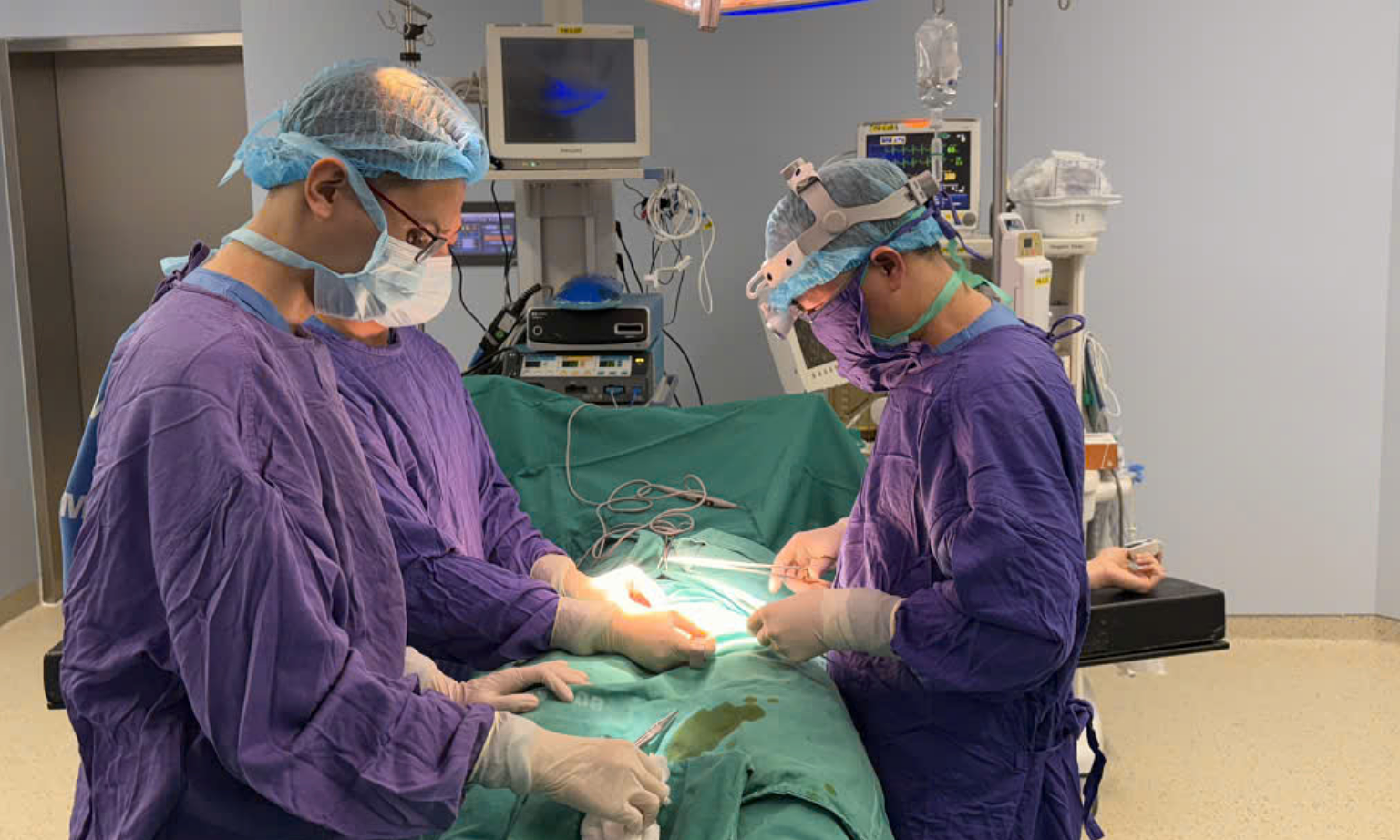 |
Doctors perform surgery on a patient with genital malformations. Photo: Hospital provided |
The most common abnormality parents often overlook is undescended testes. Normally, both testes descend from the abdomen into the scrotum during the final three months of pregnancy. If this process is interrupted, the testes can get stuck in the inguinal canal or in the abdomen, resulting in an empty scrotum where no testes can be felt. Many families mistakenly believe the testes will descend on their own, but after 6 months of age, the likelihood of spontaneous descent is almost nonexistent. Prolonged undescended testes expose them to higher than normal temperatures, destroying sperm-producing cells, leading to infertility and increasing the risk of cancer. Doctor Phuc recommends surgery to bring the testes down before 12-18 months of age to preserve their function.
The second easily recognizable defect is hypospadias. Instead of opening at the tip of the glans, the urethral opening is located on the shaft, base of the penis, or under the scrotum. This condition is often accompanied by a curved penis and an incompletely closed foreskin. Children with this defect typically urinate while sitting, with the stream spraying backward or downward. Families must not circumcise the child prematurely in such cases, as doctors need that skin for urethral reconstruction. The optimal time for surgery is before 18 months of age.
The most serious and alarming condition is ambiguous genitalia, where a baby's sex cannot be determined at birth. Signs such as an enlarged clitoris, small scrotum, or an abnormal urethral opening suggest a disorder of sex development due to chromosomal or hormonal abnormalities. Children require specialized tests to determine their true sex, allowing for appropriate reconstructive surgery and hormone therapy. This not only addresses the medical issue but also helps shape the child's gender identity and psychosocial well-being.
Additionally, some boys with a penis size under 1,9 cm (micropenis) due to hormone deficiency or a "buried" penis beneath the pubic fat layer also warrant attention. A buried penis is common in obese children; externally, it may appear as if there is no penis, but it is actually developing normally. Most of these cases can be resolved with minor reconstructive surgery to properly position the genitals.
Regarding phimosis, which causes concern for many parents, Doctor Phuc reassures that over 90% of newborns have physiological foreskin adhesion, which will gradually separate as they grow. The hospital only intervenes with dilation or circumcision if the child experiences swelling, inflammation, difficulty urinating, or recurrent infections. Adults should not forcefully retract the foreskin when bathing the baby, as this can cause tears, bleeding, and painful scarring.
Le Nga