In a petition sent to the 10th session of the 15th National Assembly, voters from An Giang province stated that applying the base salary coefficient to calculate health insurance fees creates difficulties for citizens and hinders efforts to encourage participation in the policy. Voters argued that the income of most freelance workers is not calculated using a salary coefficient, unlike civil servants and public employees. Therefore, basing contribution levels on the base salary (currently 2,34 million dong) is not consistent with actual income and requires adjustment.
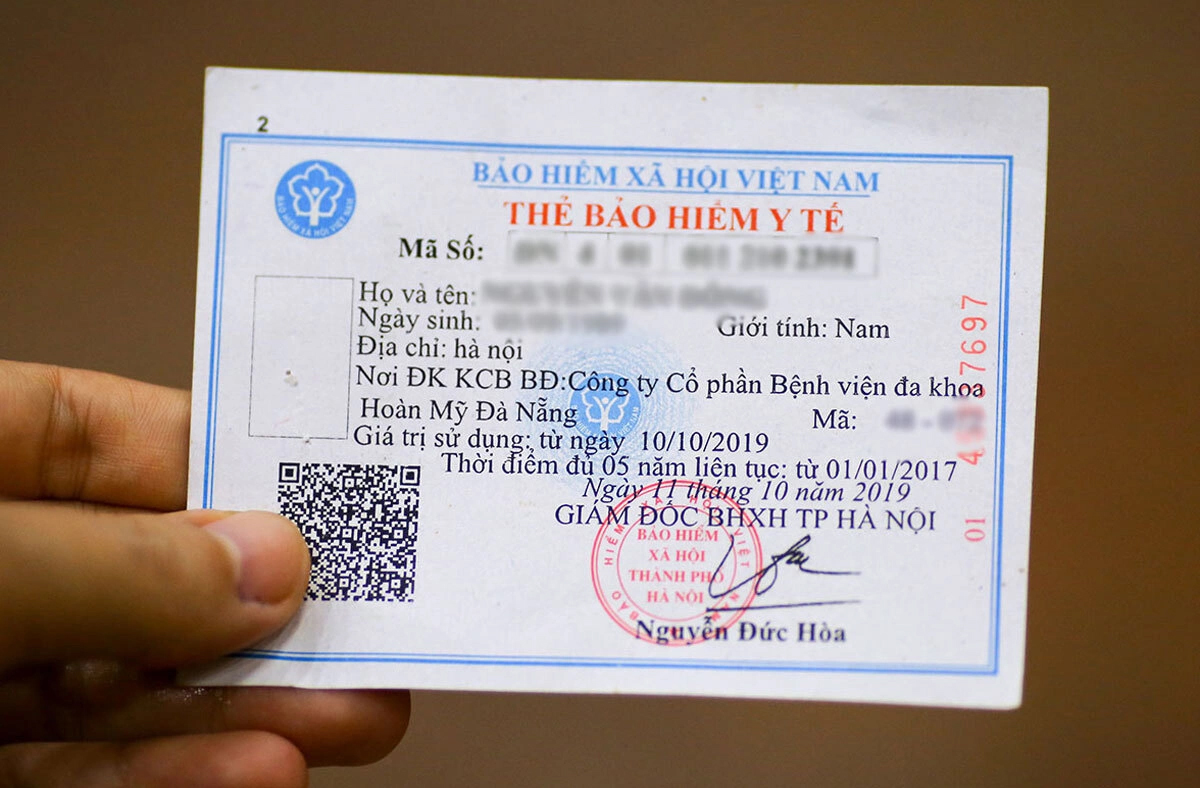 |
Health insurance card. Photo: Nguyen Dong
Responding to this issue, Minister of Health Dao Hong Lan explained that the Health Insurance Law and Decree 146 (amended and supplemented by Decree 75) clearly define different participant groups. Specifically, employees at agencies and enterprises contribute based on their actual monthly salary. Conversely, household participants, who do not receive a monthly salary, contribute based on the base salary.
The head of the health sector affirmed that using the base salary as a standard ensures consistency and fairness among participant groups. This mechanism also assists the state in calculating health insurance support levels from the budget, which are based on the same reference system.
Currently, the monthly household health insurance contribution is 4,5% of the base salary. With the base salary set at 2,34 million dong from 1/7, the first participant in a household must contribute 105,300 dong per month, totaling over 1,2 million dong annually.
To alleviate financial burdens, current policy applies a reduction mechanism for multiple members within the same household. The first person contributes 100% of the fee (105,300 dong). For the second, third, and 4th persons, the contribution decreases to 70% (73,710 dong), 60% (63,180 dong), and 50% (52,650 dong) respectively. From the 5th person onwards, the fee reduces to 40%, equivalent to 42,120 dong per month.
Additionally, the government's Decree 75 allows localities to use their budgets and other legal funding sources to provide further support for residents' contributions, exceeding the minimum stipulated level. For instance, Hanoi passed a resolution to use its local budget to cover the remaining 30% of contributions for near-poor households, granting this group completely free health insurance cards. Similarly, Ho Chi Minh City also provides 100% contribution support for members of near-poor households and those who have recently risen above the near-poor threshold, aiming to prevent the risk of re-impoverishment due to illness burdens.
Several localities with strong revenues, such as Quang Ninh and Binh Duong (previously), expanded coverage by purchasing health insurance for ethnic minorities and elderly individuals aged 70 to 79 without pensions. In Central provinces like Nghe An and Ha Tinh, the provincial People's Councils also decided to increase support for farmers, foresters, and fishermen with average living standards to a level higher than the minimum set by the Central government.
The Ministry of Health assesses that compared to countries with similar economic conditions, health insurance contributions in Vietnam are low, while benefits are comprehensive. The agency hopes voters will support the general policy, viewing it as a solution for risk sharing and ensuring financial security during illness.
Le Nga