Answer:
Knee replacement is a common treatment often indicated for severe osteoarthritis, post-traumatic knee deformities, or other causes. Surgeons remove damaged bone ends and replace them with artificial materials, preventing direct bone-on-bone contact during movement. This significantly reduces patient pain and corrects joint and limb axis deformities.
Both traditional and robotic knee replacement methods offer distinct advantages, suiting diverse patient needs. Techniques like kinematic alignment and mechanical alignment are currently used in many hospitals, helping patients reduce pain, minimize blood loss, and recover quickly.
When knee replacement is performed with the assistance of the Cuvis-Joint robot, existing surgical techniques can still be utilized to enhance treatment effectiveness. Key advantages of this technology include:
Integrated artificial intelligence (AI) analyzes 3D CT images to assess bone morphology and natural knee joint anatomy, thereby assisting surgeons in creating personalized surgical plans for each patient. During surgery, AI technology helps surgeons optimize joint space balance, align the limb axis, and orient joint rotation according to individual anatomy, leading to more natural and stable knee movement.
High precision in bone cutting maximizes the preservation of bone and soft tissue. The Cuvis-Joint can also accurately predict 100% of tibial bone size and 98,9% of femoral bone size, enhancing post-operative joint fit. This allows for faster patient recovery and an artificial joint lifespan potentially exceeding 20 years.
Kinematic alignment knee replacement with integrated software helps restore knee joint mechanics closer to the patient's natural anatomy. This improves gait, optimizes range of motion, and limits long-term load misalignment on the joint.
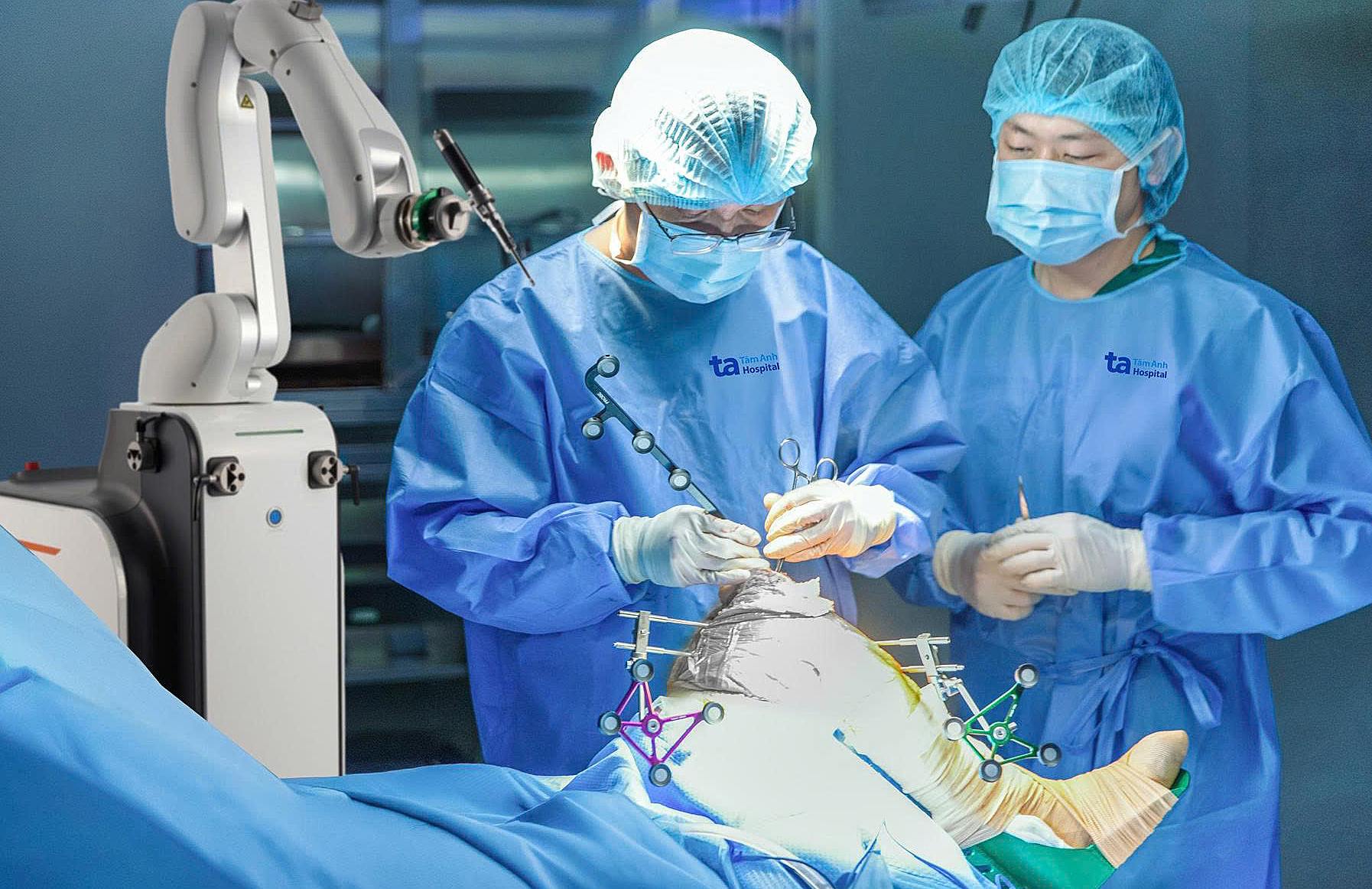 |
Doctor Bao (left) performs knee replacement surgery with the assistance of the Cuvis-Joint robot. Photo: Tam Anh General Hospital
The robot reduces the risk of complications such as joint loosening, dislocation, limb length discrepancy, pulmonary embolism, fractures, and infection. This method is suitable even for complex cases, including severely obese patients or those with intricate limb axis deformities.
Compatibility with various artificial joint types allows surgeons to proactively choose the most suitable joint based on a patient's anatomy, activity needs, and economic considerations.
To determine the most appropriate treatment method, it is advisable to visit a hospital for a direct examination and assessment by a doctor.
Master, Doctor, First-Degree Specialist Truong Huu Bao
Head of Orthopedic Trauma Department
Tam Anh General Clinic, District 7
| Readers can submit questions about musculoskeletal diseases here for a doctor's answers. |