Professor, Doctor Tran Phan Chung Thuy, director of the Ear, Nose, Throat Center at Tam Anh General Hospital Ho Chi Minh City, president of the Vietnam Ear, Nose, Throat Association, and president of the Asian Head and Neck Cancer Society, stated that doctors diagnose approximately 70-80% of nasopharyngeal cancer patients in late stages (stage 3, 4). At this point, symptoms are clear, including unilateral nasal obstruction, swollen cervical lymph nodes, rapid weight loss, and fatigue.
According to Professor Chung Thuy, multiple factors contribute to the late diagnosis of nasopharyngeal cancer. In its early stages, symptoms such as unilateral nasal congestion, transient headaches, and sore throats closely resemble the common cold or rhinitis, leading to easy misdiagnosis. Additionally, early-stage cervical lymph nodes are often painless, causing patients to self-medicate rather than seek medical examination. The nasopharynx is situated in a hidden, deep area behind the nose and throat, making it difficult to visualize with the naked eye during a routine throat examination. Consequently, lesions are often overlooked and can only be detected through endoscopy.
Early detection allows doctors to treat nasopharyngeal cancer patients with standard radiation therapy or endoscopic nasopharyngectomy combined with an AI-powered IGS navigation system. This method helps preserve function for patients in early stages, a feat difficult to achieve with previous techniques. A late-stage diagnosis negatively impacts treatment outcomes and reduces patients' quality of life.
At the XXIII World Congress of Otolaryngology - Head and Neck Surgery (IFOS 2026) in Turkey on 12-13/9, Professor Chung Thuy stated that biomarkers and genetic markers combined with early imaging screening (narrow band imaging (NBI) endoscopy, I-Scan) can help doctors predict disease risk at very early stages, 6-12 months before conventional clinical diagnosis, even when patients are asymptomatic.
The professor cited a study on nasopharyngeal cancer in Vietnam that analyzed gene variants in individuals infected with the Epstein-Barr virus (EBV). The results indicated that "G" and "GG" gene types play a protective role, reducing the risk of nasopharyngeal cancer compared to groups without these gene types. Based on this biomarker, doctors can develop targeted screening strategies, stratify high-risk groups, and focus on those who truly require close monitoring instead of mass screening.
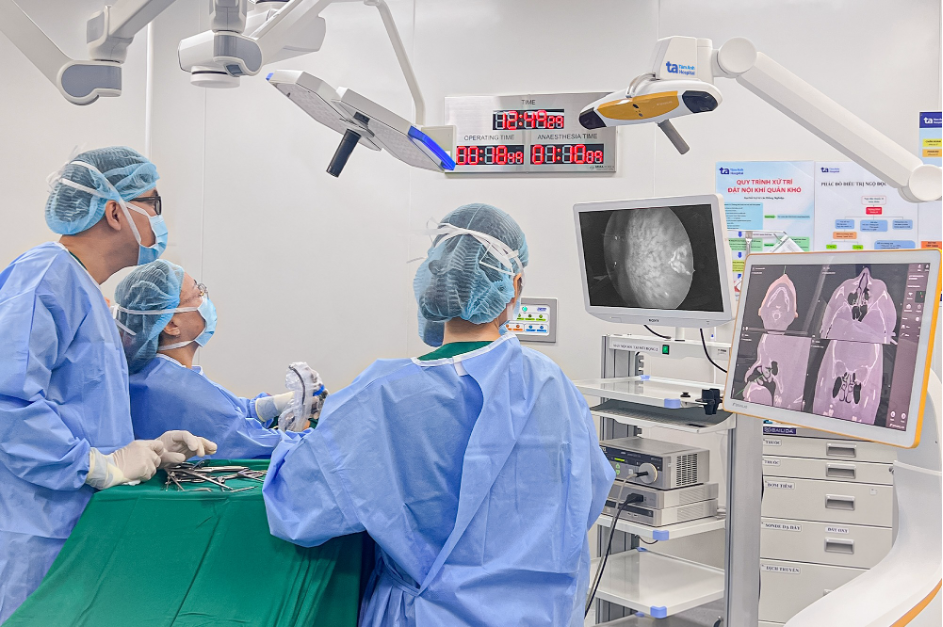 |
Professor Chung Thuy (center) and his team are performing surgery combining an AI-powered IGS navigation system and endoscopy. Photo: Tam Anh General Hospital
Nasopharyngeal cancer is a common type of cancer. According to Globocan 2022, Vietnam records approximately 5,610 new cases annually, accounting for 3.1% of all cancer cases and ranking 9th in overall cancer incidence nationwide.
The mechanism causing nasopharyngeal cancer involves three interacting factors: Epstein-Barr virus (EBV) infection, which is the leading cause; genetic factors; and environmental factors (exposure to carcinogens such as nitrosamine...).
The World Congress of Otolaryngology - Head and Neck Surgery is one of the largest conferences in the specialty, held once every four years. At this year's congress, the congress elected Professor Chung Thuy to the Executive Board of the International Federation of Otolaryngology Societies, serving as the representative for the Southeast Asia - Oceania region.
Uyen Trinh
| Readers can ask questions about ear, nose, and throat conditions here for doctors to answer. |