


Health officials in the Democratic Republic of Congo (DRC) and Uganda are working to control an Ebola outbreak, which has grown to 246 suspected cases and 88 deaths, according to The Guardian on 17/5. The disease started in Ituri province, eastern DRC, but cases have now been found in other areas of the country and in neighboring Uganda.
The World Health Organization (WHO) yesterday declared this outbreak a "public health emergency of international concern" (PHEIC), calling for robust efforts to curb the disease's spread.
The initial reason for the disease's widespread transmission was a "deadly" delay in the health alert system. The Guardian noted in mid-May that the outbreak began in late april. The first suspected case was a 59-year-old man who developed symptoms on 24/4 and died three days later. However, health officials remained unaware until receiving reports via social media on 5/5, by which time 50 people had already died.
Doctor Anne Cori, a professor of infectious disease modeling at Imperial College London, observed that the high number of cases identified upon announcement indicated the virus had been silently spreading for weeks. This delay rendered standard containment measures, such as contact tracing, completely ineffective.
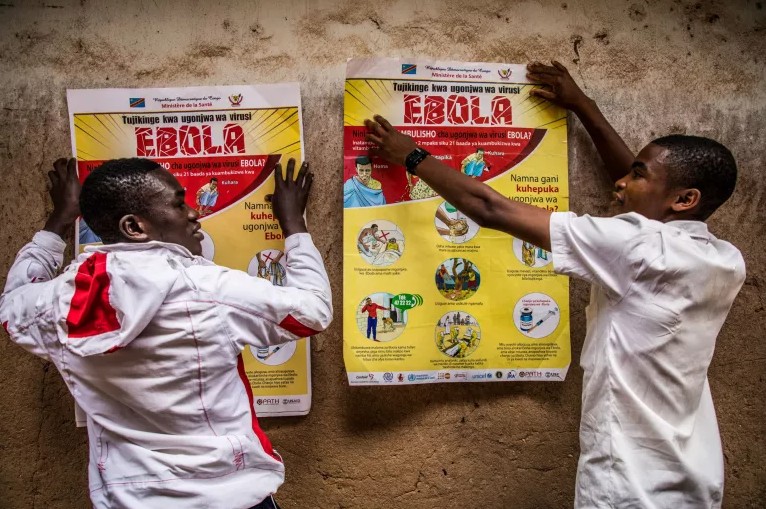 |
Students hang health education posters on Ebola prevention at a school in Butembo, Democratic Republic of Congo. *Photo: Unicef* |
A second factor escalating this outbreak to an emergency is the emergence of the rare Bundibugyo virus strain. Among the four Ebola strains that cause human disease, Bundibugyo has only appeared two times, in 2007 and 2012.
Doctor Simon Williams from Swansea University explained the outbreak's severity stems from the current Ervebo vaccine being ineffective against the Bundibugyo strain, and the absence of specific medical treatments.
Characterized by internal and external hemorrhagic fever and a fatality rate of up to 50%, this pathogen can claim anyone's life, not exclusively the elderly or immunocompromised.
The third reason, and the greatest obstacle to containment, is the local violence. In the DRC, experiencing its 17th Ebola outbreak since 1976, armed conflicts have severely hampered health efforts.
Professor Paul Hunter from the University of East Anglia stated that without a vaccine, the only control measure is isolating patients in treatment centers. However, these medical facilities frequently become targets for militia attacks. Fear of violence causes many infected individuals to refuse medical care, choosing to hide within communities and inadvertently becoming continuous sources of infection for their families.
The cumulative effect of these factors means the actual scale of the outbreak is far larger than reported figures. Originating in Ituri province in eastern DRC, the disease has spread to neighboring Uganda. Two cases involving individuals who traveled from the DRC have been confirmed, with one person dying in the capital, Kampala.
Experts warn that a high positive test rate, coupled with the virus's entry into densely populated urban areas, signals a catastrophic health risk for the entire region without timely international intervention.
Yesterday, the Ministry of Health also advised citizens not to panic about the Ebola outbreak, but urged those returning from affected areas to monitor their health for 21 days.


