Ms. Phuong's abdominal CT scan at Tam Anh General Hospital in Ho Chi Minh City revealed a significantly distended and enlarged stomach extending into the pelvis, filled with a large amount of undigested food. Doctor Nguyen Duc Nghia, from the Department of Thoracic and Vascular Surgery, stated that the superior mesenteric artery was compressing the small intestine, causing food to accumulate in the stomach. This is a typical manifestation of superior mesenteric artery syndrome.
In healthy individuals, the superior mesenteric artery and the abdominal aorta form an angle of approximately 45 degrees. A portion of the duodenum (the first part of the small intestine) passes through the origin of the superior mesenteric artery and runs between this artery and the aorta. Superior mesenteric artery syndrome occurs when this angle narrows to 6-25 degrees. This narrowing partially or completely obstructs the duodenum, leading to bloating and indigestion as food is not fully digested. Ms. Phuong had experienced bloating and indigestion for 10 years. She was diagnosed with a digestive disorder, but medication provided no relief. She suffered from appetite loss and significant weight reduction, weighing less than 40 kg.
Ms. Phuong's CT scan also revealed a narrowing of the renal vein, which carries blood to the kidney, due to nutcracker syndrome. Specifically, the renal vein was compressed between the aorta and the superior mesenteric artery, preventing blood from flowing into the inferior vena cava and causing it to reflux into other veins, leading to swelling. According to Doctor Nghia, this condition can easily cause renal vein thrombosis, kidney damage, and pulmonary embolism.
 |
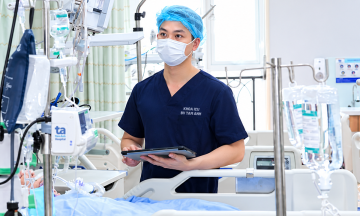
Doctor Nghia checks on the patient before discharge. Photo: Tam Anh General Hospital |
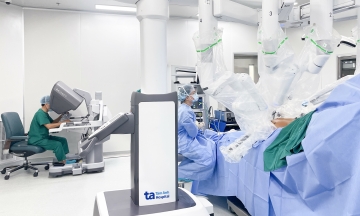
Doctor Nguyen Anh Dung, Head of Thoracic and Vascular Surgery at Tam Anh General Hospital in Ho Chi Minh City, explained that the team typically uses stent placement or bypass surgery to treat nutcracker syndrome and superior mesenteric artery syndrome. These methods alter the anatomical and physiological structures of blood vessels and the intestines. To avoid this, the patient underwent laparoscopic surgery to release the compressed structures.
Instead of resecting the compressed renal vein and attaching it to the inferior vena cava, then creating an anastomosis between the duodenum and jejunum, the team widened the space between the constricted blood vessels. After more than two hours, blood flow from the kidney to the heart was restored, and the small intestine expanded. The patient recovered quickly, experienced minimal pain, resumed normal activities and eating, and was discharged after three days.
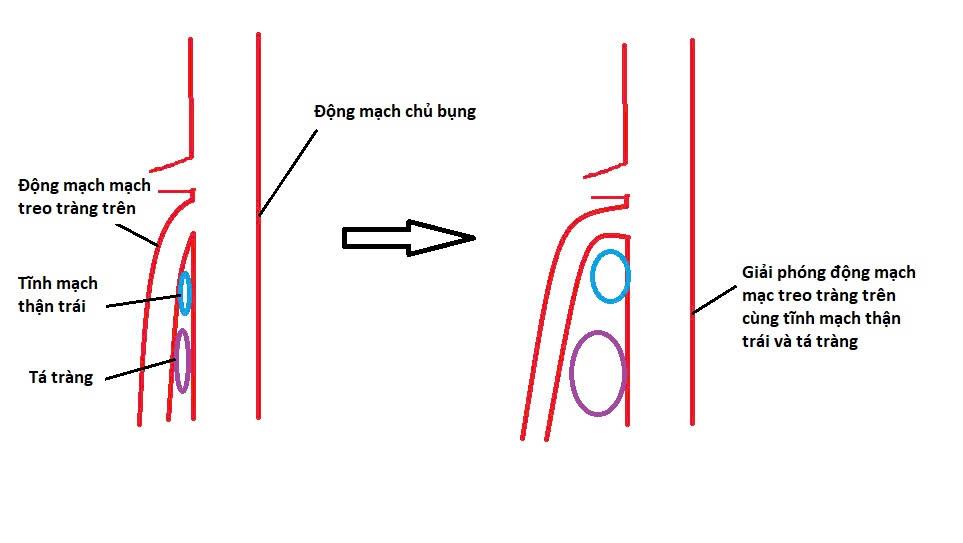 |
Illustrative image before and after laparoscopic surgery to release the superior mesenteric artery, renal vein, and duodenum. Photo: Tam Anh General Hospital |
Superior mesenteric artery syndrome and nutcracker syndrome have prevalence rates of 13/10,000 and 6/1,000, respectively. Diagnosing these two syndromes is challenging because their symptoms are easily confused with digestive diseases. According to Doctor Dung, the conditions are often only detected in late stages, after other causes have been ruled out.
In addition to congenital factors, superior mesenteric artery syndrome can be associated with a lean body type, rapid weight reduction, malabsorption, or certain anatomical abnormalities. Nutcracker syndrome is also linked to a lean body type, weight changes, and certain anatomical features; pregnancy can increase the risk due to altered blood flow and vascular structures.
Doctor Dung recommends regular screening for individuals with risk factors. Patients experiencing indigestion, bloating, epigastric pain, flank pain, appetite loss, or unintentional weight reduction should seek early medical attention.
Thu Ha
* Patient's name has been changed
| Readers can submit questions about cardiovascular diseases here for doctors to answer |