At the age of three, he showed signs of jaundice and was diagnosed with hepatitis due to cytomegalovirus (CMV) infection, a herpes-family virus capable of infecting all ages through bodily fluids such as saliva, urine, blood, and breast milk. Despite adhering to treatment, the jaundice only temporarily subsided before recurring. Throughout his 12 years of childhood, he received continuous inpatient and outpatient treatment at a pediatric hospital.
Upon reaching adulthood, the young man continued to visit leading hospitals with hepatobiliary specialists in TP HCM, receiving a diagnosis of "cholestatic hepatitis of unknown origin." From 2020, he was repeatedly hospitalized for jaundice, acute liver failure, and severe anemia, requiring multiple blood transfusions.
On 8/4, Dr. Le Huu Phuoc, Deputy Head of the Hepatitis Department at Cho Ray Hospital, stated that records indicated that during treatment at the pediatric hospital, specialists suspected the patient might have Wilson's disease, a rare genetic disorder of copper metabolism. However, at that time, all paraclinical results, such as gene analysis and blood tests, did not meet the diagnostic criteria. The biggest barrier was the patient's lack of the ATP7B gene mutation, considered the "gold standard" for diagnosis, leading all subsequent treatment directions to shift.
A turning point came in 5/2023. During treatment at the Hepatitis Department, doctors paid special attention to the detail that the patient had an elder brother and an elder sister who died at the ages of 6 and 8, respectively, from prolonged jaundice. Based on global medical literature, which notes that under 1% of Wilson's disease patients do not carry the ATP7B gene mutation, and combined with the family history, doctors boldly suspected a rare form of Wilson's disease and decided to initiate trial treatment.
Two years of follow-up showed clear improvement in abnormalities such as jaundice and anemia. During a follow-up visit on 7/4, the patient's health was stable, and he returned to normal activities. As Wilson's is a genetic condition, the patient will continue to receive lifelong monitoring, symptom control, and treatment.
 |
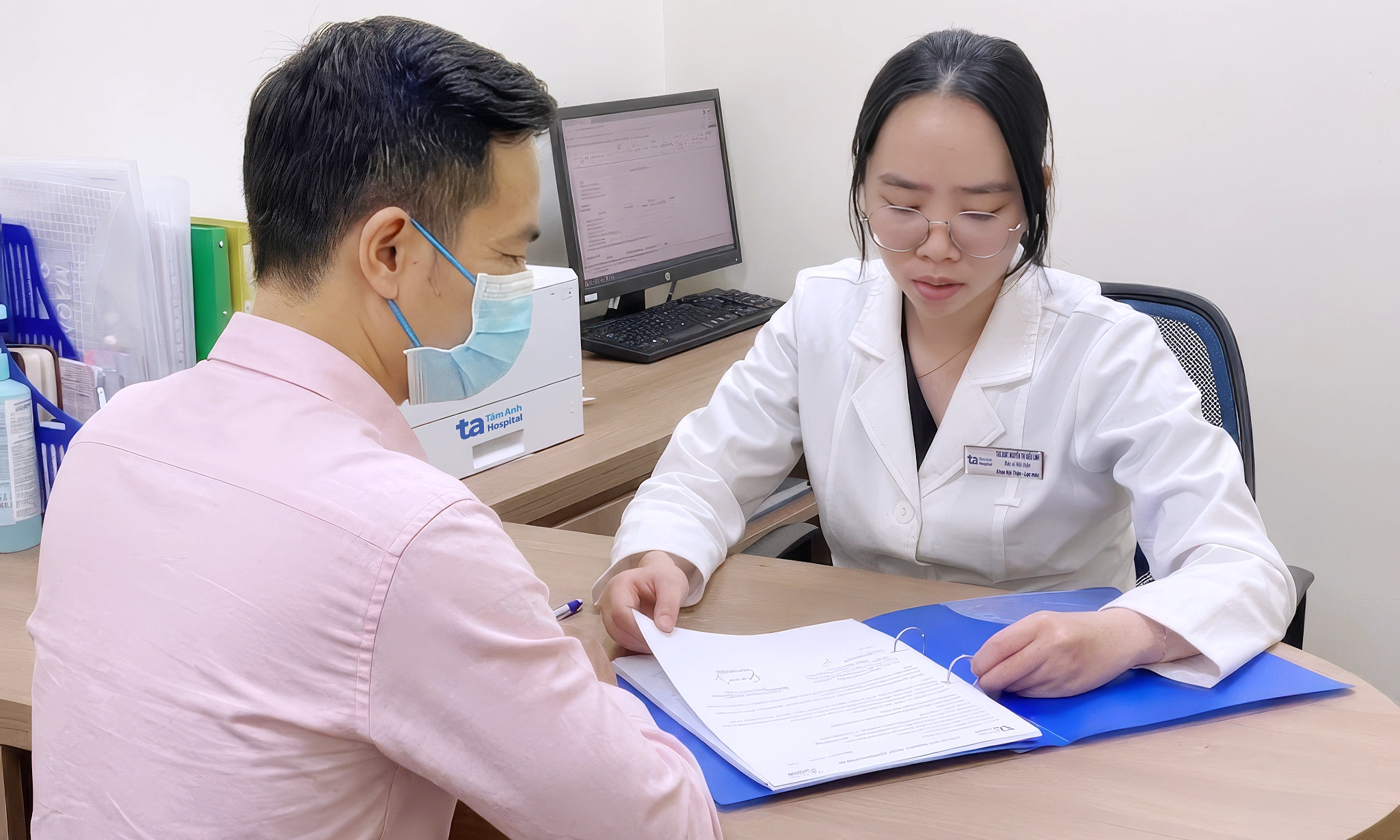
Dr. Phuoc examines and consults with the patient. *Photo: Provided by the hospital* |
Dr. Pham Thanh Viet, Deputy Director in charge of operations management at Cho Ray Hospital, commented that unwavering perseverance in challenging cases, continuously re-evaluating and connecting comprehensive information, helped find the "solution" for the disease that had been hidden for many years. This is the second case of rare Wilson's disease (without detected ATP7B gene mutation) successfully treated by the Hepatitis Department, out of over 500 Wilson's disease patients the unit has admitted in the past 10 years.
Wilson's disease, first identified in 1912, is an autosomal recessive genetic disorder caused by an ATP7B gene mutation, leading to impaired copper metabolism. If both parents carry the disease gene, there is a 25% chance of their child inheriting the disease. It is a rare and difficult-to-diagnose condition, but if detected early, treatment is straightforward and less costly. Conversely, if missed, most patients will die at a very young age.
Individuals, especially young people, should seek immediate medical attention if they experience unusual symptoms such as prolonged elevated liver enzymes, unexplained jaundice, anemia, or neurological and psychiatric symptoms of unknown origin.
Le Phuong