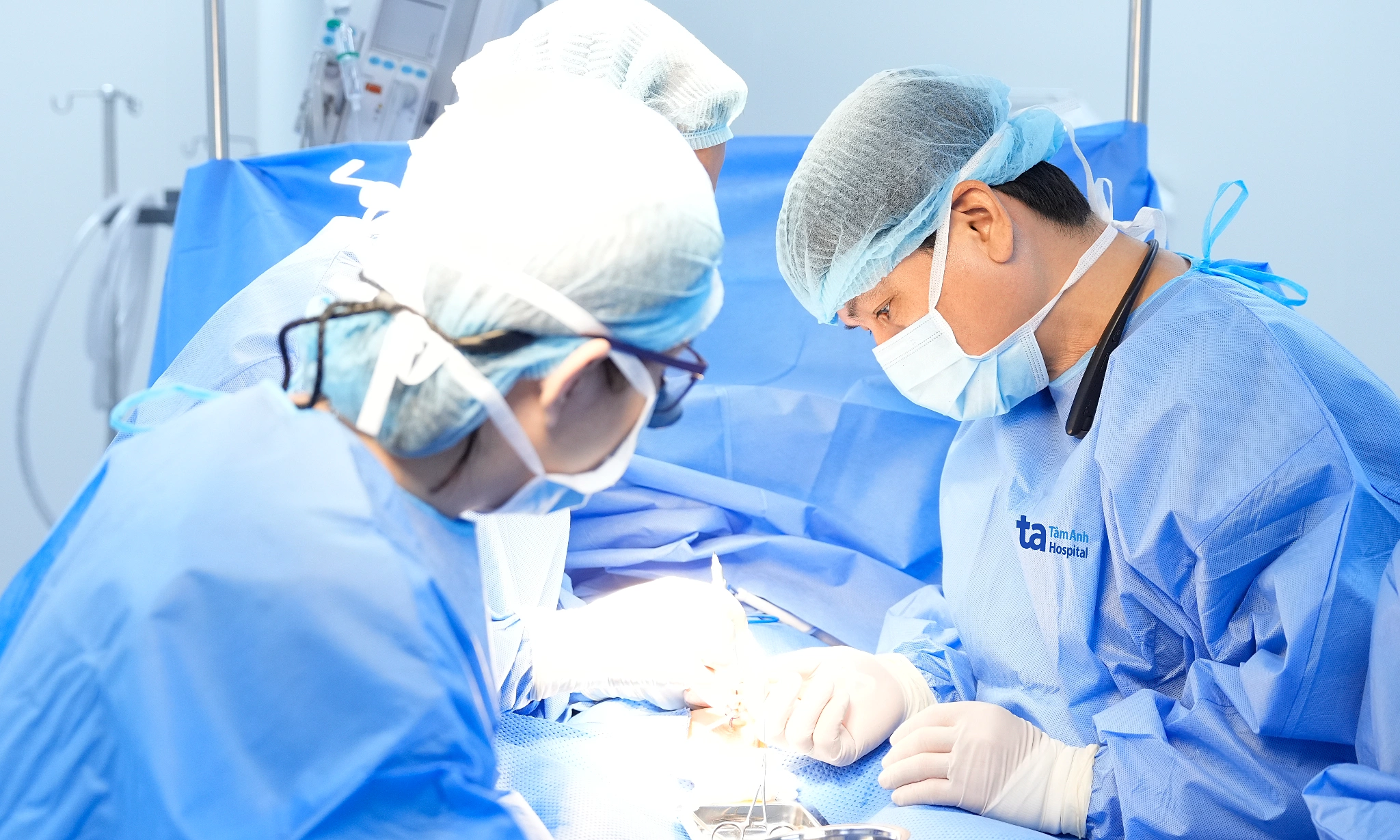
In the video frame, the young man in a wheelchair waves to viewers. Around him are boxes of peanut salt, sesame salt, cu do candy, and peanut oil. As he introduces his products, Hai shares his life story and invites customers to buy.
The livestream on 27/7 concluded with 17 orders, making it mot of his busiest days since launching his channel. Hai reads the orders for his father to note down, while his mother packs the goods. The small house in Thai Hoa village, Can Loc commune, fills with cheerful conversation.
"Today was busy; we are very happy," said Dao Sy Quan, Hai’s father.
Hai gioi thieu san pham trong mot video ban hang. Video: Dao Sy Hai
Quan and his wife have ba children, with Hai being their only son. For the past 5 years, the couple's daily routine has revolved around caring for their son, from meals and sleep to personal hygiene, in addition to assisting with livestreams and packaging orders. Every hai den ba hours, they lift him onto the bed to change his position. Before sleep, they massage his arms and legs. At night, his father wakes up hai times to turn him, preventing bedsores and joint stiffness.
"For 5 years, day and night, his parents helped him train. He also persistently practiced on his wheelchair," Quan said. The couple rarely travels far, as someone must always be home.
The turning point came in 7/2021. Hai was then a final-year student in Animal Husbandry and Veterinary Medicine at Tay Nguyen University in Dak Lak. Quan received a call reporting that his son had been in a motorcycle accident, found unconscious on his way back to his rented room. Quan asked his nephew to search for him. Hai was found lying on a bypass road on a rainy night; the driver who caused the accident had fled.
He was rushed to the provincial hospital with a prognosis of "unlikely to live." Suffering from head trauma and fractured cervical and thoracic vertebrae, he was transferred to Cho Ray Hospital, TP HCM. Amidst the Covid-19 pandemic, no family members could accompany him.
"I was worried at home, fearing my son would die, not knowing where they took him," Quan recounted.
Tran Anh Duong, 30, a university classmate, was shocked to hear the news. The university, faculty, class, a group of friends, and the company where Hai was interning all contributed funds for his surgery in Saigon. "At that time, we only hoped he would live; we didn't think he would be paralyzed," Duong said.
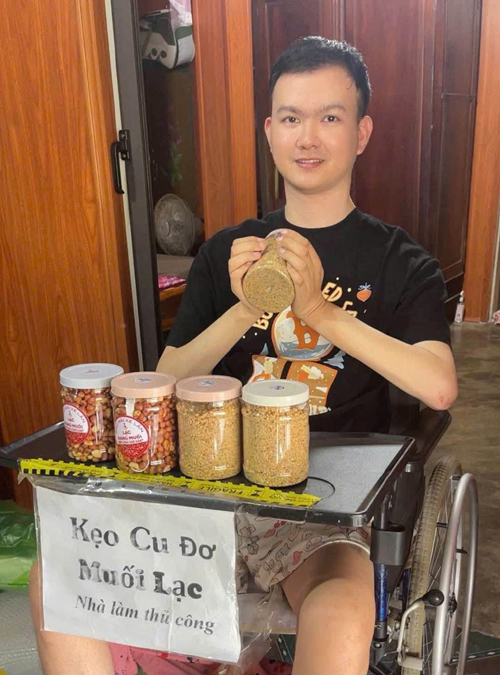 |
Hai hien ban cac san pham nhu keo cu do, muoi lac, dau dau phong. Anh: Dao Sy Hai
After the surgery, Hai was transferred to the Rehabilitation Hospital in District 8 for physical therapy. His family concealed his true condition, fearing he would become despondent. Despite persistent therapy, his limbs remained unresponsive. He pressed the doctors and learned he would likely be confined to a wheelchair for life.
"I was shocked and couldn't believe it. For several nights, I couldn't sleep because my life had completely changed," Hai said.
Six months later, he returned to Ha Tinh. His arms showed slow progress, and he had completely lost sensation from his chest down. His family took him for physical therapy at the provincial hospital, then sought examination and rehabilitation at hospitals in Ha Noi.
According to experts, sudden spinal cord injury in young adulthood causes severe psychological trauma. The abrupt loss of physical autonomy for a young person requires a process of adaptation and a complete restructuring of life.
In clinical psychology, Hai’s initial reactions—from shock, denial, and insomnia to feelings of inadequacy and self-isolation—are common among individuals experiencing sudden disability. Medical assessments record clinical depression rates in spinal cord injury patients as many times higher than in the general population, often accompanied by post-traumatic stress disorder (PTSD) stemming from both the accident and initial emergency surgeries.
Hai felt inadequate and did not want to talk to anyone, but he continued his exercises, thinking, "who knows, maybe one day I will recover." Along with his family's encouragement, the book "I Choose to Live" by Nguyen Chanh Tin, which tells the story of a quadriplegic who successfully started a business after an accident, helped him open up.
"I was determined to change my destiny," Hai stated.
In 2022, he began selling online. For the first six months, due to his inexperience in communication, he was lucky to get just mot den hai orders a day. Frustrated, he took a break for mot month, watched livestreams by celebrities and others in similar situations to learn, and then restarted. He livestreamed 6 hours daily. It took until the fifth day to receive his first order.
"That order was from Duong. I was a bit shy but happy to reconnect with a friend," Hai recalled.
Subsequently, university friends began watching and buying to support him. He learned to follow trends to create content, actively converse, inquire, and send well wishes to viewers. His customer base gradually expanded nationwide, no longer limited to acquaintances. On average, he secures 9-10 orders daily.
Ngoai duoc bo me ho tro, Hai cung kien tri tu tap luyen hang ngay tren xe lan. Video: Dao Sy Hai
The most challenging task is replying to messages. His fingers type slowly, so he uses voice messaging software and prepares pre-written responses for recurring questions.
Since he started selling, he no longer has time for sadness. His farming parents have additional work, and the family earns 6-7 million VND each month, enough for Hai to cover his medical expenses and buy supplements.
He plans to expand his range of local specialties and continue studying to increase sales, while also maintaining daily arm and leg exercises. "I am grateful to my parents and myself for our continuous efforts. I cherish life and want to work to show filial piety to my parents," Hai said.
Quan watches his son livestream with confidence, no longer hesitant to meet people. "Hai is happy, and his parents are happy too," he shared.
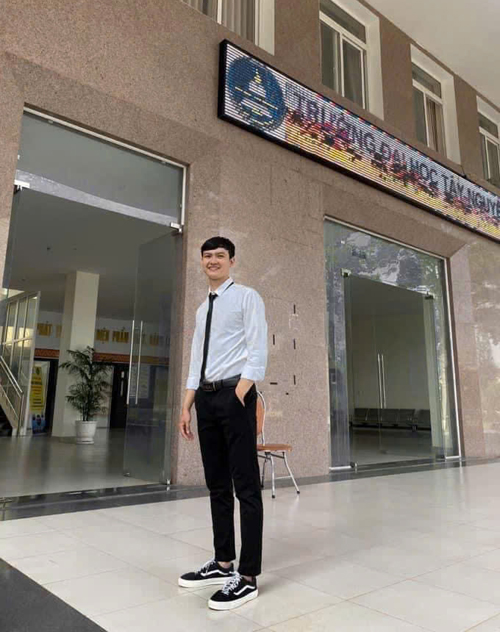 |
Hai khi con la sinh vien truong Dai hoc Tay Nguyen. Anh: Dao Sy Hai
Binh Minh