During the process of handling the appeals, Ms. Nguyen Ngoc Anh, the mother of late actor Duc Tien, repeatedly petitioned the court to authenticate her son's signature on a will dated 9/8/2023, which was made in the US and bequeathed his entire estate to his wife, Nguyen Binh Phuong (Dallas Ao Dai Queen Binh Phuong).
Additionally, Ms. Anh requested the court to re-evaluate two disputed properties: a house and land in Hiep Binh ward, Ho Chi Minh City, and a parcel of land in Tay Ninh (formerly Long An). She argued that a re-evaluation was necessary to accurately determine the asset values, as changes in legal policy and market fluctuations rendered the valuations from the first-instance appraisal certificate outdated.
In May 2024, Duc Tien passed away at age 44 in the US. His wife subsequently presented a will stating that he left all his assets to her. Ms. Anh, Duc Tien's mother, deemed the will "illegal," leading to a dispute between the parties. Unable to reach an agreement, Binh Phuong filed a lawsuit last March to request an inheritance division.
On 28/10, the Ho Chi Minh City People's Court held the first-instance trial, affirming the will made in the US as legal and duly consularized. Duc Tien's estate included a house and land in Linh Dong ward, Thu Duc City (now Hiep Binh ward), valued at 6,2 billion VND, and a parcel of land in Long An (now Tay Ninh), valued at approximately one billion VND.
During the lawsuit and at the first-instance court, Ms. Anh requested the trial panel not to recognize the will made in the US (bequeathing all assets to Duc Tien's wife) as legal in Vietnam. She argued that the house in Thu Duc was joint property between her and her son, proposing an equal division with her receiving the house as an in-kind asset. Regarding the land parcel in Long An, she asserted it was Duc Tien's separate property and requested it be equally divided by law among herself, her daughter-in-law, and her grandchild.
The court did not accept Binh Phuong's argument that all assets were acquired during the marriage, as the house was purchased before marriage and 70% of the land parcel was paid for before the marriage registration. As the legal guardian of her daughter, Binh Phuong was entitled to and managed over 70% of the total estate value; the court assigned her to receive the in-kind assets and reimburse Ms. Anh a corresponding amount.
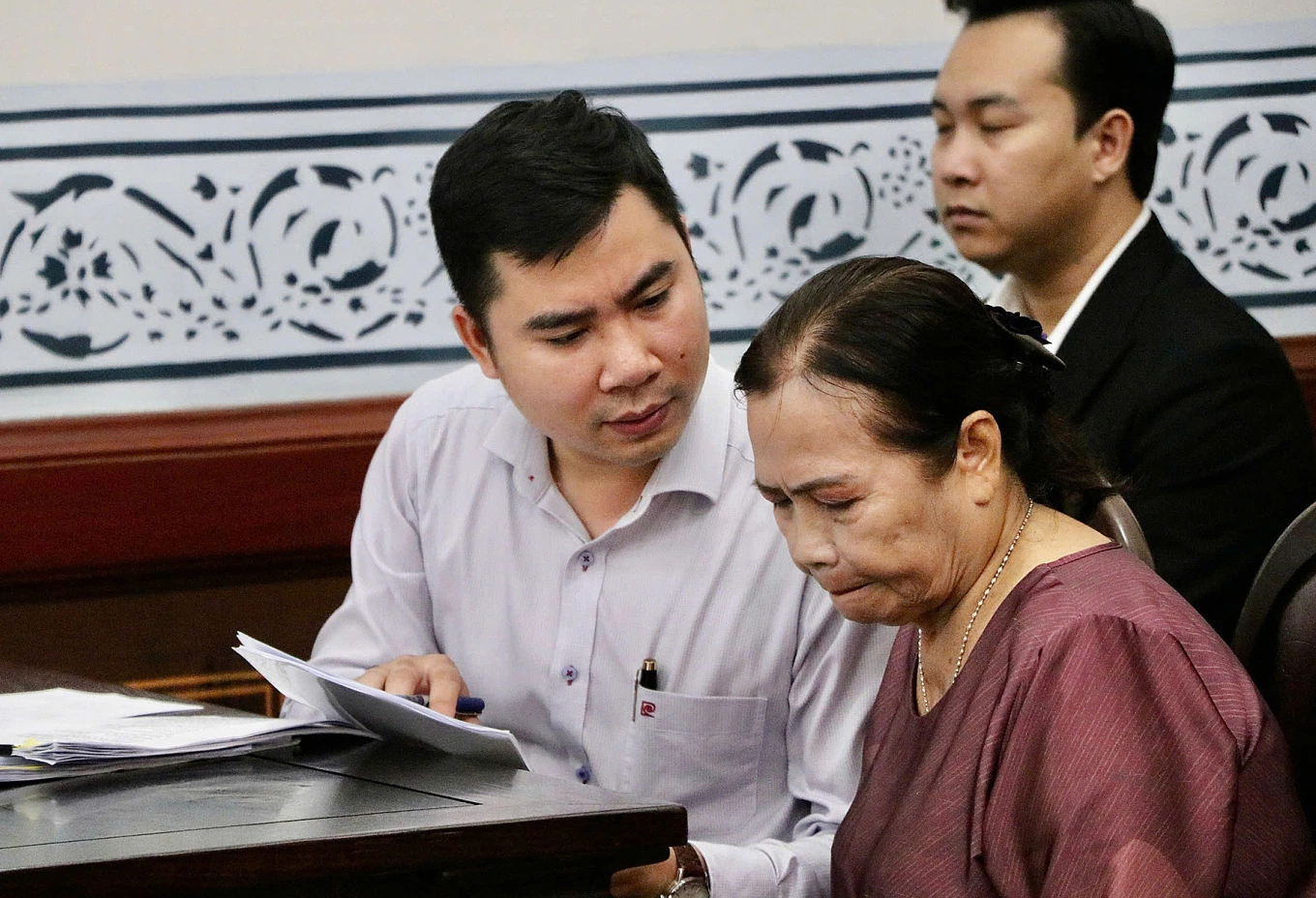 |
Ms. Nguyen Ngoc Anh and her representative at last year's first-instance trial. |
Following the first-instance court's ruling, Binh Phuong appealed part of the judgment. She requested the appellate court to review and recognize her ownership of 50% of the value of the house and land in Hiep Binh ward (formerly Linh Dong ward, Thu Duc City) and a parcel of land in Long An, now Tay Ninh province.
Furthermore, Binh Phuong disagreed with Ms. Anh receiving 10% of the value of the house and land in Hiep Binh ward, arguing that Ms. Anh "did not contribute financially" to the formation of these assets. Article 33 of the Law on Marriage and Family 2014 stipulates that assets acquired during marriage are joint property of spouses, unless proven to be separate property.
Binh Phuong also objected to the first-instance court's assertion that Ms. Anh "contributed to managing and improving the assets," stating that her caretaking of the house was a temporary arrangement and did not increase the asset's value. The plaintiff requested the court to determine Duc Tien's estate as the remaining assets after deducting reasonable medical and funeral expenses incurred in the US.
Ms. Anh, on the other hand, appealed the entire first-instance judgment, contending that the court had not fully evaluated all evidence in the dossier. She claimed errors in legal application led to a non-objective ruling that failed to secure her legitimate rights and interests. She requested the appellate court to amend the judgment to accept all her counterclaims, granting her ownership of the house her son left behind.
Binh Nguyen