The Hanoi People's Court is scheduled to hear the appeal in the case of "Abuse of position and power while performing official duties" involving former Ba Dinh Secondary School principal Nguyen Thi Binh and former accountant Pham Minh Nguyet. The appellate hearing is set for two days, on 26-27/8.
The judicial panel has summoned many witnesses, individuals with related rights and obligations, and several teachers from the school. Eight lawyers from six law firms have registered to defend Binh, six more than during the initial trial.
At the first-instance trial five months ago, Binh's violations were identified as revolving around the collection of tutoring fees exceeding the maximum limit stipulated in Decision 22/2013 by the Hanoi People's Committee. This decision was a key basis for prosecuting the defendant. According to this regulation, classes with 20-40 students could only collect a maximum of 7,000-9,000 VND per lesson. However, the defendant instructed teachers to collect 15,000 VND. Of the collected amount, 70% was paid to the teachers directly involved in teaching, and 30% was used for administration and facilities.
| Number of students/class | Maximum fee per student/lesson |
| 1-9 | 26.000 VND |
| 10-19 | 13.000 VND |
| 20-29 | 9.000 VND |
| 30-39 | 7.000 VND |
| 40 tro len | 6.000 VND |
| *Fees according to Decision 22/2013 by the Hanoi People's Committee | |
At the first-instance trial in March, defendant Binh argued that the fee collection was carried out after an agreement with parents, aligning with Circular 17/2012 of the Ministry of Education and Training. Specifically, Article 7 states: "The amount of tutoring fees shall be agreed upon between parents and the school." The circular authorized provincial-level People's Committees (in this case, the Hanoi People's Committee) to regulate "collection, management, and use", but not to impose a maximum fee as shown in the table above.
Binh's lawyers asserted that, legally, if two legal normative documents have different provisions on the same issue, the document with higher legal validity applies, according to the Law on Promulgation of Legal Normative Documents. In this instance, it is the circular from the Ministry of Education and Training. Therefore, Principal Binh's agreement on tuition fees with parents was in accordance with Circular 17 – a legal document with higher validity than Decision 22 of the Hanoi People's Committee. The lawyers argued that the indictment's use of a lower-level document (Decision 22) to prosecute their client violated the principle of legal application.
In response, the Procuracy maintained its prosecution stance, recommending a sentence of four to five years in prison. The court found Binh guilty as charged, determining that her material gain was negligible, approximately 72 million VND, but that she gained "immaterial benefit" by enhancing personal prestige through increasing teachers' income. Following the first-instance trial, Binh appealed the entire verdict and sent a petition to the Ministry of Justice, requesting a review of the legality of Decision 22/2013 by the Hanoi People's Committee.
Decision 22/2013 entirely revoked
Over a month later, on 4/5, the Department of Document Inspection and Law Enforcement, Ministry of Justice, issued a conclusion on the matter. The Department cited Circular 17 of the Ministry of Education and Training, which states that tutoring fees are determined by agreement between parents and the school. "This circular does not stipulate or delegate authority to local governments to set maximum tutoring fees", the Ministry of Justice's conclusion stated. Therefore, Hanoi's Decision 22 imposing a "price ceiling" was deemed inappropriate.
After Decision 22, the Hanoi Department of Education and Training continued to issue guiding documents with similar maximum fee regulations. According to the Ministry of Justice, these regulations were issued "improperly in form and authority". The Ministry of Justice also stated that, under current regulations, schools are not permitted to collect fees from students for additional classes; funding must come from the state budget or other legal sources. Consequently, the regulation imposing a maximum fee in Decision 22 and the guiding document from the Hanoi Department of Education and Training are no longer appropriate.
The agency recommended that the Hanoi People's Committee and Department of Education and Training "urgently address" the illegal content and consider the responsibility of the collectives and individuals who advised on and issued the documents. One day after the Ministry of Justice's conclusion, on 5/5, the Hanoi People's Committee issued a decision to revoke Decision 22/2013 entirely, effective from the date of signing.
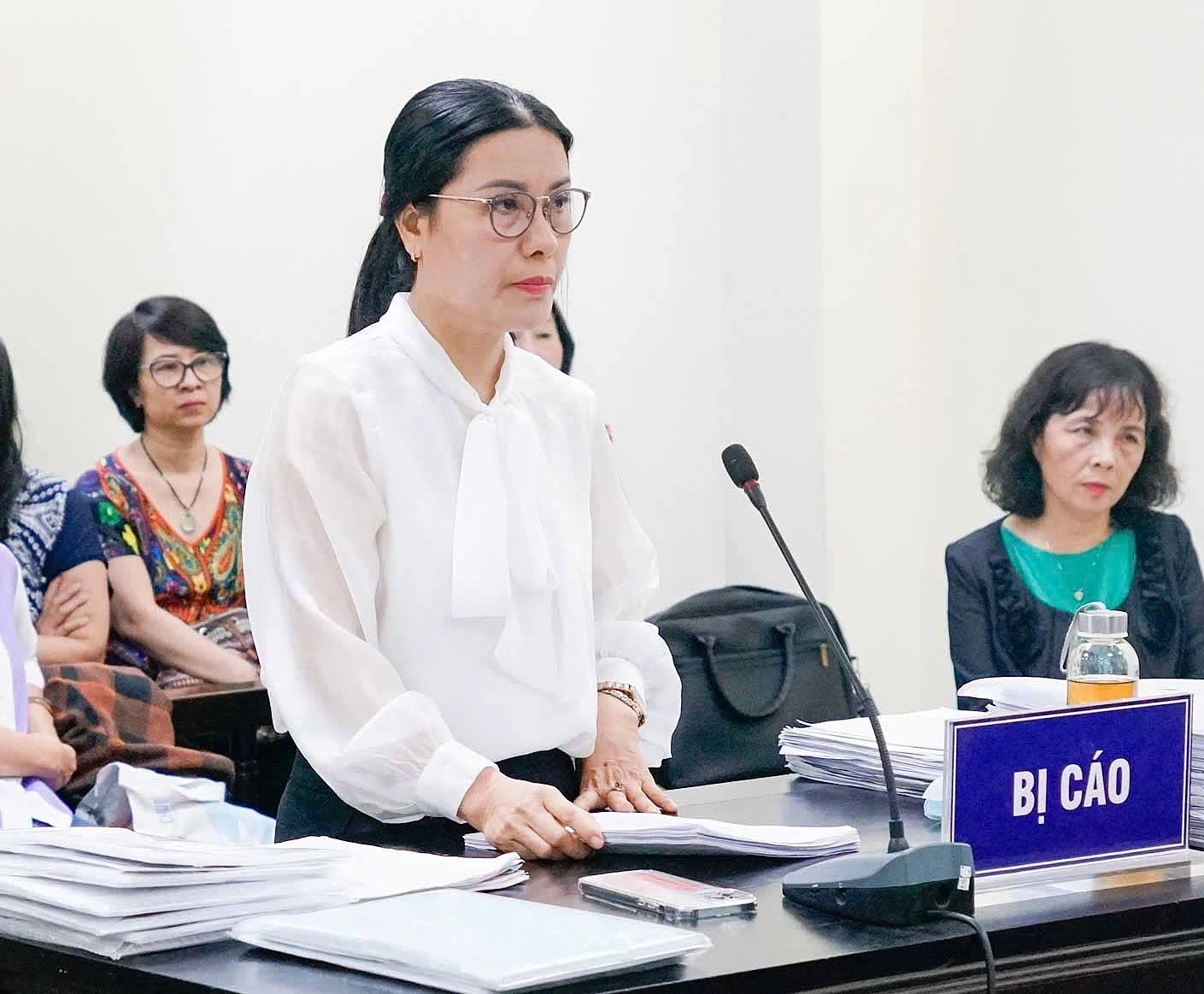 |
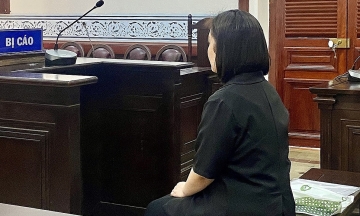
Nguyen Thi Binh, former principal of Ba Dinh Secondary School, during the first-instance trial in March. *Photo: Danh Lam* |
In her appeal against the entire verdict, Binh argued that the first-instance court's reasoning was "extremely unreasonable and harsh" in determining "immaterial benefit gained by enhancing prestige through increasing teachers' income". According to the former principal, a school head's responsibility is to care for teachers' livelihoods, creating motivation for teaching to improve students' learning quality. Fairly increasing teachers' income through their labor should not be considered an act of self-enrichment to constitute a crime.
Thanh Lam