On 29/4, after directly observing the electronic court model at People's Court Area 1, President of the Supreme People's Court Nguyen Van Quang announced plans to pilot and expand this approach synchronously in many locations. The initiative aims to digitize data, enhance transparency, and streamline procedures for citizens.
**Closed-loop operation, fully digital case processing**
During the meeting, President of People's Court Area 1 Nguyen Quang Huynh explained that the model comprises two parts: an internal management system and a portal for citizens.
Internally, all official dispatches and case files are digitized from the outset and transferred to the president's account. From there, cases are assigned to judges either randomly or by designation for specialized matters.
Judges can access full case files and documents simply by logging in, even before receiving physical copies. Data is entered once and standardized with information such as citizen identification numbers and contact phone numbers.
Each case file has a unique code for judges and clerks to process, displaying only essential information and limiting the exposure of irrelevant data.
The system also accurately compiles statistics and categorizes cases. Resolution progress is updated in real time, allowing the president to monitor directly without waiting for paper reports as before.
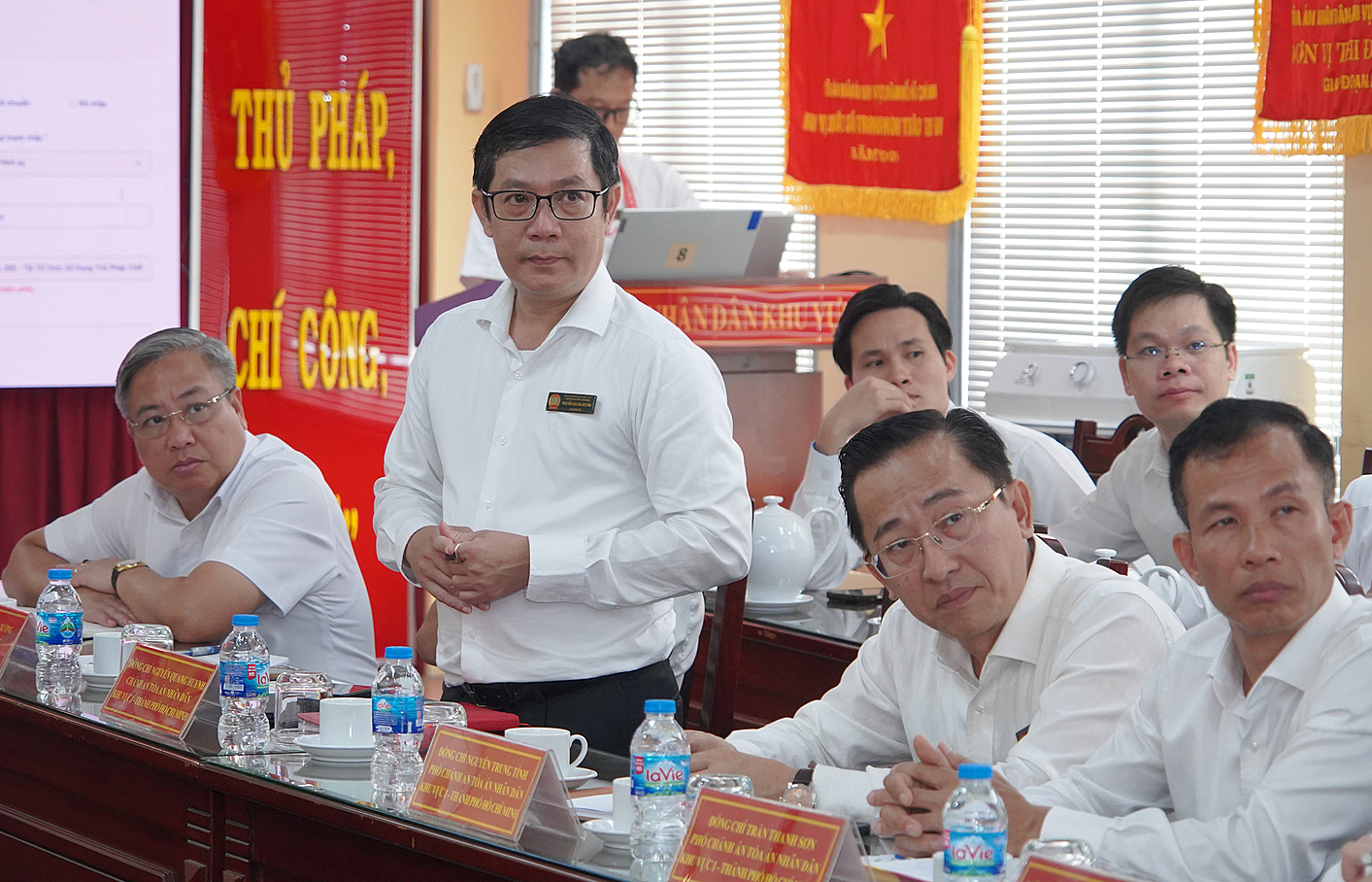 |
President of People's Court Area 1 Nguyen Quang Huynh reports on the electronic court model in use. *Photo: Quang Trung* |
According to Mr. Huynh, the software is built in a modular format, allowing flexible updates and feature expansion without replacing the entire system if the sector implements a new platform later.
The unit has digitized nearly all case files to establish a database. With digital signatures, the system can add online document drafting and signing functions. Currently, only the stamping process cannot be performed digitally.
The software is designed to closely follow judicial administrative procedures, enabling judges and clerks to process cases from input to output on a single platform.
**President commissions software to integrate appellate case management**
Acknowledging the efforts of People's Court Area 1, Mr. Quang praised the unit's proactive self-research and software development despite lacking initial funding or directives.
Based on this model, he requested that Ho Chi Minh City implement it synchronously across all people's court areas, considering it a key region as it accounts for approximately 1/4 of the nation's caseload. Implementation requires a specific roadmap, periodic reports, and widespread pilot programs.
"Only through actual implementation can we verify data synchronization," he stated, adding that the adoption of the model would be decided after an effectiveness assessment.
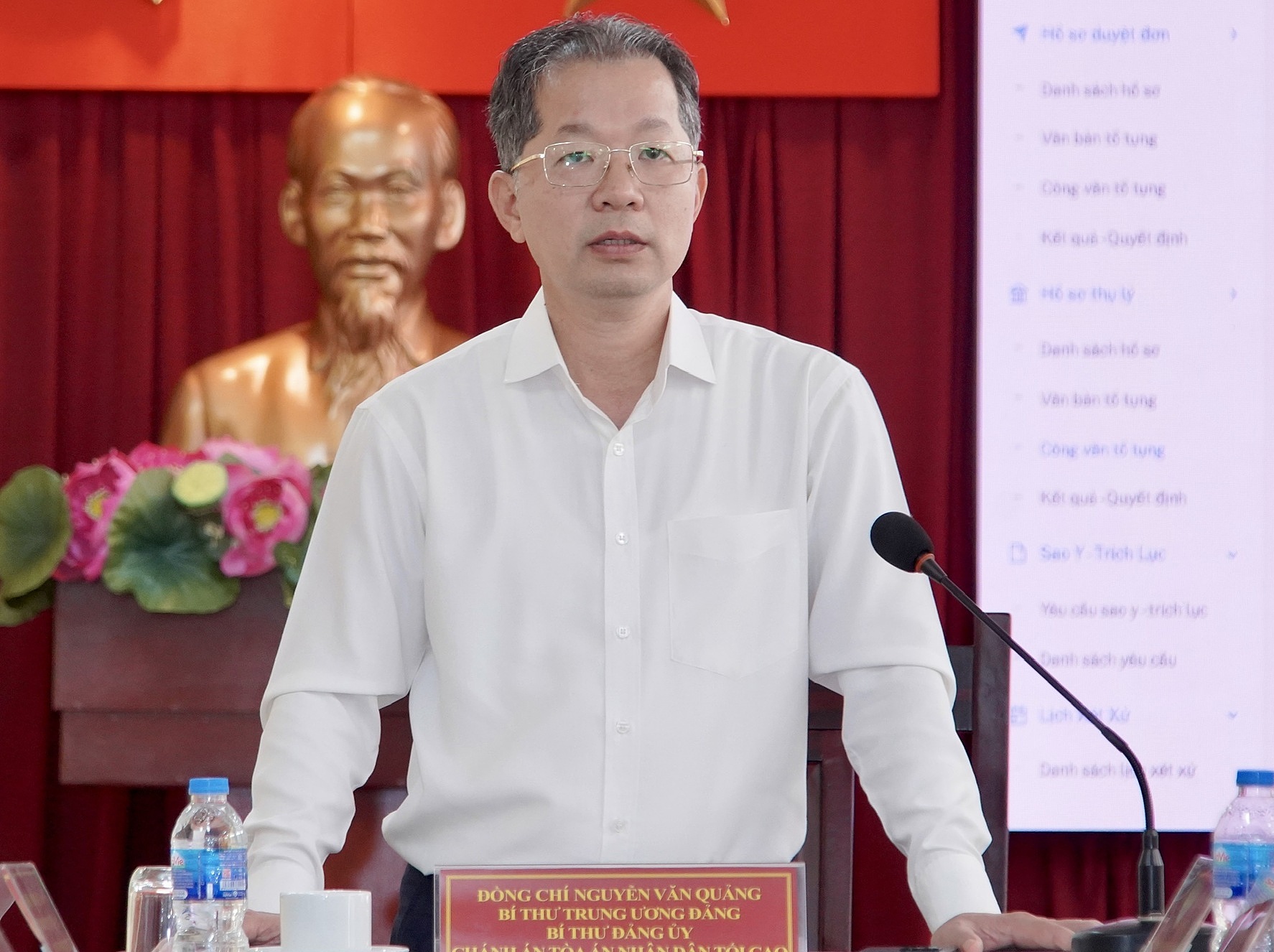 |
President of the Supreme People's Court Nguyen Van Quang speaks during the meeting at People's Court Area 1. *Photo: Quang Trung* |
Evaluating the model, President of the Supreme People's Court Nguyen Van Quang observed that the software is currently suitable for the first instance stage. He proposed that People's Court Area 1 continue to refine it, integrating additional procedures for appellate, cassation, and retrial processes.
"If these steps are completed, the Supreme People's Court will consider adopting the model," he said.
According to Mr. Quang, the software must address judicial administrative procedures while reducing time and costs for citizens and increasing transparency. The system needs to allow citizens to clearly know processing deadlines, case status, and whether relevant digitized documents have been made public.
**Ho Chi Minh City People's Court identifies implementation challenges**
Participating in the meeting, new President of the Ho Chi Minh City People's Court Pham Quoc Hung stated that the complete digitization of court data in Ho Chi Minh City is an inevitable trend, enabling work processing independent of time and space.
However, according to Mr. Hung, the current software is not connected to the Supreme People's Court's Court Management System (QLTA), forcing units to operate two platforms simultaneously. Therefore, coordination between the areas and the Supreme People's Court's Information Technology Department is necessary to leverage existing data fields from QLTA.
To expand the model, resources for personnel and finance must be considered, along with updating new legal conditions, such as applying digital signatures in the software to shorten case resolution times.
In the coming period, the Ho Chi Minh City People's Court will prioritize data digitization and propose city support for the effective implementation of the electronic court model.
Previously, under Mr. Quang's direction, the Da Nang City People's Court and its subordinate people's court areas received a pilot transfer of this model from People's Court Area 1. Currently, the model has also been implemented at two-tier people's courts in many provinces and cities and dozens of people's court areas nationwide.
People's Court Area 1 is the first unit nationwide to apply an electronic court system for internal management, considered a breakthrough in judicial reform and digital transformation within the court sector.
The entire process, from case reception to conclusion, is carried out on integrated software with multiple applications, operating as a closed "electronic ledger" storing all court data.
This model was implemented at the beginning of the year at People's Court District 1, then further integrated when the former District 1, 3, and 4 courts merged.
By Hai Duyen