Hanoi City Police announced on 15/12 that an additional charge of tax evasion has been filed against Nguyen Hoa Binh, widely known as Shark Binh, and Nguyen Huu Tuat. Do Cong Dien, Chairman of the Board of Directors cum General Director of Vimo Technology Joint Stock Company, faces the same charge.
According to Colonel Nguyen Duc Long, Deputy Director of Hanoi City Police, an expanded investigation revealed that in 2024, Vimo Technology Joint Stock Company, with Dien as its legal representative, had three shareholders: Dien, Binh, and Tuat. The company operates as a payment intermediary, collecting and disbursing funds on behalf of others through POS machine services, for which it charges fees.
Due to Vimo's substantial revenue, Shark Binh's group reportedly devised a plan to conceal actual earnings and reduce their tax obligations. Binh allegedly instructed Dien and Tuat to keep transactions off the books and declare reduced revenue for February, March, and April of 2024. Police accuse the three individuals of evading nearly 30 billion dong in taxes.
Beyond the tax evasion, police allege Binh withdrew funds from 30,000 investor wallets, misappropriating approximately 117 billion dong. He is also accused of violating accounting regulations, causing a loss of 44.8 billion dong to the State Budget.
Authorities have seized, temporarily frozen, and blocked assets including money, gold, and land use rights certificates belonging to involved individuals, totaling approximately 900 billion dong. Police are urging all relevant parties to come forward and cooperate with the investigation to clarify the entire case.
 |
Colonel Nguyen Duc Long, Deputy Director of Hanoi Police, at the press conference. Photo: Pham Du |
Previously, Nguyen Hoa Binh, Chairman of the Board of Directors of NextTech Group, was arrested and detained by the Hanoi City Police Investigation Agency on charges of fraudulent appropriation of assets and violating accounting regulations causing serious consequences.
Nine other individuals have also been charged in connection with the case: Dao Minh Phu (former CEO of NextTech Group), Nguyen Huu Tuat (General Director of NextPay), Mai Thanh Ha, Nguyen Trung Hieu, Le Van Luong, Doan Van Tuan, Nguyen Thi Thanh Huong (CFO of NextTech Group), Tran Thi Thanh Van, and Nguyen Hoang Thin.
Police accuse Binh and several associates of contributing 7 billion dong to develop the AntEx digital currency project. The group's stated goal was to sell AntEx tokens and encourage investors to buy them to raise capital for the future development of the VNDT digital currency project and VNDT e-wallet software.
However, the group allegedly issued and sold 100 billion AntEx tokens to the market before the VNDT digital currency project was fully developed. From August 2021 to November 2021 alone, they issued and sold 33.2 billion tokens to approximately 30,000 investors across various exchanges.
Through these sales, the group accumulated 4.5 million USDT (equivalent to 4.5 million USD, or about 117 billion dong) in e-wallets on the exchanges. Police determined that Shark Binh and his founding associates subsequently withdrew these funds from the 30,000 investor wallets, misappropriating approximately 117 billion dong.
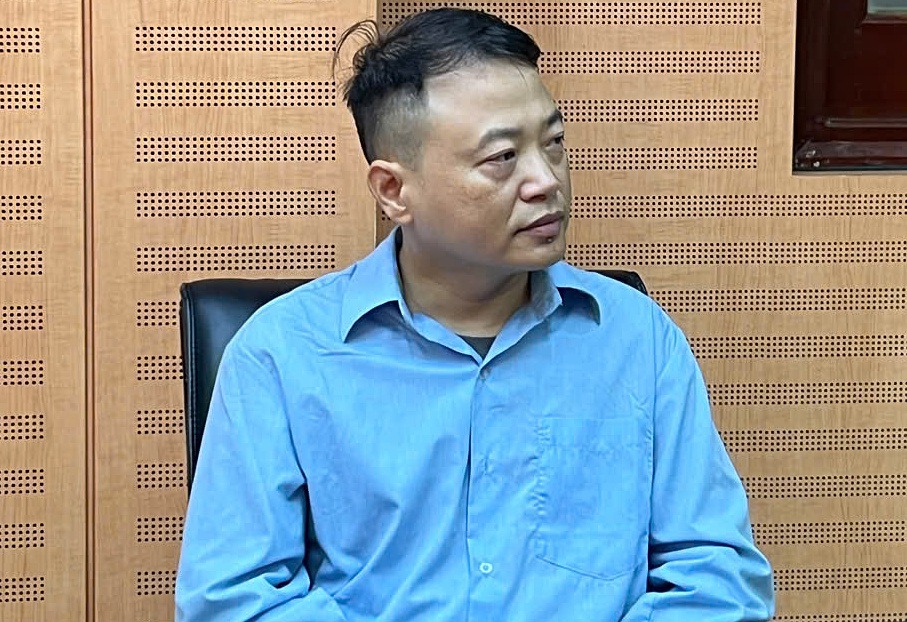 |
Shark Binh at the investigation agency. Photo: Linh Dan |
Binh, 44, gained public recognition through his nickname "Shark Binh" as a participant in "Shark Tank Vietnam". He is known as a "technology shark" and has invested in dozens of startups primarily in e-commerce, fintech, and media.
Beyond his professional life, Shark Binh's personal life also attracted attention following his second marriage to an actress.
NextTech Group operates across four main business segments: fintech (Ngan Luong, mPOS, VIMO); e-commerce and logistics (Boxme, NextSmartShip); O2O services and platforms, notably FastGo, a ride-hailing app that competed during Grab's expansion; and a domestic investment fund supporting nascent technology businesses.
By 2020, NextTech had expanded into 7 countries, owned over 20 member companies, and was dubbed the "mini-Alibaba of Vietnam," establishing itself as one of the largest private technology groups in Southeast Asia.
Pham Du