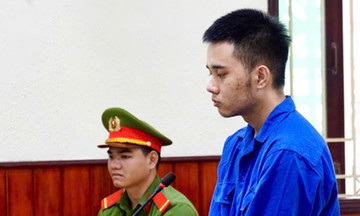
On 25/11, Pham Thi Phuong, 26, from Thanh Hoa province, was sentenced by the Hanoi People's Court to 14 years in prison for property fraud.
The indictment stated that from February 2023 to May 2024, Phuong, unemployed, conceived a fraud scheme. She falsely claimed to facilitate in vitro fertilization (IVF) procedures to defraud three infertile couples from Nghe An, Lam Dong, and An Giang provinces of a total of 1,83 billion dong.
The first incident occurred in February 2023 when Phuong joined Facebook groups to find prospective clients and connected with a 39-year-old couple from Nghe An. She also found two additional women online, agreeing to pay them 300-320 million dong each after childbirth if they donated eggs and served as surrogates.
Phuong quoted the infertile couple 800-860 million dong, depending on whether it was a single or twin pregnancy. Full payment was due one week after the couple received the child. The two surrogate candidates, Thao and Thuong, were brought to a cafe for the couple to approve, with the option to replace them if the "client" was not satisfied.
Phuong proposed creating a first profile for Thao to undergo examinations, donate eggs, and use the husband's sperm for conception. A second profile would be under Thuong's name at a different clinic. This second profile required a fake marriage certificate between the surrogate and the husband to meet administrative requirements at the hospital.
Phuong then accompanied Thao, Thuong, and the couple to two clinics to complete the procedures. During this process, the couple transferred a total of 400 million dong to Phuong.
According to authorities' accusations, doctors informed Phuong that Thao was not healthy enough for IVF pregnancy, but Phuong did not relay this to the "client." Instead, she continued her deception to extort more money.
Phuong found images of two-line pregnancy tests online and sent them to the couple, claiming the surrogate was pregnant with twins, a boy and a girl. She also hired someone to create fake documents, including false ultrasound images and prescriptions for pregnant women, leading to an additional transfer of 250 million dong.
Meanwhile, the other surrogate secretly underwent multiple embryo implantations as instructed by Phuong, spending over 240 million dong, but all attempts were unsuccessful.
In September of the same year, Phuong falsely claimed that Thao had a missed miscarriage and developmental delays, leading to an abortion. When the couple requested a confirmation video, Phuong cited various excuses for not providing it and asked to find another surrogate to restart the process.
The victims disagreed and demanded their money back, but Phuong claimed she had spent it all, leading them to file a complaint.
Using similar tactics, Phuong defrauded two more couples. In these cases, despite the surrogates having health issues, being unfit for pregnancy, or failing to conceive, Phuong never informed the infertile couples. Instead, she concealed the truth with fake images and documents showing pregnancy to demand further payments.
The women hired by Phuong as surrogates stated that they only received several million dong for travel and food expenses. They did not benefit from Phuong's fraudulent earnings and were unaware that Phuong was using false information to extort money, hence they were not prosecuted.
Regarding Phuong's act of hiring unknown individuals online to forge documents such as fake marriage certificates and ultrasound reports, investigators could not obtain the original copies for examination. Therefore, there was insufficient basis to prosecute Phuong for using false seals or documents of agencies or organizations.
Hai Thu