At 17:30 on 2/4, Emma finished work and quickly drove from Tay Ho ward to a Vietnamese communication class on Hoang Quoc Viet street, Cau Giay ward.
This was the 25-year-old preschool teacher's first class after three months of living in Hanoi. In a small room borrowed from a familiar cafe, Emma and five other students from Russia, Germany, and the UK began their lesson on greetings, self-introductions, and bargaining skills for shopping at the market.
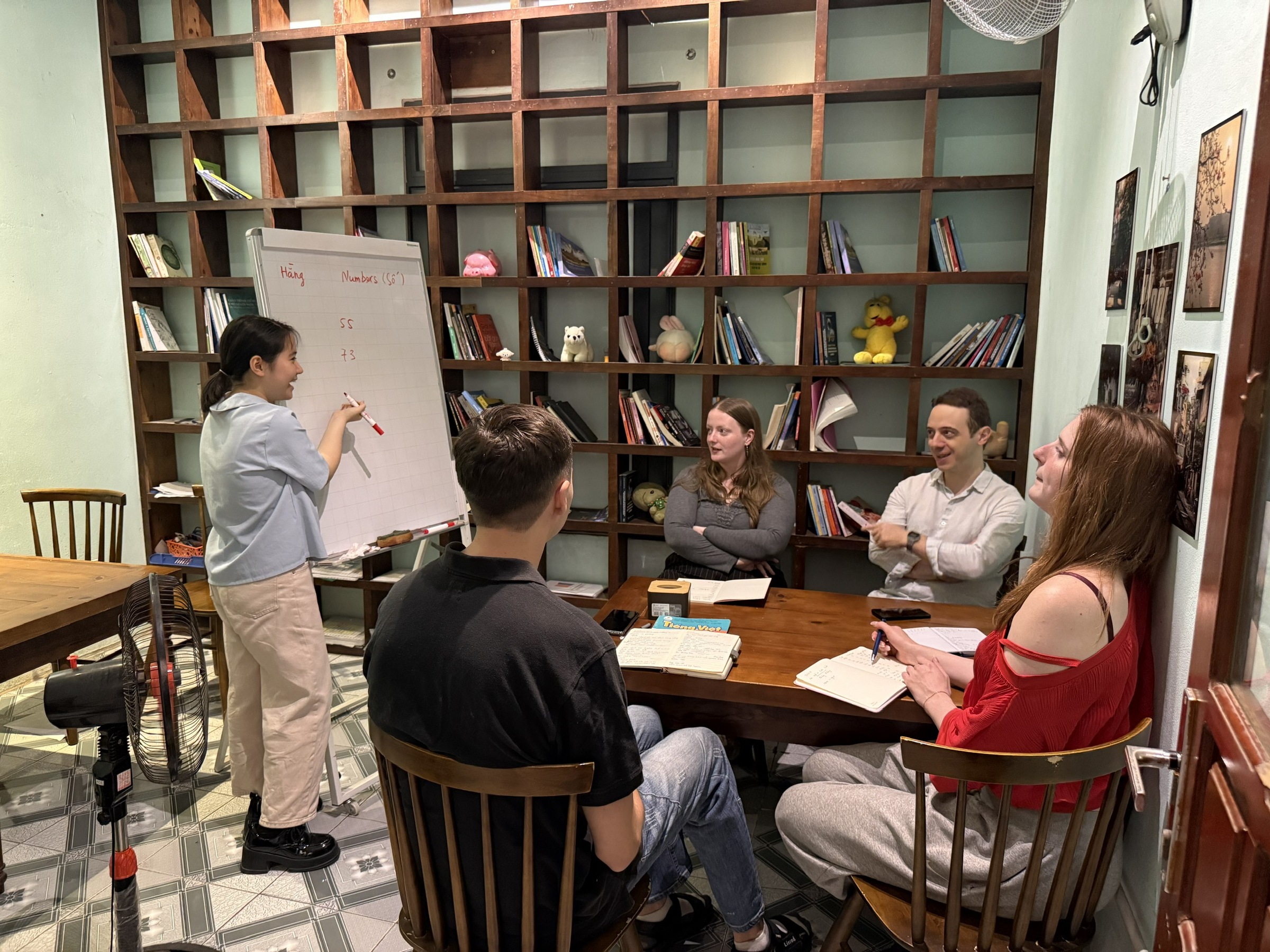 |
A class on daily Vietnamese communication and behavior for foreigners, evening of 2/4. Photo: Nga Thanh
Arriving in Vietnam with no Vietnamese language skills, Emma was initially confused about how to cross streets amidst heavy traffic. She was also surprised to see colleagues napping right in the office.
"In class, I learned that Vietnamese people take afternoon naps to recharge their energy. I was also instructed on how to raise my hand to signal for traffic to yield", she recounted. By the end of the session, Emma quietly practiced the phrase: "This is too expensive, please reduce the price a little", carefully noting it in her notebook for her market trip the next morning.
Lukas, 27 years old, from Germany, admitted that even after living in Hanoi for nearly three years, he still struggled with social etiquette. He explained that in Germany, asking about marriage or salary is considered impolite, but in Vietnam, it is a common way to start a conversation.
"I was shocked when neighbors I had just met asked about my wife and children, and colleagues even tried to set me up. Only after attending this class did I understand that these were expressions of care and connection, not prying", Lukas stated.
For the German man, the biggest challenge was the six tones of the Vietnamese language. To avoid turning "bun cha" into "mud scrub", he bought a complete set of textbooks from grade 1 to grade 5 to practice at home.
A class on shopping, bargaining, and counting at the Vietnamese culture class on Hoang Quoc Viet street, Cau Giay ward, on 2/4. Video: Nga Thanh
Emma and Lukas's class is part of the Hanoi Exploring project, founded in early 2024 by Le Huy Khanh, a final year student at the University of Languages and International Studies, Vietnam National University, Hanoi. Having moved from Kon Tum to the capital for his studies, Khanh understood the feeling of being lost. Seeing many foreigners "isolating" themselves due to language barriers, the student conceived the idea of creating a free cultural exchange space.
According to Khanh, the greatest challenge is maintaining volunteer motivation due to the heavy workload and lack of remuneration. Initially, the project had six members and no fixed location, often renting or borrowing spaces. The number of foreign students was also sparse. "But seeing the students' enthusiasm in class and their passion for learning Vietnamese culture motivates us to continue", he shared.
In the early days, the group faced curriculum challenges. Tran The Thanh, 25 years old, an alumnus of Hanoi University of Science and Technology, said the group spent months refining their teaching approach. Instead of teaching academic spelling or grammar, which often discourages students, the group adopted a criterion of simplicity and high applicability.
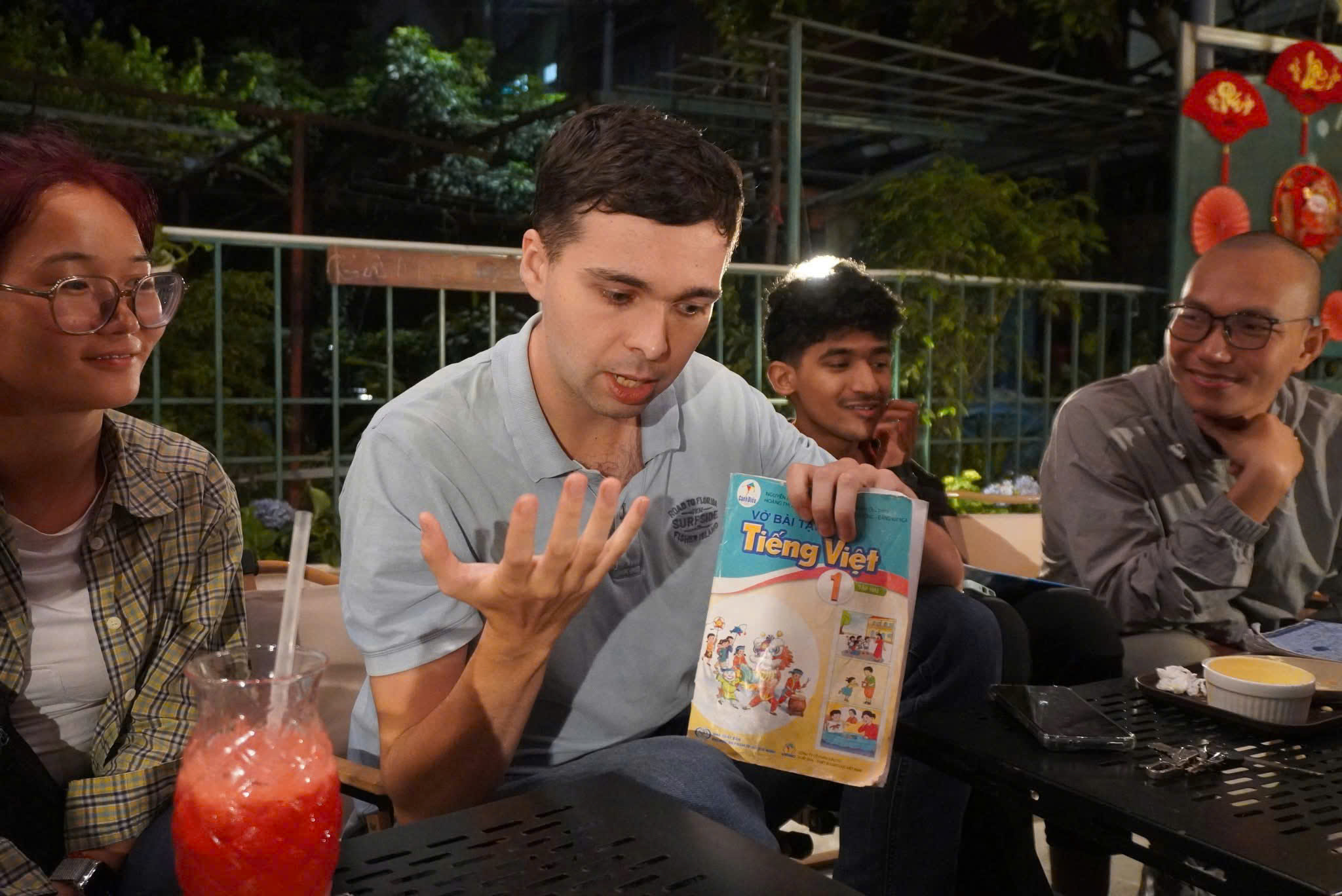 |
A German man holding a Vietnamese exercise book to review lessons. Photo: Huy Khanh
Each course consists of six sessions, directly teaching short conversational phrases based on practical topics: going to the market, bargaining, asking for directions, and ordering food. "The goal is that when they leave the classroom, they should be able to order an iced milk coffee themselves. This gives students the motivation to continue their learning journey", Thanh explained.
Teaching a tonal language always presents a challenge. Nguyen Minh Hang, a 21-year-old volunteer, revealed that many students struggle with vowel pairs like "o-o" and "u-u", or take weeks to distinguish between the rising-falling tone (dau hoi) and the glottal-stop tone (dau nga). To address this, Hang creates real-life scenarios and integrates explanations of "culture shock" directly into her lessons.
To sustain operations, Khanh's group receives support from a cafe owner in Cau Giay district, who provides space on weekend evenings. From an initial six members, the project now has 20 volunteers, all university students with advanced foreign language certificates. The project has helped over 200 foreigners integrate into the community.
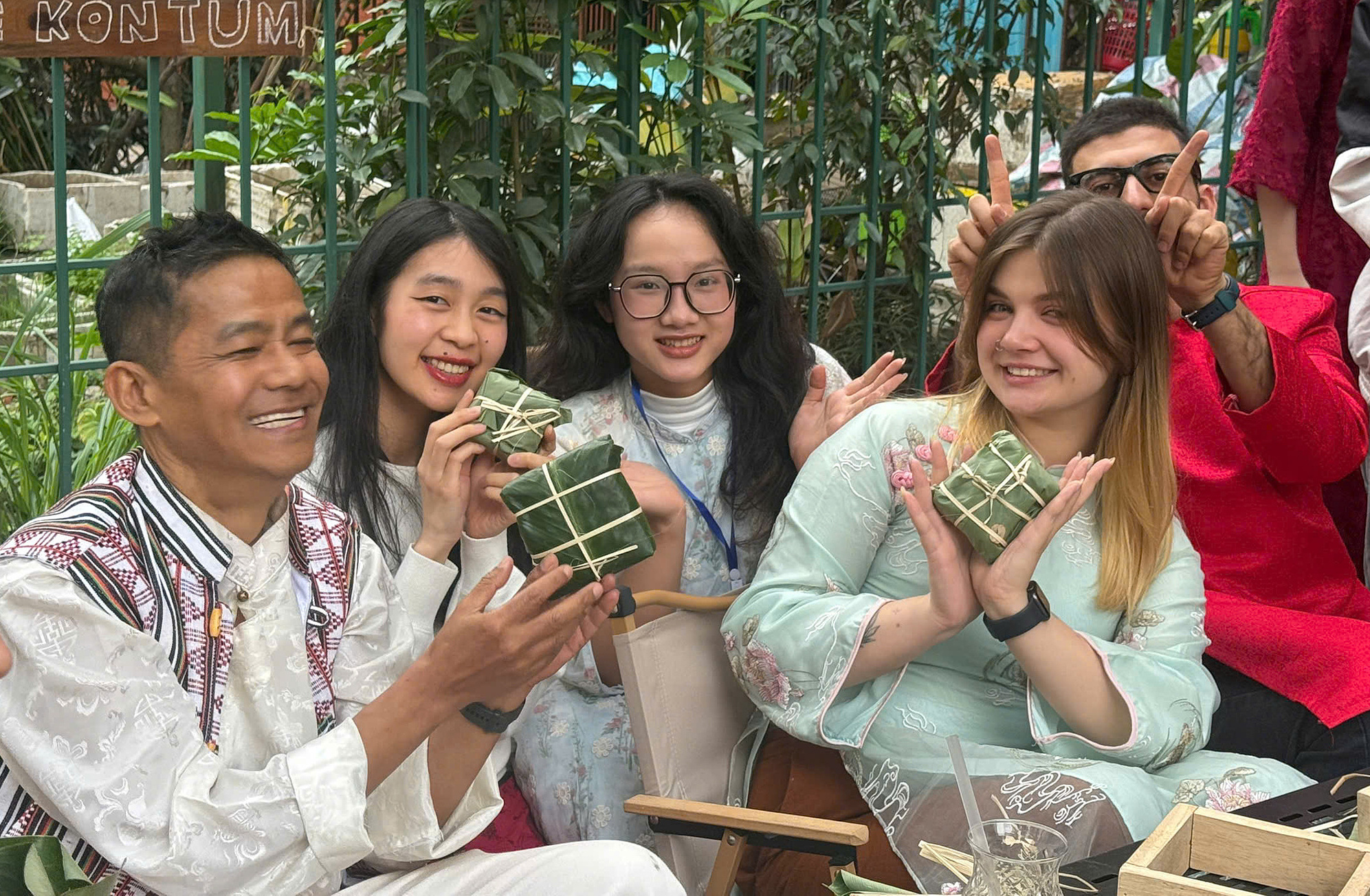 |
Aleksandra (2nd from right) participating in making banh chung during Tet at the class, 2/2026. Photo: Contributed
Aleksandra, 24 years old, a Russian teacher, has been involved with the class since last October. After completing the course, she continues to stay after classes each week to socialize. "During the recent Tet Nguyen dan, I joined everyone in making banh chung, learned the meaning of the five-fruit tray, and practiced the custom of xong dat (first-footing). The warmth and affection of everyone helped ease my homesickness while celebrating Tet far from home", she shared.