Many Grab drivers in Hanoi and TP HCM are planning a collective "app shutdown" on 12-13/9. This action aims to pressure the ride-hailing company to reconsider its revenue-sharing model, which drivers claim results in unacceptably low earnings. The call to action has gained traction among drivers who feel that current fares are too low and commission rates are too high, making it difficult to cover operational costs and earn a living.
Xuan Hung, 28, a Hanoi-based ride-hailing driver since 2020, shared his experience. Initially, he earned tens of millions of VND monthly even while working part-time. However, after switching to car services in late 2024, he now works 14-15 hours daily to maintain an income of around 30 million VND per month. According to Hung, the platform he partners with currently pays only 4,000-5,000 VND per km for car services and 2,500 VND for motorcycles, which is significantly lower than the 6,000-7,000 VND offered by other platforms.
"The fares are too low, forcing me to turn off this app and work simultaneously with other companies," Hung stated. He added that many colleagues are also frustrated by commission rates reaching 30-50% depending on the time, while drivers bear the full cost of fuel and vehicle depreciation. Duc Anh, 35, from Hoang Liet ward in Hanoi, recounted a recent 10 km trip that displayed a 50,000 VND fare. After deductions for commission and various fees, his actual earnings were just over 30,000 VND. "After deducting operating costs, the amount I take home isn't enough to cover living expenses," he said.
On an online forum for ride-hailing drivers with over 312,000 members, numerous Grab drivers have posted about earning less than 150,000 VND after driving for 5 hours. Some calculations suggest actual earnings are only 11,000-12,000 VND for a 4-5 km trip (2,000-2,500 VND/km). A car driver in TP HCM reported receiving only 26,000 VND for a 4 km journey. Another car driver in Hai Phong shared that he received 157,000 VND from a trip for which the customer paid 262,000 VND, with the difference attributed to fees and taxes.
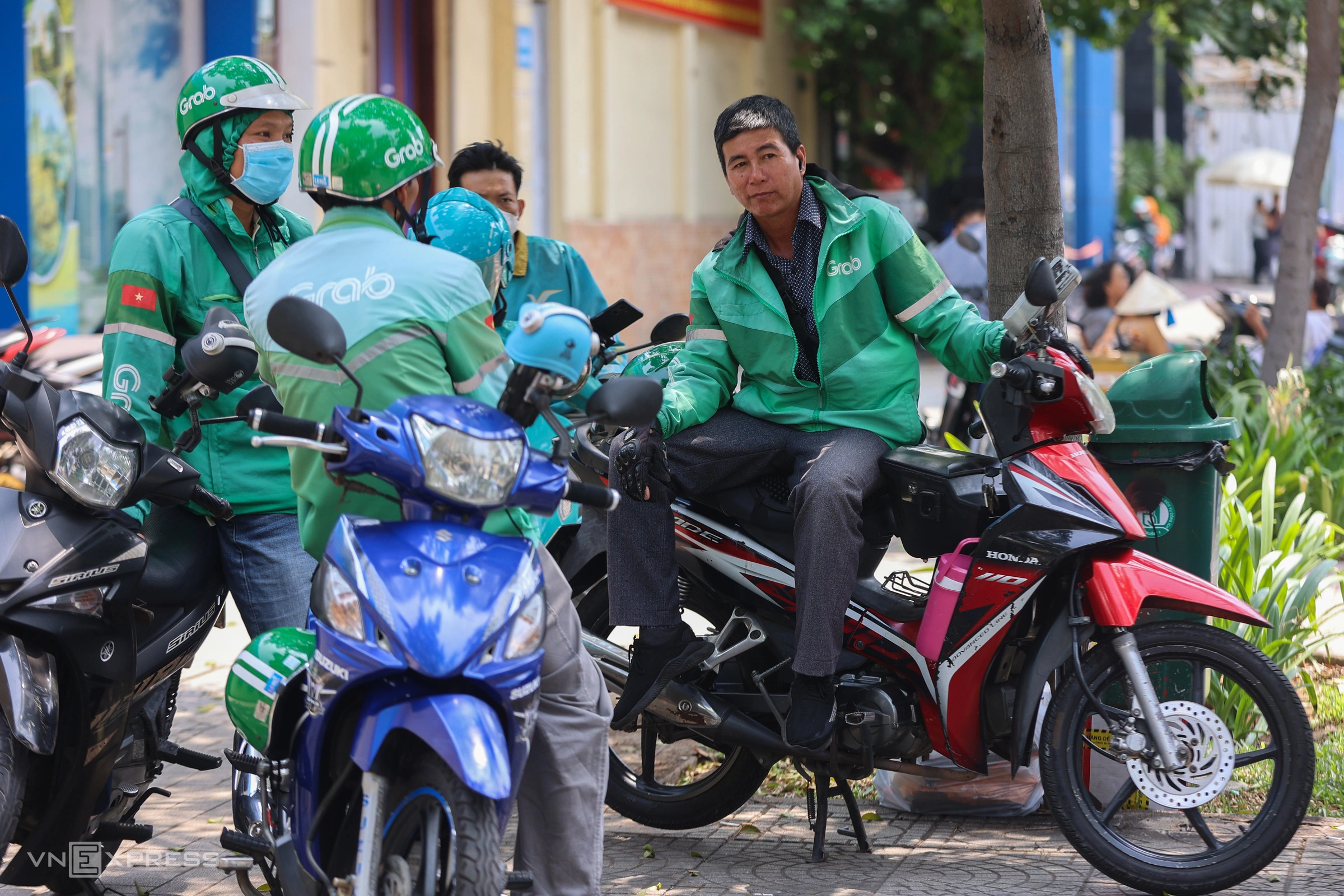 |
A ride-hailing motorcycle driver in TP HCM, 4/2026. Photo: Quynh Tran |
Grab's current pricing policy involves a 20% commission rate for two-wheel services and 25% for four-wheel services. The amount customers pay includes a base fare plus a platform fee and surcharges based on area and time. The total fare displayed on the customer's app is always higher than the basic transport fare. A driver's actual earnings are calculated by subtracting the fixed commission and relevant taxes and fees from the trip's revenue, leading to a significant difference compared to the amount paid by the customer.
On the evening of 10/9, a Grab representative informed VnExpress that the platform's operations have remained normal in recent days, with service quality metrics stable. The company acknowledged discussions within the driver community on social media and is seriously evaluating the situation. The representative emphasized that Grab prioritizes maintaining drivers' livelihoods and ensuring service quality for users.
Despite this, adjustments to commission rates and bonus policies have repeatedly triggered collective service suspensions and "app shutdowns" by Grab drivers. In 2017, Grab increased its app usage fee from 5% to 20% in Hanoi and TP HCM, citing policy unification and increased competitiveness. This decision led many drivers to simultaneously turn off their apps and protest in inner-city streets. In 1/2018, a large-scale protest occurred in both northern and southern Vietnam when Grab raised commissions from 20% to 23.6% for both car and motorcycle services. The platform later adjusted the rate back to 20%.
In mid-2019, numerous GrabBike drivers gathered at the company's representative office in TP HCM to protest increased fees resulting from tax collection on behalf of drivers. Immediately after the incident, Grab stopped collecting personal income tax for its driver-partners. In 12/2020, hundreds of drivers in Hanoi and TP HCM protested an increase in tax deductions and service fees from 20% to over 27.2%. This fee hike was implemented under Decree 126, which stipulated a 10% value-added tax on the platform's total revenue. To ease tensions, Grab increased fares for both car and motorcycle services to offset the incurred costs. During 2023-2024, waves of complaints occurred sporadically in major cities. Drivers reported changes in the order allocation algorithm, unstable bonus policies, and opaque account deactivation decisions. Temporary service suspensions were observed sporadically on Grab and other ride-hailing platforms in the market.
Le Tan Luu, Chairman of the Binh Tan Ride-Hailing Drivers' Union in TP HCM, confirmed that drivers' incomes have recently declined. The reason is that apps have lowered fares to compete and retain customers, while commission rates have remained unchanged. Luu noted that actual income also depends on bonus programs. Drivers who complete enough trips within specific time frames can offset reduced fares, unlike part-time drivers. He added that some drivers' conclusion that the company retains 50-60% based solely on the difference between customer payment and actual earnings is inaccurate, as this amount includes insurance or additional service fees.
"Drivers should avoid spontaneous gatherings or hastily turning off the app, as this can affect traffic, public order, and personal interests," Luu advised. He suggested that groups compile data on unreasonable trips and appoint representatives to work directly with the company and regulatory agencies to find common ground.
Amidst calls for a service suspension, some drivers continue to operate their apps. Duc Minh, 45, in Hanoi, stated that he still picks up customers but will be selective about trips with good fares. "If I turn off the app now, my family will lose their source of income," Minh explained.
Ngan Quynh