Chef Vu Nhat Thong from Eric Cooking Class Center explains that the distinction between a standard sauce and traditional Italian tomato sauce lies not just in the ingredients, but also in the cooking time and temperature.
According to culinary science principles, when tomatoes are subjected to high heat for a short duration, their natural water content evaporates rapidly. However, the cellular structure of the ingredients does not have enough time to break down completely. This results in a finished sauce that is thin, prone to separating, and lacks a naturally smooth consistency.
Furthermore, the abundant organic acids in tomatoes do not have sufficient time to break down and mellow. Consequently, the sauce often retains a sharply sour taste that overpowers other flavors. To temporarily address this, many people add white sugar or other sweeteners. However, this method only creates a superficial sweetness, failing to highlight the balance and authentic flavor of the tomatoes.
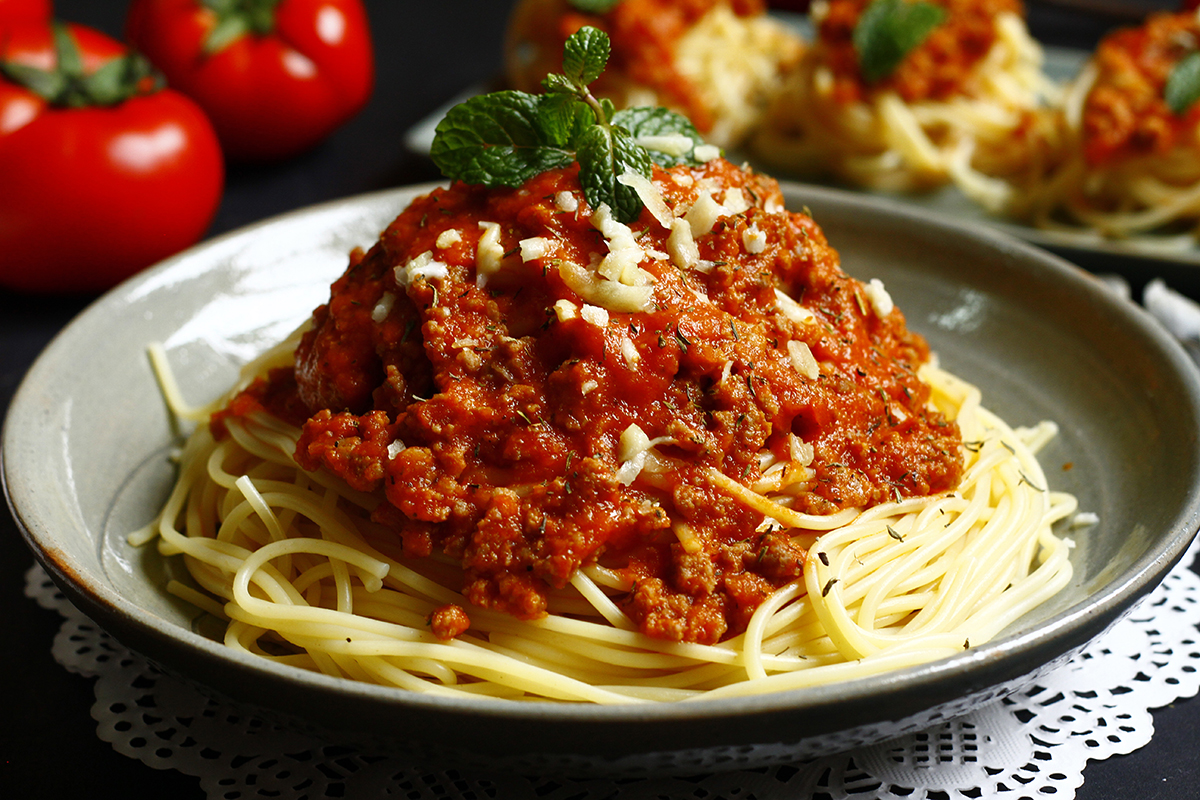 |
Spaghetti with smooth tomato sauce. Photo: Bui Thuy |
Instead of a rolling boil, the slow cooking technique requires maintaining the lowest possible heat, allowing the sauce to simmer gently for a minimum of three hours. This process unfolds in three distinct phases of structural and flavor transformation:
The first one to 1,5 hours: Low, stable heat begins to directly impact the cell walls of the tomatoes. Pectin compounds – a soluble fiber that maintains the firm structure in fruits – gradually soften and break down. This hydrolysis process helps tomatoes release water slowly and evenly, causing the mixture to naturally thicken and create a smooth consistency without the need for auxiliary starches.
The second hour of cooking: Natural sugars, including fructose and glucose, under the continuous effect of low temperature, initiate the caramelization process. This completely eliminates the sharp sourness and replaces it with a mellow sweetness. Simultaneously, the Maillard reaction, an interaction between amino acids and sugars, intensifies, creating hundreds of new flavor compounds and transforming the sauce's color from bright red to deep red.
The final hour of cooking: As the ingredient structure is maximally broken down, protein chains continue to decompose into free amino acids. The emergence of glutamate molecules during this phase is crucial for creating the umami (savory) taste. The release of umami content makes the purely plant-based sauce rich, deep, comparable to bone broth, and leaves a lasting aftertaste.
To successfully apply this technique, cooks must adhere to principles from ingredient selection to preparation:
Use naturally ripe tomatoes with taut, firm skins to ensure the highest sugar content.
Always start by sauteing onions and garlic in olive oil at the lowest heat.
When adding tomatoes to the pot, cover it partially to allow steam to escape slowly. Limit vigorous stirring throughout the three hours to preserve the evolving structure.
"Cooking demands patience. Intentionally accelerating the process with high temperatures often compromises the ingredient's structure and fails to deliver optimal flavor to the dish", Thong said.
Bao Nhien