Master of Vietnamese Studies Tran Thi Kim Hoa states that in worship rituals, not only for Vietnamese people but also for many cultures worldwide throughout history, offering flowers plays an important role in attracting vital energy and helping people connect with the spiritual world.
According to the Vietnamese dictionary, "cung" means to offer sacrifices to deities or the souls of the deceased, often involving incense and prayers, in accordance with traditional beliefs or customs.
In Vietnam, family worship means offering sacrifices to ancestors, those who have passed away. Therefore, flowers specifically for worship differ slightly from ordinary flowers. However, many households often make mistakes when choosing and offering flowers out of habit, overlooking core principles.
 |
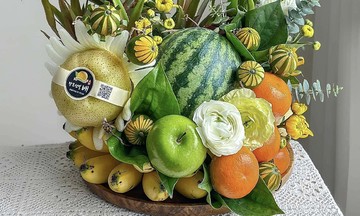
Grapefruit flowers are often placed on a five-fruit tray and offered on the altar by Vietnamese people. *Photo: Le Bich*
Here are some considerations to ensure that offering flowers maintains solemnity and purity.
**The 'golden' time to harvest flowers for worship**
The time of harvesting and cutting flowers directly affects the energy of the offerings. It is best to harvest between 3h and 7h. This is when flowers strongly absorb the dawn energy of heaven and earth, helping to maintain their purity and freshness.
Conversely, households should avoid cutting flowers in the late afternoon or evening. As the sun sets, negative energy increases, making flowers susceptible to elements unsuitable for worship.
Today, most flowers are purchased, often even refrigerated, making this practice difficult. However, families with gardens who grow their own flowers should apply this harvesting time for offerings.
**Avoid buds, prefer fully bloomed flowers**
Another principle is not to offer flower buds. Many mistakenly believe that buds will stay fresh longer, but from an energy perspective, buds have not yet accumulated enough spiritual essence to serve as a spiritual bridge.
"The best flowers for worship are those that have fully bloomed at their peak, with complete fragrance and color. Artificially forcing petals open by hand only creates superficial beauty and has no effect in offerings", said Ms. Hoa.
Additionally, flowers must be healthy, free from pests, diseases, or damage. After the ceremony, flowers should be removed immediately or within the day. Never leave withered or rotten flowers on the altar.
**Principle of 'natural alignment'**
Purity is the primary factor in the ritual of offering flowers. The person making the offering should wash their hands and face before preparation. Flowers should be gently cleaned, arranged on a clean plate, or placed in a simple vase, positioned at the base of a statue or incense burner.
The expert specifically advises against violently altering the shape of flowers. Actions such as stringing them together, stapling petals, or elaborately shaping them will diminish their natural spiritual power.
Worship flowers should remain in their original state. Do not use artificial flowers, synthetic gold branches and jade leaves, or flowers of unknown origin (stolen flowers, those picked from cemeteries, roadsides, parks, or unclean places).
**Choose flowers with sincerity and appropriateness**
Each Saint, Deity, Buddha, or ancestor corresponds to different energy frequencies. Generally, chrysanthemums, lilies, and peonies are suitable for ancestral worship, while lotus flowers, plumerias, and marigolds are often used for offering to Buddha.
Another factor to consider is the culture of each nation and region. For example, Thailand and Cambodia use jasmine flowers for offering to Buddha. However, for Vietnamese people, although jasmine is fragrant, it is not used for offerings.
Nevertheless, the core of any ritual remains sincerity. "Heaven and earth bear witness to the heart of the person making the offering, not distinguishing between local or foreign flowers, expensive or inexpensive. one flower from a home garden, cared for and offered with reverence, will bring a more peaceful energy field than a lavish spread lacking sincerity", emphasized expert Kim Hoa.
Bao Nhien