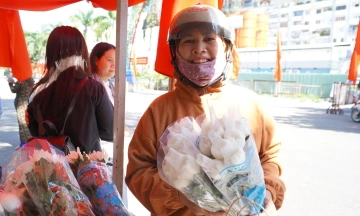
Lin Yi, 19, a gig worker in Quanzhou city, Fujian province, has never contributed to pension insurance. His colleague, Hai Liang, 42, calculated: "A monthly contribution of nearly 900 yuan (134 USD) equals four days of work. I choose to keep that money."
Lin and Hai are among 150 drivers at the Puxi Wanda delivery station. At Luo Kai's restaurant, near the station, a "eat now, pay later" policy is offered to employees before payday. Luo, 35, stated: "Most of them live on credit; convincing them to pay for pension insurance is unrealistic."
In China, freelance workers are not mandated to participate in the social insurance system. Over the past 17 months, the Meituan service platform has launched a subsidy program in Quanzhou and Nantong to integrate drivers into the pension system. Under this initiative, the company covers 50% of the contributions, with workers responsible for the remainder.
Despite meeting income requirements, fewer than 20 drivers at the Puxi Wanda station have enrolled. Wu Xiaohua, the station manager, attributed the low participation rate to high employee turnover. Before the Lunar New Year alone, nearly 80 workers at the station resigned. He stated: "Asking people who want to earn quick money to pay for insurance they won't use for decades creates a conflict."
According to research by Nankai University, the average age of Chinese food delivery drivers is 33. With a planned increase in the retirement age to 63 for men and 55 for women by 2040, this group of workers tends to prioritize immediate financial goals.
"We deliver food to cover basic needs; pension insurance is not among them," said driver Wang Xu, 25.
 |
Gig workers in China. Illustration: VCG. |
Worker reluctance
A 2024 survey by associate professor Zhang Dandan (Peking University) of 30,000 drivers revealed that over half desired a pension but few were willing to contribute. 23% refused to participate even if mandatory, and nearly 40% were only prepared to deduct less than 5% of their monthly income.
Additionally, many workers are wary of platforms automatically deducting money from their accounts. Jin Luhui, a driver team leader, explained: "Many fear companies will misuse their earnings because they don't understand that these contributions go directly into the state social security system."
A general decline in income is also a significant factor. In Quanzhou, a driver stated that he previously delivered over 50 orders daily, but now the maximum is only 35 orders due to a sharp increase in new workers. Manager Wu noted that many employees lack financial management skills, leading him to advance about 20,000 yuan (2,988 USD) monthly to help them cover living expenses, even though the app allows three withdrawals per month.
Prioritizing short-term cash flow
The decision to join insurance schemes depends on individual risk priorities. Jin Cailin, 30, a driver in Shanghai, wants to save money as capital to open a restaurant and plans to consider insurance only after 45. Li Min, 27, prioritizes using her income to buy an electric motorcycle and get braces to improve her current life.
Zhu Tian, an expert researching driver protection initiatives, believes that for delivery work, welfare should prioritize short-term risks like occupational accidents. Although 70% of rural-origin drivers have basic health insurance, pensions remain a significant gap. Paradoxically, the highest-income group is the least willing to participate, as they need cash for living expenses and debt repayment.
Associate professor Zhao Qing (Wuhan University) assessed that the current pension system requires continuous contributions, which is incompatible with the high turnover nature of freelance work.
Currently, station manager Wu Xiaohua chooses to respect individual drivers' decisions rather than coerce them. A prime example is Hai Liang, who supports two young children and rents an unairconditioned room for 300 yuan (45 USD) per month. Although he desires a pension, he must constantly switch between apps to optimize his daily earnings, making him ineligible for the company's support program. Instead of discussing insurance, last July, the station manager gave him a new uniform for Driver's Day as a practical form of support.
 |
Delivery workers resting at the Puxi Wanda delivery station in Quanzhou, Fujian province, July 2026. *Yang Shuyuan/Original*. |
Minh Phuong (According to Sixth Tone)