Called the "Poverty Challenge", this trend spread across social media platforms Instagram and X in South Korea in late 2025. Participants, typically high-income individuals, shared images of their lavish lifestyles accompanied by captions lamenting their financial hardship.
One post that went viral on 25/12 depicted a humble bowl of instant noodles and kimbap, but placed beside them was a Ferrari supercar key. The owner of the photo wrote, "Poverty is truly unbearable. Today, I'm forced to eat ramen again. When will I escape this destitution?"
In another post, a Dior baby stroller, valued at 15 million won (approximately 275 million VND), was described as an item that "bankrupted" the family. Many also photographed spacious apartments adorned with expensive art, sarcastically captioning them, "This is all the property I own."
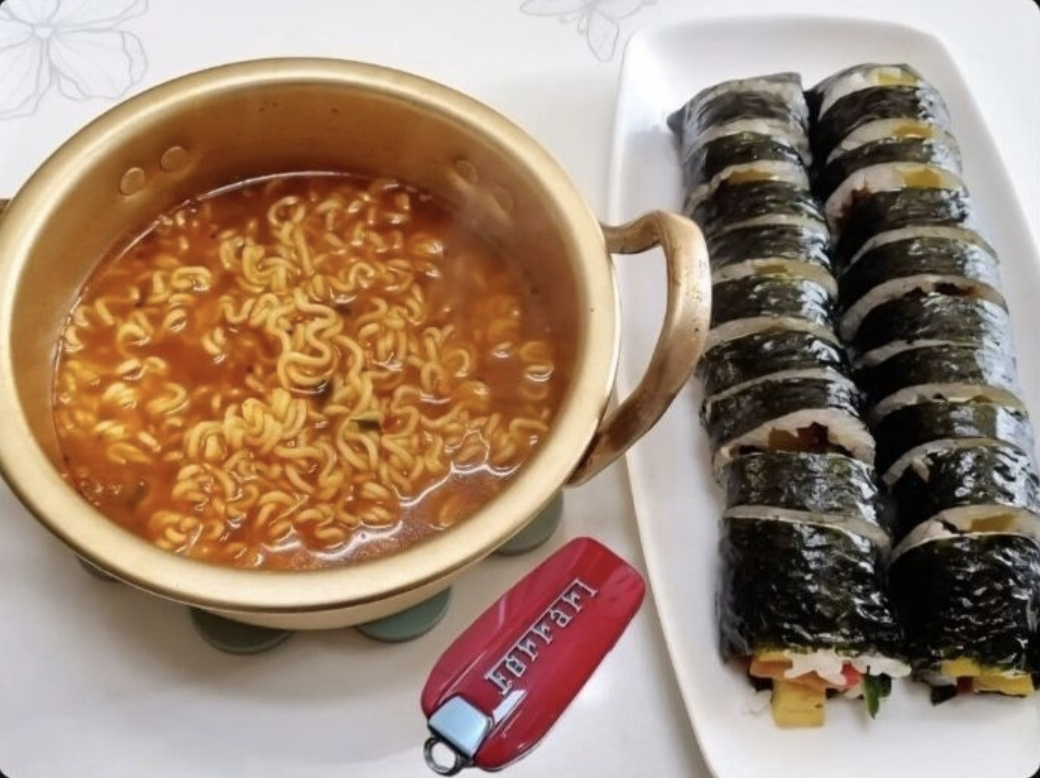 |
An individual in South Korea photographed a pot of instant noodles, a plate of kimbap, and a Ferrari car key with the caption, "Poverty is unbearable. Today, I'm eating ramen and kimbap again. When will I escape this poverty?", sparking anger on social media on 25/12. *Photo: Korea Herald* |
The South Korean public reacted strongly to the commodification of hardship for entertainment. Opinions on online forums like Theqoo and Pann suggested that this disguised display of wealth was more irritating than direct ostentation. Critics highlighted a lack of empathy and a provocative attitude towards those genuinely struggling due to economic recession.
This controversy echoes the 1975 short story "The Stolen Poverty" by writer Park Wan-suh, a work that criticized how the wealthy appropriated the concept of "poverty" as an aesthetic accessory to embellish their already opulent lives.
Singer and actor Kim Dong-wan, a member of the group Shinhwa, was the first celebrity to publicly criticize this trend. Having lived for an extended period with his mother in a cramped semi-basement apartment, he understood the sensitivity and hurt associated with the word "poverty."
"Poverty is not a prop for a show or a joke, especially when many students and laborers out there are still carefully counting every penny to buy a single kimbap," Kim Dong-wan wrote on his personal page. His post received significant support, leading many participants in the trend to delete their posts.
Sociology experts warn that mocking hardship reflects emotional insensitivity among a segment of the elite class. In a context where the wealth gap in South Korea is widening, trends like the "Poverty Challenge" inadvertently deepen social conflict and harm the vulnerable.
By Minh Phuong (According to Korea Herald, Joongangdaily)