Valerie Lockhart faced a sudden career setback in 3/2025 when she was laid off from Morgan Stanley at the age of 40. The woman, who was her family's main provider, suddenly found herself without income. She had been an employee at the bank, included in a list of mass layoffs. Living in Georgia and working remotely, Valerie realized that geographical distance was a disadvantage, making her contributions easily overlooked.
After one month of reflection, Valerie began her job search. Her extensive efforts, involving over 550 applications, yielded minimal results. She updated her CV to bypass applicant tracking systems (ATS) and consistently connected with her old professional network. She even created a spreadsheet to manage her applications. After nearly one year, she received only 25 responses. Despite reaching the final interview rounds multiple times, job offers remained out of reach.
 |
Illustrative photo: Pexels |
Valerie observed a prevailing trend among employers: a relentless pursuit of "unicorn candidates"—individuals with a rare skill set who could meet 100% of employer requirements at a low salary. Companies preferred to leave positions vacant rather than hire an experienced person deemed "overqualified" or no longer young.
This struggle is not isolated, as the US saw over one million workers laid off in 2025. White-collar workers and office staff are facing a frozen job market. Many companies prefer to leave positions open or use AI for replacement rather than hiring new middle management personnel.
The financial and emotional toll of unemployment profoundly impacted Valerie and her family. Unemployment is not just a loss of income; it is also a severe mental drain. Valerie and her husband had to rely on their savings, retirement funds, and meager unemployment benefits. Their monthly mortgage payments became a suffocating burden. Crisis struck as their savings dwindled. One day in 9/2025, Valerie discovered her garage flooded due to a leaking underground pipe, causing thousands of USD in damage. To prioritize food purchases, her family had to postpone repairing their water heater and lived with cold showers for several months. Self-respect gave way to the pressure of survival, and Valerie decided to launch a crowdfunding campaign on social media, receiving a few hundred USD in support.
A glimmer of hope appeared early this year when Valerie secured a temporary contract job. The first thing she did with her salary was repair the water heating system. After experiencing such hardship, she now appreciates life's simple values more and continues to apply daily for permanent positions. She does not aspire to be an exceptional "unicorn" but merely seeks one opportunity to prove her abilities and protect her home.
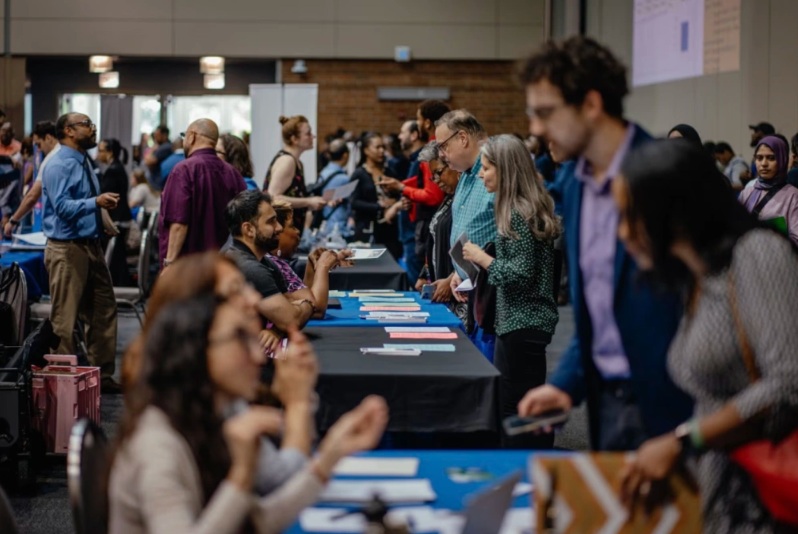 |
A job fair in Chicago in 6/2025 attracted many workers. Photo: WSJ |
Valerie's experience underscores a broader, harsh reality within the US labor market, particularly for older workers. According to the US Bureau of Labor Statistics, workers over 45 years old typically take 20-25 weeks to find new employment. Up to 24% of workers over 50 years old who are laid off never regain stable employment. Data released in early 2026 indicates that long-term unemployed individuals (those without work for 27 weeks or more) account for over 25% of the total unemployed.
The proliferation of automated AI-powered resume submission tools has intensified competition, exacerbating challenges for job seekers. In response, companies are increasing requirements, extending interview processes to 5-7 rounds, only to eventually reject candidates or engage in ghosting. As a result, job seekers experience extreme frustration after hundreds of fruitless applications.
Age discrimination remains a significant concern, compounding the financial pressures faced by middle-aged workers. A survey by the American Association of Retired Persons (AARP) shows that over 60% fear age discrimination, while research from Harvard Business School indicates many are rejected simply for being "overqualified". Financial pressures from housing and children mean even a few months of unemployment can plunge middle-aged workers into severe crisis.
Nhat Minh (According to Business Insider)