Eng English
China 中国人

Eng English
China 中国人
  • News
  • World
  • Business
  • Entertainment
  • Sports
  • Law
  • Education
  • Health
  • Lifestyle
  • Travel
  • Science
  • Digital
  • Automobiles
  • Trở lại Thể thao
  • Lifestyle
Monday, 23/2/2026 | 14:39 GMT+7

Thailand's battle to reduce sugar in bubble tea

The Thai government is intensifying its campaign to cut sugar in beverages, directly challenging the public's habit of consuming excessively sweet bubble tea.

Customers raise their phones, intently watching Nid prepare her bestselling Thai tea in Bangkok's old quarter. She pours in condensed milk, adds 12 spoonfuls of sugar, then fills a plastic bag with ice and tea. This rich, sweet drink has made the 68-year-old woman's stall famous across social media.

"I prepare it this way to please my customers," Nid stated.

However, this practice runs counter to the Thai government's efforts to improve public health. Data shows that Thai citizens consume an average of 21 spoonfuls of sugar daily, significantly exceeding the 6-spoon recommendation from the World Health Organization (WHO). Sugary drinks are considered the primary culprit, positioning Thailand among Asian countries with the highest caloric intake from such beverages.
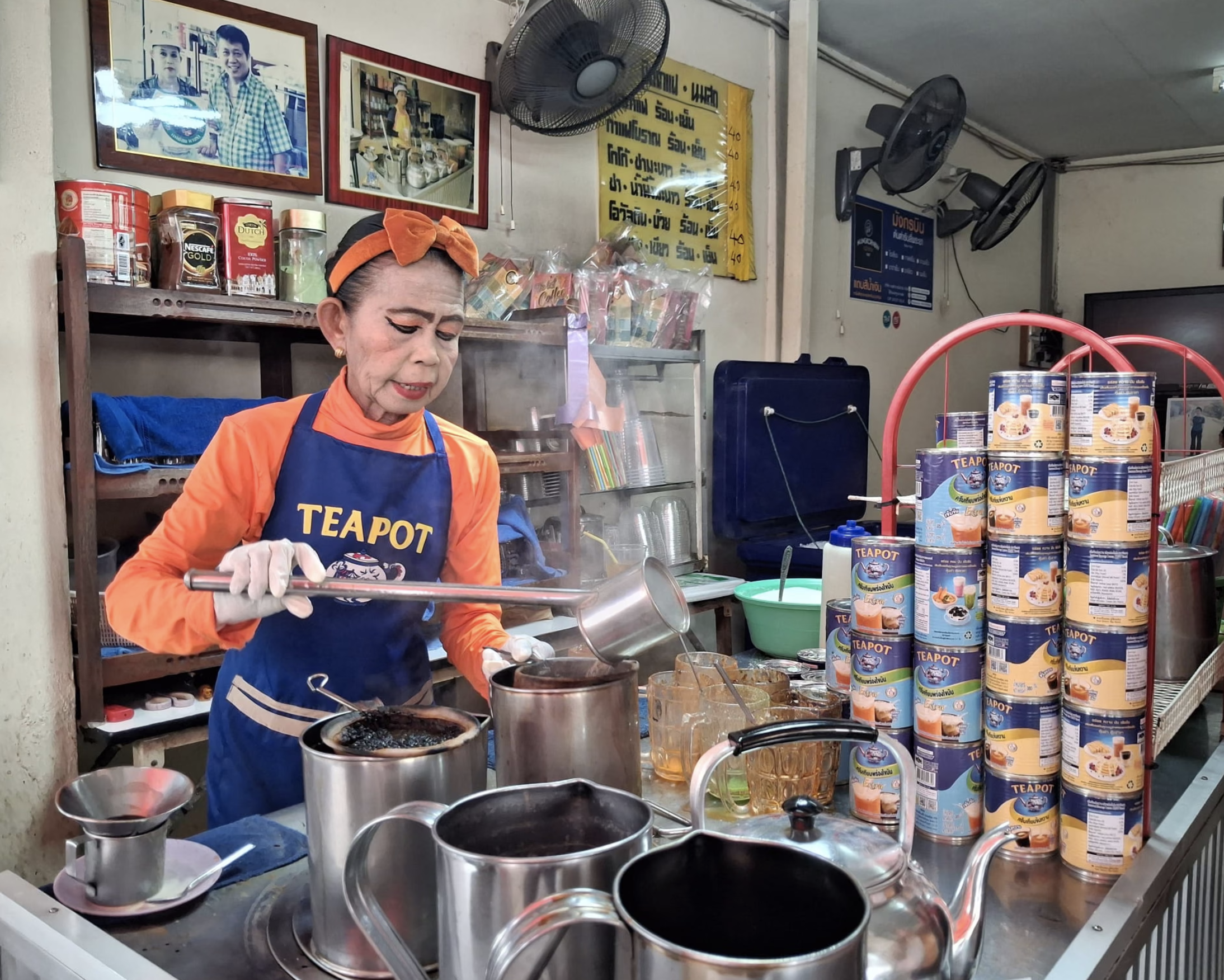
Nid, owner of a tea and coffee stall in Bangkok's old quarter, Thailand, has been selling her globally famous, super-sweet beverages for 30 years. Photo: Rebecca Ratcliffe/The Guardian

To address this, the government implemented a sugar excise tax on pre-packaged beverages in 2017. This February, the campaign expanded to freshly prepared drinks, with 9 major coffee chains in Thailand committing to halve the sugar content in their "normal sweet" options.

The government's latest initiative includes some of the country's largest coffee chains. Many establishments have installed signs allowing customers to choose sweetness levels from 0-100%. Under the new regulations, the 100% sweetness level for some drinks will contain only half the sugar amount compared to before.

Associate Professor Pojjana Hunchangsith at Mahidol University believes the policy is proving effective, as many manufacturers are proactively changing their formulas. "However, the biggest challenge lies with street stalls. The bubble tea, iced cocoa, and iced Thai milk tea sold here are a huge source of sugar but remain outside regulatory control," Pojjana emphasized.

To change consumer behavior, Associate Professor Phumsith Mahasuweerachai from Khon Kaen University suggests that stores displaying signs for 0-100% sweetness options is a smart move. "Without such suggestions, customers would automatically order sugary drinks out of habit," he remarked.

Change is gradually occurring. Phakamas, 39, shared that she now treats herself to only one or two glasses of iced cocoa each week to maintain her health.

Despite this, for traditional vendors like Nid, reducing sugar remains a distant prospect. Looking at the long line of tourists waiting, she waved her hand and asserted, "Without sugar, the tea and coffee would be bitter. Customers come here precisely for the inherent rich flavor."

According to the WHO, regular consumption of sugary beverages, including bubble tea and soft drinks, is a proven risk factor for weight gain, obesity, and diabetes.

Obesity is rapidly increasing in Asia. In Vietnam, for example, the rate of overweight and obese children aged 5-19 reached 19% in 2020, exceeding the Southeast Asian regional average of 17,3%.

To prevent the health consequences of sugary drinks, six Southeast Asian nations: Thailand, the Philippines, Malaysia, Cambodia, Laos, and Brunei, have officially implemented excise taxes on high-sugar products.

Minh Phuong (According to The Guardian)

By VnExpress: https://vnexpress.net/cuoc-chien-giam-duong-trong-tra-sua-o-thai-lan-5043050.html
Tags: sugar reduction obesity sugary drinks sweet drinks Thailand sugar tax bubble tea Thailand Thai bubble tea Nid

News in the same category

Young Chinese adults 'financially drained' by red envelopes

Young Chinese adults 'financially drained' by red envelopes

The pressure to save face during Lunar New Year gift-giving is financially draining many young people in China, sparking calls for more symbolic red envelope exchanges.

Risk of poisoning from eating ornamental kumquats after Tet

Risk of poisoning from eating ornamental kumquats after Tet

Many people, regretting wasting the fruit-laden kumquat trees after Tet, juice them for dipping sauces, steep them for cough remedies, or mix them into drinks, unknowingly consuming large amounts of chemicals.

Office workers exchange lottery tickets as li xi

Office workers exchange lottery tickets as li xi

On the first day back to work after Tet, many office workers choose to give lottery tickets as li xi, a gift to wish good luck and foster connection in the workplace.

elderly people 'addicted' to beauty treatments

elderly people 'addicted' to beauty treatments

at 91, Kim Jeom-hee prefers cosmetic clinic visits for wrinkle treatment over health supplements from her children and grandchildren.

Debate sparks over AI-generated cosmetic surgery photos

Debate sparks over AI-generated cosmetic surgery photos

A trend using AI to merge before-and-after cosmetic surgery photos has garnered millions of views, sparking mixed opinions.

Three mistakes parents make that push their children away

Three mistakes parents make that push their children away

Many parents lose connection with their children not due to indifference, but rather "over-intervention"—a form of love characterized by anxiety and control.

Cumbersome interviews for low-paying jobs

Cumbersome interviews for low-paying jobs

Rising unemployment in the UK is leading many businesses to tighten recruitment processes, forcing applicants to undergo unusual tests even for minimum wage positions.

Nation reverses the 'sex recession'

Nation reverses the 'sex recession'

Contrary to the "sex recession" trend in the West, Danish youth maintain a stable intimate life thanks to strong welfare and an open culture.

Filter malfunction reveals streamer's real face, sparks online debate

Filter malfunction reveals streamer's real face, sparks online debate

A beauty filter malfunction during a livestream exposed a Chinese streamer's real face, igniting a discussion about the blurred lines between reality and illusion on social media.

The tragedy of a young man determined to be 'beautiful at all costs'

The tragedy of a young man determined to be 'beautiful at all costs'

From a self-conscious boy, Braden Peters embarked on a "looks-optimization" journey using banned substances and a hammer to smash his facial bones, only to realize he had lost the chance to live a normal life.

Eng English
China 中国人
  • News
  • World
  • Business
  • Entertainment
  • Sports
  • Law
  • Education
  • Health
  • Lifestyle
  • Travel
  • Science
  • Digital
  • Automobiles
FPT Tower, 10 Pham Van Bach Street, Dich Vong Ward,
Cau Giay District, Hanoi, Vietnam
Email: contacts@vnportal.net
Tel: 028 7300 9999 - Ext 8556
Advertise with us: 090 293 9644
Register
© Copyright 2026 vnnow.net. All rights reserved.
Terms of use Privacy policy Cookies