This Lunar New Year, a video featuring a man named Chen from Guangdong who divided 100 yuan (approximately 14 USD) among his 23 grandchildren garnered millions of views. His act of giving 4 yuan to each grandchild, far from drawing criticism, earned widespread approval online.
Chen explained that in Guangdong, red envelopes are primarily a gesture of good luck, not a metric of generosity or wealth.
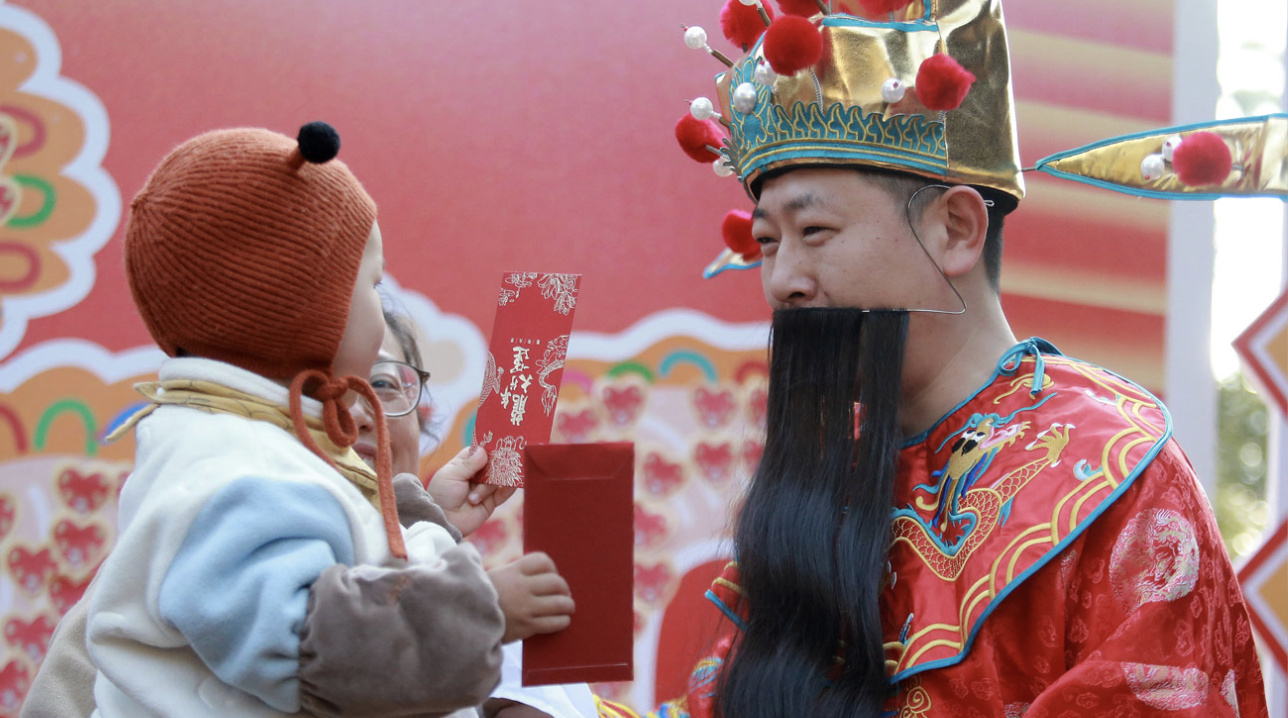 |
A child in Guangdong, China, receives a red envelope during Lunar New Year 2026. *Photo: Liu Ranyang/CNS/VCG* |
This simple cultural practice, however, is not universally observed. The modesty seen in Guangdong starkly contrasts with the substantial financial burden experienced in eastern and northern Chinese provinces, including Fujian, Zhejiang, and Beijing.
Surveys indicate that Fujian leads the nation in average red envelope amounts, reaching 3,500 yuan (approximately 490 USD). Zhejiang and Beijing also see figures ranging from 2,900 to 3,100 yuan. When compared to the average monthly salary of a recent graduate, which typically falls between 5,000 and 8,000 yuan, giving red envelopes to just a few relatives can deplete an entire month's earnings. This significant gap between actual income and the expected 'red envelope' standard is the primary factor leaving many young people financially drained and even apprehensive about returning home for Lunar New Year.
On the Xiaohongshu platform, posts lamenting 'li xi money' have collectively amassed over 2 billion views. While children eagerly anticipate red envelopes, young Chinese adults express anxiety, often budgeting months in advance to cover these 'emotional debts'.
The '80s generation faces dual pressure: providing gifts for elders and distributing funds to younger children. Meanwhile, '90s couples without children experience significant financial strain, as they primarily 'give' without 'receiving'. Increasing incomes, coupled with the societal pressure to 'save face', have continually inflated the expected value of red envelopes.
This widespread fatigue is fueling a movement to restore the symbolic nature of red envelope giving. A 'Guangdong reference table' is gaining traction on social media, suggesting amounts like: 100 yuan for immediate family, 50 yuan for close relatives, and 5 yuan (approximately 0,7 USD) for neighbors.
Local governments are also stepping in. In Guangxi province, Long’an district and Baise city have jointly issued a proposal titled 'Small Red Envelopes, Big Sincere Hearts', recommending a maximum red envelope amount of 20 yuan (nearly 3 USD). Authorities are urging residents to prioritize symbolic gestures, suggesting alternatives such as: giving handwritten couplets, sharing stories with children and grandchildren, or contributing to an 'investment fund' for books and educational toys.
From a cultural psychology perspective, the 'fear of losing face' (mianzi) among East Asians stems from a collectivist social structure. Unlike Western cultures, which prioritize internal validation, an individual's self-worth in this context is often defined by external perception and community judgment. Consequently, the act of straining to provide red envelopes beyond one's financial capacity is less about ostentation and more about a psychological defense mechanism. This protects social standing and prevents feelings of isolation or inadequacy. This underlying mindset has inadvertently transformed a simple good luck tradition into a suffocating burden for young adults.
Guangming Daily noted that Lunar New Year financial pressure originates from deeply ingrained perceptions of 'face'. Society should foster a mindset that values emotional connections over material wealth, as the true essence of the New Year lies in warm family reunions, not the monetary value of red envelopes.
By Minh Phuong (According to SixthTone)