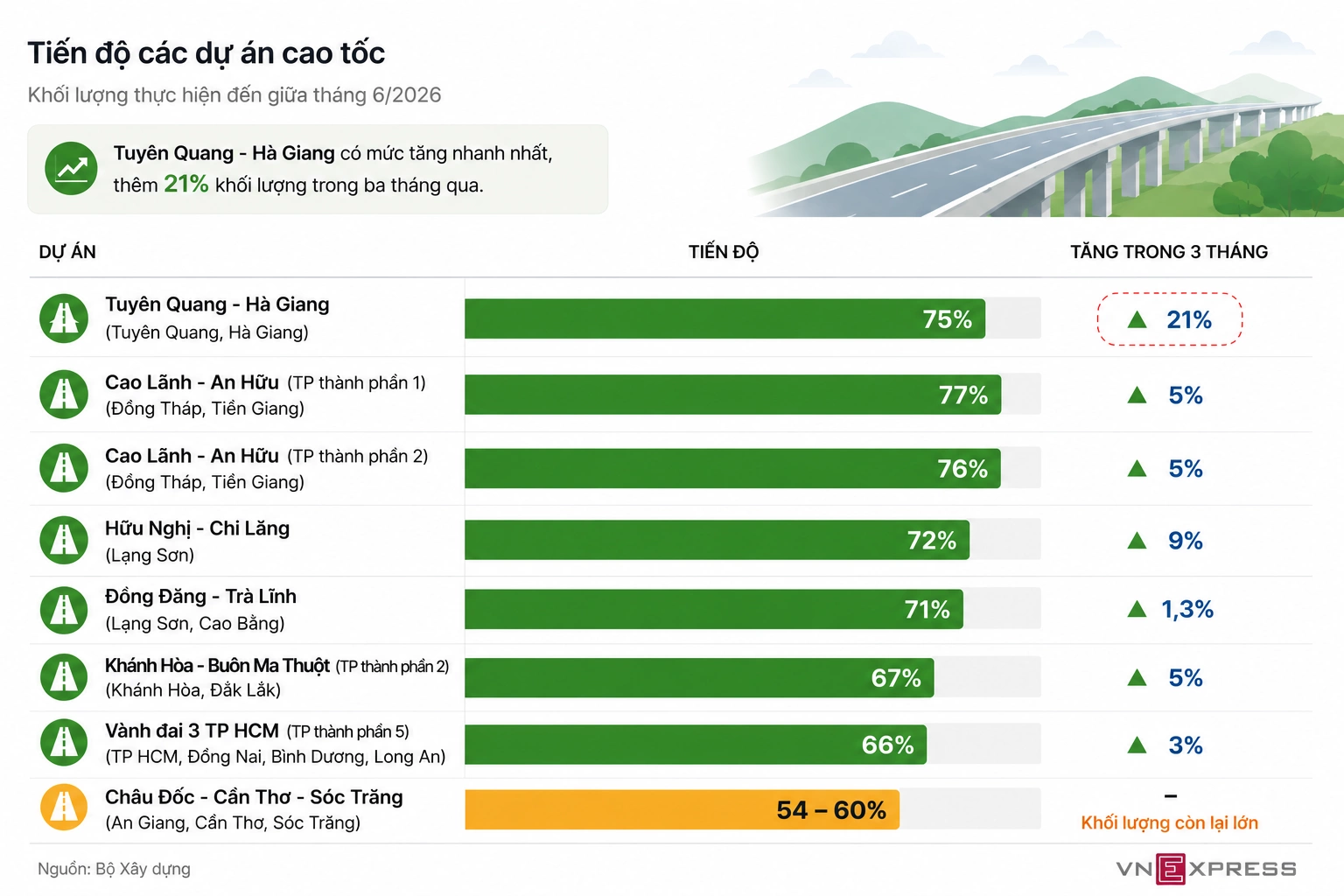
In a report submitted to the Prime Minister regarding the implementation of national key projects and major transportation sector initiatives, the Ministry of Construction noted that while seven projects have shown recent improvements in construction output, their overall progress remains below expectations. The current status of these seven projects is as follows:
 |
Graphics created with AI assistance. |
According to the Ministry of Construction, despite improved construction output across many sites, these projects still face a substantial amount of work requiring completion within a tight timeframe. The Ministry has directed investors and project companies to ensure contractors accelerate construction efforts, deploy more machinery and equipment, add construction teams, implement overtime shifts, and proactively secure material supplies to meet deadlines.
Beyond the projects slated for completion in 2026, the Ministry of Construction also highlighted numerous projects that began in 2025. These projects are experiencing slow construction progress, even with their scheduled completion phases set between 2027 and 2029.
Specifically, the Quy Nhon - Pleiku expressway project, which began in 12/2025, has seen component project one reach only about 3% of its contract value. For component project three, one package is still in contractor selection, while another is mobilizing equipment and clearing the site.
The primary reason for these delays is an unusual surge in fuel prices, influenced by political conflicts in the Middle East. Furthermore, the project has not received its central government capital allocation for 2026, and local counterpart funds have been fully disbursed. This has resulted in delayed advances and payments to contractors, making it challenging for them to manage their working capital for construction.
The Tan Phu - Bao Loc expressway project, which started in 12/2025, is currently at the stage where contractors are mobilizing equipment and constructing temporary camps. Component project three of Ring Road 4 in the Hanoi Capital Region, launched in 9/2025, has reached over 12% completion.
The Ho Chi Minh City - Thu Dau Mot - Chon Thanh project, launched in 2/2025, is continuing to mobilize equipment, address weak soil foundations, and cast structural components. The Ninh Binh - Hai Phong expressway, a public-private partnership (PPP) project that began in 5/2025, has reached almost 9% of its contract value.
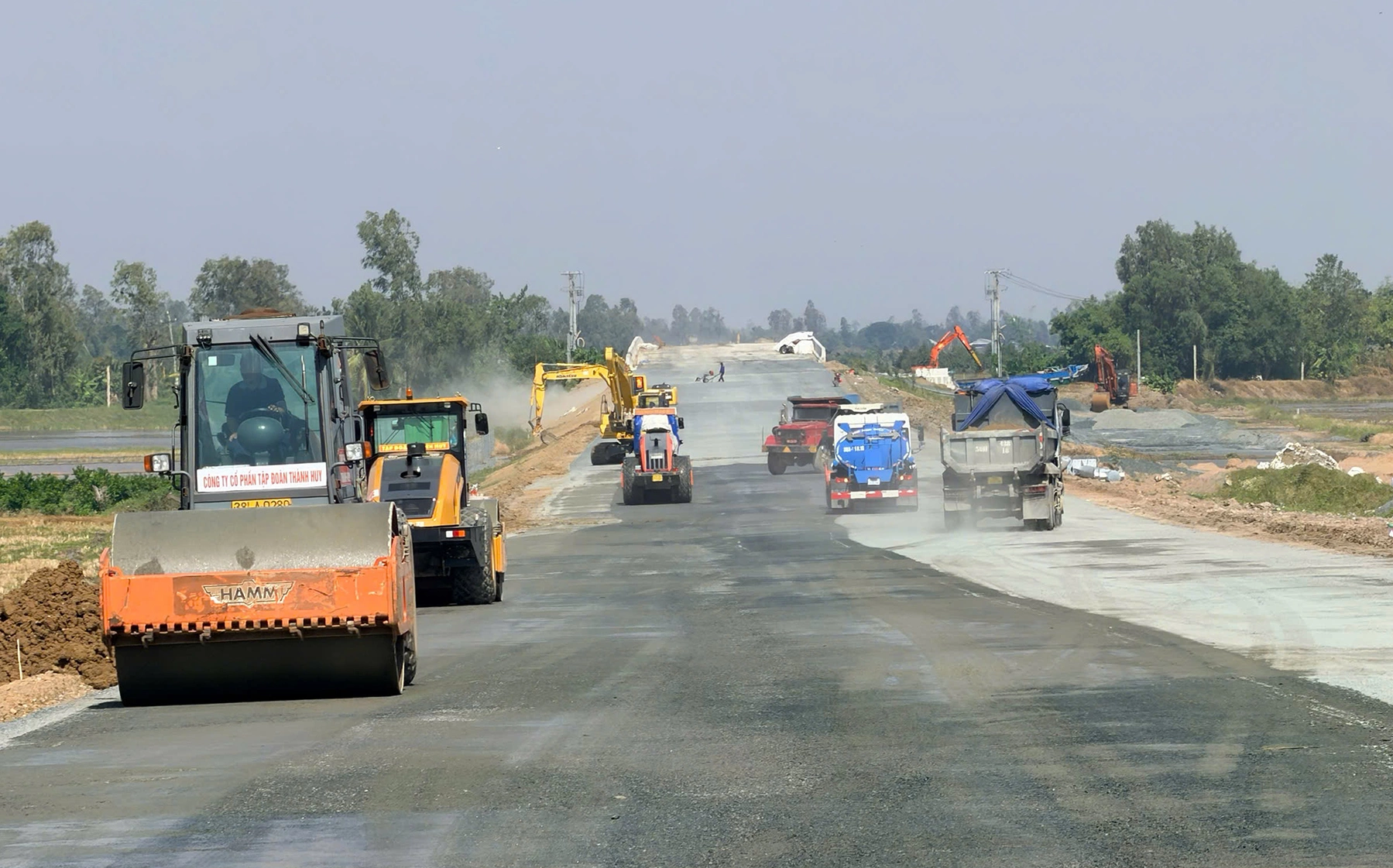 |
Sections of the Chau Doc - Can Tho - Soc Trang expressway are taking shape. _Photo: Huy Phong_ |
Two component projects of the Gia Nghia - Chon Thanh expressway, which started in 3/2025, have completed about 30% of their contract value. In contrast, the Bao Loc - Lien Khuong expressway, launched in 6/2025, remains in the design documentation phase with no construction yet underway.
For the Dau Giay - Tan Phu expressway project, which began in 8/2025, the investor has fully mobilized equipment and initiated the casting of structural components. However, local authorities have only handed over about 23% of the site area. This inconsistent handover prevents the project from commencing simultaneous construction across all sections.
The My An - Cao Lanh expressway, which started in 7/2025, has achieved over 14% completion. Even after a schedule revision on 4/5, the project remains nearly 1% behind schedule. This delay is attributed to the contractor's failure to adequately increase machinery, equipment, and personnel, and to organize construction with sufficient resolve.
The Cho Moi - Bac Kan expressway, which began in 3/2025, is almost 26% complete, falling behind schedule. The primary reason for this delay is the generation of an exceptionally large volume of excess earth and rock, exceeding 8 million cubic meters. While the total number of approved dumping sites has increased to 41, the associated procedural approvals continue to be slow, impeding construction progress.
The Ministry of Construction emphasizes that to achieve planned project completion, localities, investors, and contractors must prioritize resolving issues concerning site clearance, materials, and capital. They also need to intensify construction efforts in the upcoming period.
Anh Duy