At 7h, the Environmental Agency's monitoring station at Hanoi University of Science and Technology on Giai Phong street recorded an air quality index (AQI) of 204, equivalent to a very unhealthy level. Air quality at this station returned to very unhealthy levels from 5h, after having dropped to unhealthy and poor levels from the early morning of 8/12. The 556 Nguyen Van Cu station maintained an AQI of about 190 in the early morning, while the Khuat Duy Tien area station was above 150.
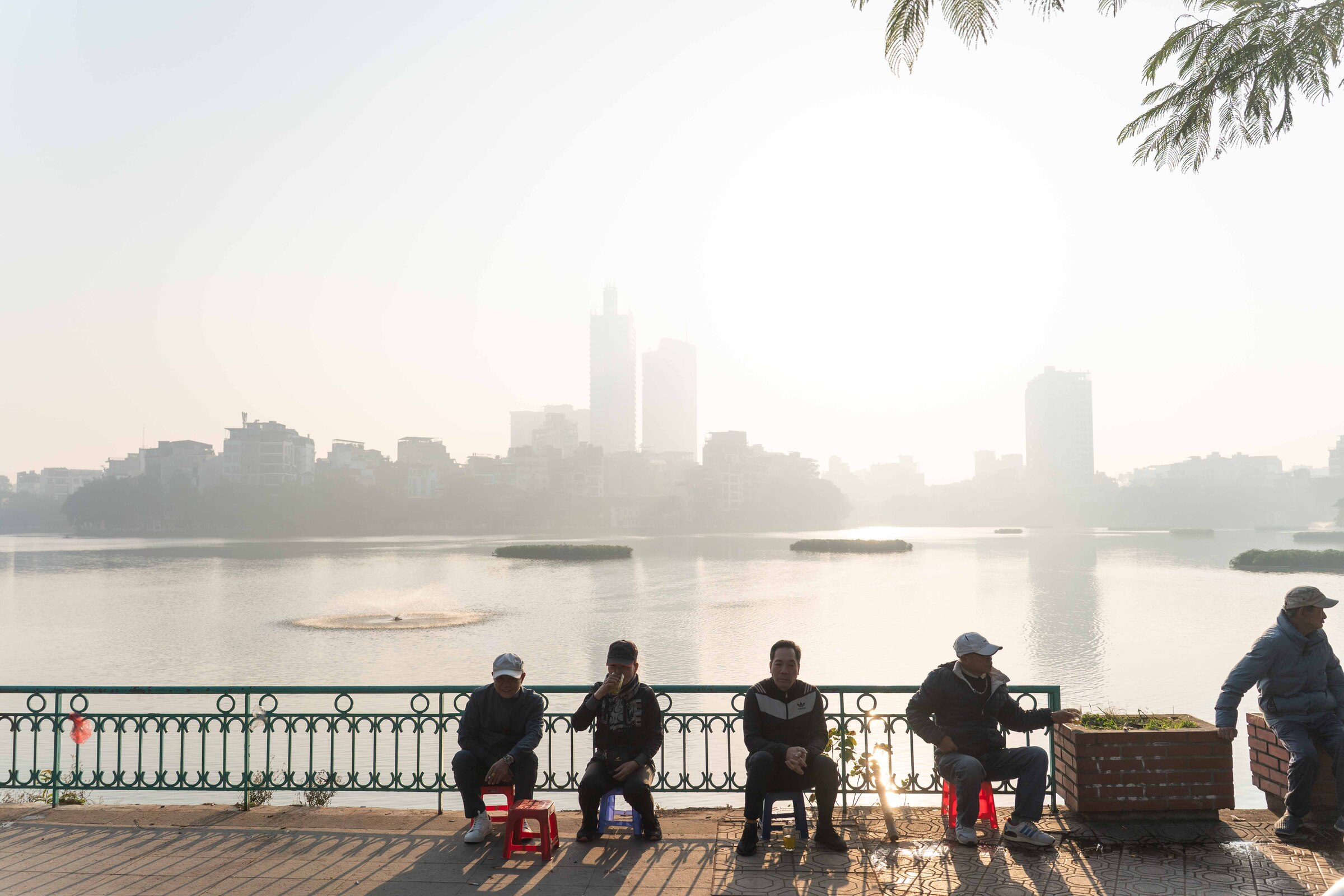 |
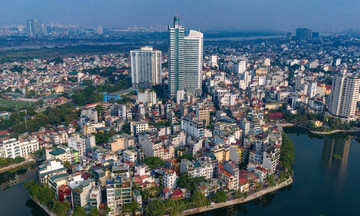
Hanoi's sky was sunny but not clear blue. *Hoang Giang* |
This morning, Hanoi city's monitoring system displayed three stations with identical addresses and readings to those of the Environmental Agency's system.
Beyond Hanoi, in Thai Binh ward, Hung Yen province, air quality also reached very unhealthy levels from early morning, with the AQI hitting 246 by 8h. Some localities, such as Ninh Binh and Thai Nguyen, recorded air quality at unhealthy levels.
According to the IQAir data aggregation platform, Hanoi ranked 9th among the world's most air-polluted cities this morning with an index of 199. Kolkata, India, topped the list with an index of 262. On this system, many inner-city areas of Hanoi were at very unhealthy levels, including Tay Ho at 227, Tran Vu at 204, and Hoang Quoc Viet at 203.
The Environmental Agency forecasts that tomorrow, air quality in Hung Yen, Ninh Binh, and Hai Phong could be at very unhealthy levels. Hanoi, Bac Ninh, Lang Son, Quang Ninh, Thanh Hoa, Nghe An, Ha Tinh, and Phu Tho are expected to experience unhealthy air quality.
According to the air quality forecasting system of the University of Engineering and Technology (Vietnam National University, Hanoi), the northern region is experiencing a prolonged pollution episode from 8/12 to 14/12. Pollution is expected to peak around 11/12 to 12/12 before gradually decreasing as cold air strengthens.
Given the serious pollution developments, on 27/11, the Ministry of Agriculture and Environment requested ministries and agencies to implement urgent response measures in Hanoi and neighboring areas. The Ministry of Industry and Trade was asked to direct thermal power plants, steel, chemical, and fertilizer factories to strictly operate their exhaust gas treatment systems, absolutely not discharge untreated waste, and reduce capacity when the pollution index exceeds 200.
The Ministry of Construction required construction sites to install coverings, wash vehicles, spray mist to suppress dust, and even temporarily halt activities generating significant dust. Local authorities were asked to re-route traffic and control material transport vehicles to reduce congestion that exacerbates pollution. The Ministry of Public Security was instructed to intensify enforcement against vehicles transporting uncovered materials, expired vehicles emitting black smoke, and illegal waste burning.
The Ministry of Health advised residents on health protection, especially for sensitive groups, while the Ministry of Education and Training requested educational institutions to limit outdoor activities when air quality is unhealthy.
Gia Chinh